
Machine-translated by Google. Questions are authored in English.
Top

Pipes & Cistern Questions and Answers

Important Instructions
91.

A leak in the bottom of a tank can empty the full tank in 6 hours. An inlet pipe fills water at the rate of 4 litres a minute. When the tank is full, the inlet is opened and due to the leak the tank is empty in 8 hours. The capacity of the tank (in litres) is

Answer: C

Let the capacity be \( C \) litres. The leak alone empties it in 6 hours, so it drains \( \tfrac{C}{6} \) litres an hour.

The inlet adds \( 4 \times 60 = 240 \) litres an hour, and the net effect empties the tank in 8 hours:

\[ \frac{C}{6} - 240 = \frac{C}{8} \]

\[ C\left(\frac{1}{6} - \frac{1}{8}\right) = 240 \quad\Longrightarrow\quad \frac{C}{24} = 240 \]

\[ C = 5760 \text{ litres} \]

The inlet rate must be converted from litres per minute to litres per hour to match the other terms.

Please log in or register to report this question.
92.

Three pipes A, B and C were opened to fill a cistern. Working alone, A, B and C require 12, 15 and 20 minutes respectively. Another pipe D, which is a waste pipe, can empty the filled tank in 30 minutes working alone. What is the total time (in minutes) taken to fill the cistern if all the pipes are simultaneously opened ?

Answer: B

Let the capacity of the cistern be LCM(12, 15, 20, 30) = 60 units.
=> Efficiency of pipe A = 60 / 12 = 5 units / minute
=> Efficiency of pipe B = 60 / 15 = 4 units / minute
=> Efficiency of pipe C = 60 / 20 = 3 units / minute
=> Efficiency of pipe D = 60 / 30 = 2 units / minute
=> Combined efficiency of pipe A, pipe B, pipe C and pipe D = 10 units / minute
 
Therefore, time required to fill the cistern if all the pipes are opened simultaneously = 60 / 10 = 6 minutes

Please log in or register to report this question.

93.

2/5 of a water tank is full. Pipe a fills the tank in 10 minutes, pipe B empties it in 6 minutes. Both the pipes if opened together, how long shall it take to fill or empty the entire tank?

Answer: A


There are two important points to learn in this type of question,
First, if both will open then tank will be empty first.

Second most important thing is,
If we are calculating filling of tank then we will subtract as (filling-empting)

If we are calculating empting of thank then we will subtract as (empting-filling)

So lets come on the question now,

Part to emptied 2/5

Part emptied in 1 minute =

1/6−1/10

=1/15

=>1/15:2/5 :: 1:x

=>2/5∗15

= 6mins

Please log in or register to report this question.

94.

Three pipes A, B and C can fill a tank from empty to full in 30 minutes, 20 minutes, and 10 minutes respectively. When the tank is empty, all the three pipes are opened. A, B and C discharge chemical solutions P,Q and R respectively. What is the proportion of the solution R in the liquid in the tank after 3 minutes?

Answer: B

Work out how much each pipe contributes in 3 minutes.

\[ P = \frac{3}{30} = \frac{1}{10}, \qquad Q = \frac{3}{20}, \qquad R = \frac{3}{10} \]

Over the common denominator 20:

\[ \frac{2}{20} + \frac{3}{20} + \frac{6}{20} = \frac{11}{20} \text{ total} \]

\[ \text{proportion of R} = \frac{6/20}{11/20} = \frac{6}{11} \]

The tank is only \( \tfrac{11}{20} \) full at that point, so the proportions are taken against that total rather than against a full tank.

Please log in or register to report this question.

95.

A tank has three taps P, Q and R. Taps P and Q can fill the tank in 1.5 and 2 hours, respectively. Tap R can empty the completely filled tank in just half hour. Tap P is opened at 8 am, tap Q is opened at 9am and tap R is opened at 10 am. At what exact time will the tank be empty?

Answer: C

Work in rates: a pipe that fills a tank in \( n \) units of time fills \( \tfrac{1}{n} \) of it per unit, and rates add (an emptying pipe counting negative).

Per hour: \( P = \tfrac{2}{3} \), \( Q = \tfrac{1}{2} \), \( R = -2 \).

By 10 a.m. P has run 2 hours and Q one hour:

\[ 2 \times \frac{2}{3} + 1 \times \frac{1}{2} = \frac{4}{3} + \frac{1}{2} = \frac{11}{6} \]

From 10 a.m. the net rate turns negative:

\[ \frac{2}{3} + \frac{1}{2} - 2 = -\frac{5}{6} \text{ per hour} \]

\[ t = \frac{11/6}{5/6} = 2.2 \text{ hours} = 2 \text{ h } 12 \text{ min} \]

\[ 10{:}00 + 2{:}12 = \textbf{12{:}12 p.m.} \]

The calculation treats the inflow as accumulating without an overflow, which is the standard convention for these problems.

Please log in or register to report this question.

96.

Two pipes M and N can fill a tank in 22.5 and 15 minutes, respectively. If both the pipes are opened simultaneously, after how much time should N be closed so that the tank is full in 18 minutes?

Answer: B

Work in rates: a pipe that fills a tank in \( n \) units of time fills \( \tfrac{1}{n} \) of it per unit, and rates add (an emptying pipe counting negative).

M runs for the whole 18 minutes:

\[ \frac{18}{22.5} = 0.8 \text{ of the tank} \]

N must supply the remaining 0.2 at a rate of \( \tfrac{1}{15} \) per minute:

\[ t = 0.2 \times 15 = 3 \text{ minutes} \]

So N is closed after 3 minutes. The question asks when N stops, not how long it is shut for.

Please log in or register to report this question.

97.

A tap can completely fill a water tank in 8 hrs. The water tank has a hole in it through which the water leaks out. The leakage will cause the full water tank to get empty in 12 hrs. How much time will it take for the tap to fill the tank completely ..?

Answer: C

The tap fills \( \tfrac{1}{8} \) of the tank per hour and the hole empties \( \tfrac{1}{12} \), so the net rate is the difference:

\[ \frac{1}{8} - \frac{1}{12} = \frac{3 - 2}{24} = \frac{1}{24} \]

\[ \therefore\; \text{time} = 24 \text{ hours} \]

Adding the two times, or averaging them, has no meaning here: rates add, times do not.

Please log in or register to report this question.

98.

A pipe is 30 m long and is 45% longer than another pipe. Find the length of the other pipe.

Answer: A

"45% longer" means the 30 m pipe is 1.45 times the other.

\[ 30 = 1.45x \quad\Longrightarrow\quad x = \frac{30}{1.45} = 20.69 \]

Taking 45% off 30 would give 16.5, a different quantity: the percentage is measured against the shorter pipe, not the longer one.

Please log in or register to report this question.

99.

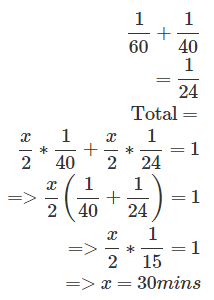
A tank can be filled by two pipes A and B in 60 minutes and 40 minutes respectively. How many minutes will it take to fill the tank from empty state if B is used for the first half time and then A and B fill it together for the other half.

Answer: D

Let the total time be x mins.

Part filled in first half means in x/2 = 1/40

Part filled in second half means in x/2 =

capture6 Dup 2 -83068520

Please log in or register to report this question.

100.

Two pipes M and N can fill a tank in 22 hours and 33 hours respectively. In how much time will the tank be full, if both the pipes are opened simultaneously?

Answer: D

Work in rates: a pipe that fills a tank in \( n \) units of time fills \( \tfrac{1}{n} \) of it per unit, and rates add (an emptying pipe counting negative).

\[ \frac{1}{22} + \frac{1}{33} = \frac{3 + 2}{66} = \frac{5}{66} \]

\[ t = \frac{66}{5} = 13.2 = 13\tfrac{1}{5} \text{ hours} \]

The joint time must be less than either pipe's own, which alone rules out the 18-hour option.

Please log in or register to report this question.

Loading…
Tags: Pipes & Cistern Questions and Answers || Pipes & Cistern MCQ Questions and Answers || Pipes & Cistern GK Questions and Answers || Pipes & Cistern GK MCQ Questions || Pipes & Cistern Multiple Choice Questions and Answers || Pipes & Cistern GK || GK on Pipes & Cistern || Quantitative Aptitude Questions and Answers || Quantitative Aptitude MCQ Questions and Answers || Quantitative Aptitude GK Questions and Answers || GK on Quantitative Aptitude