
Machine-translated by Google. Questions are authored in English.
Top

Engineering Mechanics Questions and Answers

1.

Consider two forces \(\vec{A}\) and \(\vec{B}\) of magnitudes A and B and their resultant force \(\vec{R}\) has magnitude R. If the B is doubled, then R is also doubled. Similarly, if B is reversed, then also R is doubled. Then the ratio A : B : R is:

Exam Year(s)

DSSSB JE - 2023,

Answer: B

Let \(\theta\) be the angle between the vectors and \(c = \cos\theta\). Then \(R^2 = A^2 + B^2 + 2ABc\). Doubling B gives \(4R^2 = A^2 + 4B^2 + 4ABc\), and reversing B gives \(4R^2 = A^2 + B^2 - 2ABc\). Subtracting the last two: \(3B^2 + 6ABc = 0\), so \(2ABc = -B^2\).

\[ \begin{aligned} R^2 = A^2 + B^2 - B^2 = A^2 \Rightarrow R = A \\ 4A^2 = A^2 + B^2 + B^2 \Rightarrow B^2 \\ &= \tfrac{3}{2}A^2 \end{aligned} \]

So \(A : B : R = 1 : \sqrt{3/2} : 1 = \sqrt{2} : \sqrt{3} : \sqrt{2}\). The ratios 2:3:2 and 2:1:3 are not consistent with R equal to A.

Please log in or register to report this question.
Answer: A

Coplanar forces are forces whose lines of action all lie in one plane, which is the first option. Forces acting at a single point are concurrent forces, a single force that keeps the body in equilibrium together with other forces is the equilibrant, and a single force that produces the same effect as two or more forces is the resultant. So the other three options define different terms. In coplanar force systems all the forces can be shown on a flat drawing, and this is the common case in statics problems.

Please log in or register to report this question.
3.

Which of the given options best describes the truthfulness of the following statements?

i) Physical quantities which have magnitude only are called scalar quantities.
ii) Physical quantities which have both magnitude and direction are called vector quantities.
iii) Two equal and opposite parallel forces acting at different points in a body constitute a couple.

Exam Year(s)

DSSSB TGT - 2023,

Answer: A

All three statements are true. Physical quantities with only magnitude, such as mass and time, are scalars. Quantities with both magnitude and direction, such as velocity and force, are vectors. Two equal and opposite parallel forces acting at different points of a body constitute a couple, which tends to turn the body without moving it as a whole. Since all three are true, the options that mark any of them false are wrong. The turning effect of a couple is its moment, which is the force times the perpendicular distance between the two lines of action.

Please log in or register to report this question.

4.

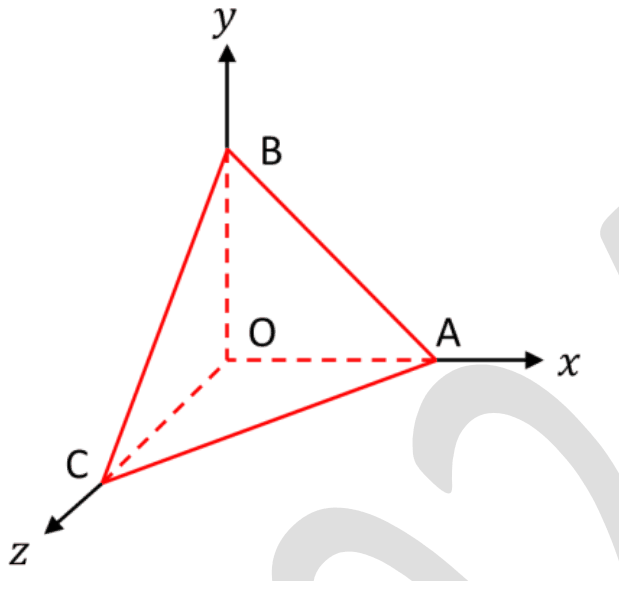
A rigid massless tetrahedron is placed such that vertex O is at the origin and the other three vertices A, B, and C lie on the coordinate axes as shown in the figure. The body is acted on by three point loads, of which one is acting at A along \(x\)-axis and another at point B along \(y\)-axis. For the body to be in equilibrium, the third point load acting at point O must be

Tetrahedron OABC with O at the origin, A on the x axis, B on the y axis and C on the z axis

Exam Year(s)

GATE ME - 2024,

Answer: B

The third load must act in the x - y plane but not along x or y axis.

The load at A acts along the x-axis and A lies on that axis, so its line of action passes through O. Likewise the load at B acts along the y-axis, through O. The third load acts at O itself. All three lines pass through O, so the moments about O are zero automatically, and equilibrium needs only the forces to sum to zero:

\[ \mathbf{F}_{O} = -(F_{A}\,\hat{i} + F_{B}\,\hat{j}) \]

With both given loads non-zero, this force has x and y components and no z component: it lies in the x-y plane but along neither axis. A force along the z-axis, or in the y-z or z-x planes, would leave an unbalanced component in x or y.

Please log in or register to report this question.

5.

An irregular planar body in space is acted upon by a force \(\vec{F} = (2\vec{i} + \vec{j})N\) at position \(\vec{r}_{1} = (\vec{i} + 2\vec{j})m\) and a moment \(\vec{M} = 3\vec{k}Nm\) at position \(\vec{r}_{2} = (-2\vec{i})m\). The corresponding equivalent force \(\vec{F}_{O}\) and moment \(\vec{M}_{O}\) at the origin are

Exam Year(s)

GATE XE - 2012,

Answer: B

The equivalent system is \(\vec{F}_{O} = (2\vec{i} + \vec{j})N\) and \(\vec{M}_{O} = 0\).

Moving a force to the origin leaves the force unchanged and adds its moment about the origin. A couple is a free vector, so it moves unchanged wherever it acts.

\[ \begin{aligned} \vec{r}_{1} \times \vec{F} &= (\vec{i} + 2\vec{j}) \times (2\vec{i} + \vec{j}) \\ &= (1 \cdot 1 - 2 \cdot 2)\vec{k} = -3\vec{k} \\ \vec{M}_{O} &= -3\vec{k} + 3\vec{k} = 0 \end{aligned} \]

The option with \(3\vec{k}\) forgets the moment of the force, the one with \(6\vec{k}\) gets its sign wrong, and reversing the force to \(-2\vec{i} - \vec{j}\) is never right, because an equivalent system keeps the same resultant.

Please log in or register to report this question.

6.

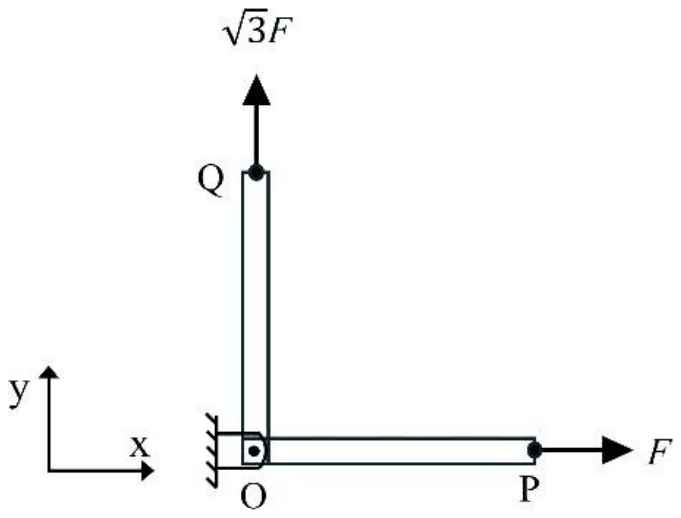
Two axial members, namely OP and OQ, are pin joined at O as shown in the figure. A force F acts at point P along the positive x direction and a force \(\sqrt{3}F\) acts at point Q along the positive y direction.

Members OP and OQ pinned at O to a wall: OP runs along the positive x direction with force F at P, OQ runs along the positive y direction with force root 3 F at Q

The resultant of the applied forces makes an angle \(\theta\) (anticlockwise from the positive x-axis).

The value of \(\theta\) is ___.

Exam Year(s)

GATE XE - 2026,

Answer: C

The resultant makes an angle of 60° with the positive x-axis.

The two forces are perpendicular, F along x and \(\sqrt{3}F\) along y. Their resultant has components (F, \(\sqrt{3}F\)), so:

\[ \begin{aligned} \tan\theta &= \frac{\sqrt{3}F}{F} = \sqrt{3} \\ \theta &= 60^{\circ},\quad |R| = 2F \end{aligned} \]

30° is the angle the resultant makes with the y-axis, a slip from swapping the components. 45° would need equal components, and 75° has no basis.

Please log in or register to report this question.

Loading…
Tags: Force Systems and Resultants Questions and Answers || Force Systems and Resultants MCQ Questions and Answers || Force Systems and Resultants GK Questions and Answers || Force Systems and Resultants GK MCQ Questions || Force Systems and Resultants Multiple Choice Questions and Answers || Force Systems and Resultants GK || GK on Force Systems and Resultants || Engineering Mechanics Questions and Answers || Engineering Mechanics MCQ Questions and Answers || Engineering Mechanics GK Questions and Answers || GK on Engineering Mechanics