
Machine-translated by Google. Questions are authored in English.
Top

Lagrangian Formulation Questions and Answers

21.

A particle has Lagrangian

\[ \begin{aligned} L = \frac{1}{2}\Big[&f(\theta)\dot{\theta}^{2} + 2g(\theta)w\dot{\theta} \\ &+ w^{2}h(\theta)\Big] - V \end{aligned} \]

Then \(\frac{1}{2}\left[f(\theta)\dot{\theta}^{2} - w^{2}h(\theta)\right] + V\) represents :

Exam Year(s)

MH SET - 2023, SET Exam - 2023,

Answer: A

The expression is the Hamiltonian H.

The generalised momentum is \(p_{\theta} = \partial L/\partial\dot{\theta} = f\dot{\theta} + g w\). Then

\[ \begin{aligned} H &= p_{\theta}\dot{\theta} - L \\ &= f\dot{\theta}^{2} + gw\dot{\theta} - \tfrac{1}{2}f\dot{\theta}^{2} - gw\dot{\theta} - \tfrac{1}{2}w^{2}h + V \\ &= \tfrac{1}{2}\left[f(\theta)\dot{\theta}^{2} - w^{2}h(\theta)\right] + V \end{aligned} \]

The total energy is \(T + V = \frac{1}{2}[f\dot{\theta}^{2} + 2gw\dot{\theta} + w^{2}h] + V\), which differs from H by \(gw\dot{\theta} + w^{2}h\). This is the typical situation for a system in a rotating frame (here with angular speed \(w\)): the Jacobi integral H is conserved but is not the energy. So the expression is H alone, not E, and not both.

Please log in or register to report this question.

22.

A particle of mass \(m\) falling vertically under gravity. Then the Lagrangian L of the particle is given by :

Exam Year(s)

MH SET - 2023, SET Exam - 2023,

Answer: B

With \(z\) measured downward along the line of fall, the Lagrangian is \(L = \frac{1}{2}m\dot{z}^{2} + mgz\).

The motion is one-dimensional, so a single coordinate \(z\) suffices, which rules out the two-coordinate forms in \(x\) and \(y\). For a falling particle the usual textbook choice measures \(z\) downward from the point of release. Gravity then does positive work as \(z\) increases, the potential energy is \(V = -mgz\), and

\[ \begin{aligned} L &= T - V = \frac{1}{2}m\dot{z}^{2} + mgz \\ m\ddot{z} &= mg \end{aligned} \]

which is free fall with acceleration \(g\) in the direction of increasing \(z\), as it should be.

The form \(\frac{1}{2}m\dot{z}^{2} - mgz\) is the same physics with \(z\) measured upward; the paper's key takes the downward convention, which is the natural one for a body described as falling.

Please log in or register to report this question.
23.

Consider an inverted pendulum comprised of a mass m attached to a rigid massless rod of length l as shown in figure. The point 'O' exhibits vertical motion (along z direction) described by equation \(z = a\sin\omega t\), where ω is constant. The Lagrangian of the system is given as :

A rod of length l rises from O to the mass m above it and makes an angle theta with the upward vertical z axis through O

Exam Year(s)

MH SET - 2023, SET Exam - 2023,

Answer: A

The Lagrangian is \(L = \frac12 ml^2\dot\theta^2 - m(g - a\omega^2\sin\omega t)l\cos\theta\).

With \(\theta\) measured from the upward vertical, the mass is at \(x = l\sin\theta\), \(z = a\sin\omega t + l\cos\theta\). Then

\[ \begin{aligned} T &= \tfrac{1}{2}m\left(l^{2}\dot{\theta}^{2} + a^{2}\omega^{2}\cos^{2}\omega t\right) \\ &\quad - mal\omega\cos\omega t\,\sin\theta\,\dot{\theta} \\ V &= mg(a\sin\omega t + l\cos\theta) \end{aligned} \]

Terms depending only on time can be dropped. The cross term equals a total time derivative plus \(mal\omega^{2}\sin\omega t\cos\theta\), so

\[ \begin{aligned} L &= \tfrac{1}{2}ml^{2}\dot{\theta}^{2} \\ &+ mal\omega^{2}\sin\omega t\cos\theta - mgl\cos\theta \end{aligned} \]

which is the first option: the oscillating pivot acts like a time-dependent gravity \(g - a\omega^{2}\sin\omega t\). The second and third options drop the coupling between the pivot motion and \(\theta\), so the pivot would have no effect on the swing, and the fourth has the wrong sign and phase.

Please log in or register to report this question.

24.

The number of degrees of freedom describing motion of a swimmer in a swimming pool is :

Exam Year(s)

MH SET - 2023, SET Exam - 2023,

Answer: C

On the key, a swimmer has 6 degrees of freedom.

The standard textbook treatment models the swimmer as a rigid body free to move in three-dimensional space (the water allows motion up and down as well as across the pool). A rigid body needs three coordinates to locate a reference point, its centre of mass, and three angles to fix its orientation, giving 3 + 3 = 6 degrees of freedom.

Three would describe the swimmer only as a point particle, ignoring orientation. Five is the count for a rigid linear body such as a diatomic molecule (three translations and two rotations), and nine has no basis for a single rigid body.

Please log in or register to report this question.

25.

The Lagrangian of a particle of mass m moving on the xy-plane which is rotating about z-axis with angular velocity \(\omega\) is given by :

\[ \begin{aligned} L = \tfrac{1}{2} m[&(\dot{x} - \omega y)^{2} \\ &+ (\dot{y} + \omega x)^{2}] - V(x, y) \end{aligned} \]

Then :

Exam Year(s)

MH SET - 2024, SET Exam - 2024,

Answer: B

The Hamiltonian H is conserved.

The Lagrangian does not contain t explicitly, so the Jacobi integral \(H = \sum p_{i}\dot{q}_{i} - L\) is a constant of the motion.

In this rotating frame H is not the total energy. Working it out,

\[ \begin{aligned} H &= \tfrac{1}{2}m(\dot{x}^{2} + \dot{y}^{2}) \\ &\quad - \tfrac{1}{2}m\omega^{2}(x^{2} + y^{2}) + V \end{aligned} \]

which contains the centrifugal term with a minus sign, so it differs from the kinetic plus potential energy, and the energy E is not separately conserved. The momenta \(p_{x}, p_{y}\) are not conserved either, because L depends on x and y through V and through the \(\omega x\), \(\omega y\) terms.

Please log in or register to report this question.

26.

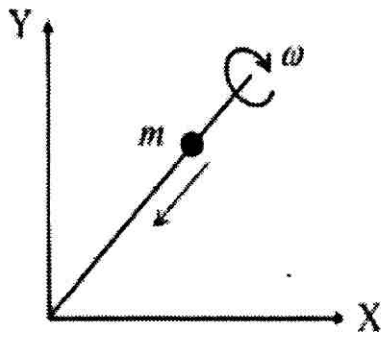
A bead of mass m slides on a smooth massless rod. The rod is rotating about one end in X-Y plane with uniform angular velocity ω (as shown in the figure). The Lagrangian of the system is given as :

X and Y axes with Y upward; the rod is pivoted at the origin and rotates with angular velocity omega, making an angle with the X axis, and the bead m is on the rod

Exam Year(s)

MH SET - 2024, SET Exam - 2024,

Answer: C

The Lagrangian is \(L = \frac{1}{2}m(\dot{r}^{2} + r^{2}\dot{\theta}^{2}) - mgr\sin\theta\).

Use polar coordinates \((r, \theta)\) in the vertical X-Y plane, with \(\theta\) measured from the X axis and Y upward. The bead slides along the rod, so \(r\) changes, and it turns with the rod at \(\dot{\theta} = \omega\). Its kinetic energy has radial and transverse parts:

\[ \begin{aligned} T &= \tfrac{1}{2}m(\dot{r}^{2} + r^{2}\dot{\theta}^{2}) \\ V &= mgy = mgr\sin\theta \end{aligned} \]

\(L = T - V\) gives the third option. The first two drop the radial kinetic energy \(\frac{1}{2}m\dot{r}^{2}\), which is essential since the bead slides. The last adds the potential energy and uses \(\cos\theta\), which would measure height from the Y axis.

Please log in or register to report this question.

27.

A particle of mass m is constrained to move on the arc of a parabola \(x^{2} = 4ay\), where y is vertical axis, under gravity. Then the canonical momentum is given by :

Exam Year(s)

MH SET - 2025, SET Exam - 2025,

Answer: D

The canonical momentum is \(m\dot{x}\left(1 + \frac{x^{2}}{4a^{2}}\right)\).

On \(x^{2} = 4ay\), \(y = \frac{x^{2}}{4a}\) and \(\dot{y} = \frac{x\dot{x}}{2a}\). With x as the generalised coordinate,

\[ \begin{aligned} L &= \tfrac{1}{2}m\left(\dot{x}^{2} + \tfrac{x^{2}\dot{x}^{2}}{4a^{2}}\right) - mg\tfrac{x^{2}}{4a} \\ p_{x} &= \frac{\partial L}{\partial \dot{x}} = m\dot{x}\left(1 + \frac{x^{2}}{4a^{2}}\right) \end{aligned} \]

\(m\dot{x}\) ignores the vertical motion forced by the constraint. Option B keeps \(\dot{y}\) as if it were independent, and option C is not even linear in \(\dot{x}\).

Please log in or register to report this question.

28.

A particle of mass m is constrained to move on a horizontal xy-plane which is rotating about the vertical z-axis with angular velcoity \(\omega\). If T is the total kinetic energy of the particle, then \(\dot{x}\frac{\partial T}{\partial \dot{x}}\) + \(\dot{y}\frac{\partial T}{\partial \dot{y}}\) is equal to :

where \(T = T_{2} + T_{1} + T_{0}\),

\[ \begin{aligned} T_{2} &= \tfrac{1}{2}m(\dot{x}^{2} + \dot{y}^{2}), \\ T_{1} &= m\omega(x\dot{y} - y\dot{x}), \\ T_{0} &= \tfrac{1}{2}m\omega^{2}(x^{2} + y^{2}) \end{aligned} \]

Exam Year(s)

MH SET - 2025, SET Exam - 2025,

Answer: B

The sum equals \(2T_{2} + T_{1}\).

T splits into parts that are homogeneous in the velocities: \(T_{2}\) of degree 2, \(T_{1}\) of degree 1 and \(T_{0}\) of degree 0. By Euler's theorem on homogeneous functions, \(\sum \dot{q}\,\frac{\partial T_{k}}{\partial \dot{q}} = k\,T_{k}\). Hence

\[ \begin{aligned} &\dot{x}\frac{\partial T}{\partial \dot{x}} + \dot{y}\frac{\partial T}{\partial \dot{y}} \\ &= 2T_{2} + T_{1} + 0 \cdot T_{0} \end{aligned} \]

Check on \(T_{1} = m\omega(x\dot{y} - y\dot{x})\): \(\dot{x}(-m\omega y) + \dot{y}(m\omega x) = T_{1}\).

2T would be correct only if T were purely quadratic in the velocities, which fails in a rotating frame. Option C wrongly counts \(T_{0}\), which has no velocity dependence.

Please log in or register to report this question.

29.

If the potential U in the Lagrangian contains velocity dependent terms, the canonical momentum corresponding to a coordinate of rotation \(\theta\) of the entire system is no longer the mechanical angular momentum \((l_{\theta})\), but given by .......

(where \(\bar{\nabla}_{v}\) is the gradient operator in velocity space, \(\hat{n}\) is the unit vector along the direction of rotation, \(l_{\theta}^{c}\) is the canonical angular momentum)

Exam Year(s)

MH SET - 2025, SET Exam - 2025,

Answer: A

The canonical angular momentum is \(l_{\theta}^{c} = l_{\theta} - \hat{n}\cdot\bar{r}\times\bar{\nabla}_{v}U\).

The canonical momentum is \(p = \partial L/\partial\dot{\theta}\) with \(L = T - U\). For a rotation about \(\hat{n}\), \(\partial\bar{v}/\partial\dot{\theta} = \hat{n}\times\bar{r}\), so

\[ \begin{aligned} p_{\theta} &= \bar{\nabla}_{v}T\cdot(\hat{n}\times\bar{r}) \\ &\quad - \bar{\nabla}_{v}U\cdot(\hat{n}\times\bar{r}) \\ &= \hat{n}\cdot(\bar{r}\times m\bar{v}) \\ &\quad - \hat{n}\cdot(\bar{r}\times\bar{\nabla}_{v}U) \end{aligned} \]

The first term is the mechanical angular momentum along \(\hat{n}\); the second is the extra piece from the velocity-dependent potential, entering with a minus sign because \(U\) enters \(L\) with a minus sign. (For a charge in a magnetic field this is the familiar \(\bar{r}\times q\bar{A}\) term.)

The option with a plus sign gets that sign wrong, and the options that multiply \(l_{\theta}\) by the correction, with \(\times\) or \(\cdot\), are not even dimensionally consistent.

Please log in or register to report this question.

30.

A number of degrees of freedom for an astronaut constrained to move on surface of a planet (moving freely in space is) :

Exam Year(s)

MH SET - 2025, SET Exam - 2025,

Answer: B

The keyed answer is 5.

Treat the astronaut as a rigid body. Moving freely in space, a rigid body has 6 degrees of freedom: 3 for the position of its centre of mass and 3 for its orientation. Being constrained to move on the surface of the planet imposes one equation of constraint, keeping the point of contact on the surface, so it removes one degree of freedom:

\[ 6 - 1 = 5 \]

The question's wording is garbled; 6 is the count for the body moving freely in space, which is what the constraint reduces. Counts of 4 or 2 would apply to a body confined more tightly, for example 2 for a point particle restricted to a surface.

Please log in or register to report this question.

Loading…

Other Subjects

Tags: Lagrangian Formulation Questions and Answers