
Machine-translated by Google. Questions are authored in English.
Top

Vapour Power Cycles Questions and Answers

Direction for [ Question No: 1 To 1 ] :

Notation used:
P : pressure, V : volume, T : temperature, s : specific entropy, h : specific enthalpy, Cp : molar heat capacity at constant pressure, Cv : molar heat capacity at constant volume, R : universal gas constant

1.

In an ideal Rankine cycle, steam enters the turbine at 10 MPa and 500 °C (h = 3375.1 kJ/kg, s = 6.5995 kJ/kg.K). It is cooled in the condenser at a pressure of 10 kPa. At 10 kPa, hf = 191.81 kJ/kg, sf = 0.6492 kJ/kg.K, hg = 2583.9 kJ/kg and sg = 8.1488 kJ/kg.K. The heat rejected in the condenser (in kJ/kg) is

Exam Year(s)

GATE XE - 2018,

Answer: A

The heat rejected is 1898 kJ/kg.

Expansion in the ideal turbine is isentropic, so the exit entropy is 6.5995 kJ/kg.K. At 10 kPa the dryness fraction and enthalpy are

\[ \begin{aligned} x &= \frac{6.5995 - 0.6492}{8.1488 - 0.6492} = 0.7934 \\ h_{2} &= 191.81 + 0.7934(2583.9 - 191.81) \\ &= 2089.7\ \text{kJ/kg} \end{aligned} \]

The condenser turns this wet steam into saturated liquid at \(h_{f}\), so it rejects \(h_{2} - h_{f} = 2089.7 - 191.8 = 1897.9 \approx 1898\) kJ/kg.

3796 is twice this value, 949 half of it and 2847 one and a half times it; none matches the isentropic exit state.

Please log in or register to report this question.
Direction for [ Question No: 2 To 3 ] :

Consider an ideal reheat cycle utilizing steam. Steam leaves the boiler and enters the turbine at 3 MPa, 400°C (state 3) and then expands to 0.8 MPa (state 4). It is then reheated at constant pressure 0.8 MPa to 400°C (state 5) and expands to 10 kPa in the low pressure turbine (state 6). The entry to the pump corresponds to saturated liquid state (state 1), and state 2 represents inlet to the boiler. The following data are given:

\(h_{1} = 191.81\) kJ/kg, \(h_{3} = 3230.82\) kJ/kg, \(h_{4} = 2891.6\) kJ/kg, \(h_{5} = 3267.97\) kJ/kg, \(h_{g}|_{10\,\text{kPa}} = 2584.63\) kJ/kg, \(x_{6} = 0.92285\), \(v_{f}|_{10\,\text{kPa}} = 0.00101\) m3/kg

2.

The heat transfer in the boiler is approximately

Exam Year(s)

GATE XE - 2012,

Answer: B

The heat added in the boiler is about 3412 kJ/kg.

First find the pump exit enthalpy, then add the heat of the boiler (2 to 3) and of the reheater (4 to 5):

\[ \begin{aligned} h_{2} &= h_{1} + v_{f}(p_{2} - p_{1}) \\ &= 191.81 + 0.00101(3000 - 10) = 194.83 \\ q &= (h_{3} - h_{2}) + (h_{5} - h_{4}) \\ &= 3035.99 + 376.37 = 3412.4\ \text{kJ/kg} \end{aligned} \]

3230 kJ/kg is just \(h_{3}\), and 2892 is \(h_{4}\); neither is a heat transfer. 4411 kJ/kg does not follow from the data. Leaving out the reheat would give about 3036 kJ/kg, which is why the reheat term matters.

Please log in or register to report this question.
3.

The net workdone in the cycle is approximately

Exam Year(s)

GATE XE - 2012,

Answer: C

The net work is about 1204 kJ/kg.

Find the low-pressure turbine exit enthalpy from the quality, using \(h_{f} = h_{1}\) at 10 kPa:

\[ \begin{aligned} h_{6} &= 191.81 + 0.92285(2584.63 - 191.81) = 2400.0 \\ w_{T} &= (h_{3} - h_{4}) + (h_{5} - h_{6}) \\ &= 339.22 + 867.95 = 1207.2 \\ w_{net} &= 1207.2 - 3.02 = 1204.2\ \text{kJ/kg} \end{aligned} \]

The pump work, 3.02 kJ/kg, is small but subtracted. As a check, the cycle efficiency is 1204/3412, about 35 percent, a sensible figure. The other options do not follow from the given enthalpies.

Please log in or register to report this question.
Answer: B

The advantage of the regenerative cycle over the simple Rankine cycle is that a small size condenser is required. In a regenerative cycle some steam is bled from the turbine to heat the feed water, so less steam reaches the condenser and the condenser can be smaller. The plant does not become more convenient, since it has heaters and extra piping, a boiler of smaller capacity is not claimed, and it does not do away with heaters, so options A, C and D are wrong.

Please log in or register to report this question.
Answer: A

The true statement for reheating of steam is that the final dryness fraction of the steam is improved. After partial expansion in the high pressure turbine the steam is taken back to the boiler and heated again, so that it expands in the low pressure turbine at a higher temperature and leaves with less moisture. Reheating does not reduce maintenance, since it adds equipment, the gain in thermal efficiency is small and not appreciable, and it adds to the cost of operation, so the other statements are wrong.

Please log in or register to report this question.
6.

Steam enters an adiabatic turbine operating at steady state with an enthalpy of 3251.0 kJ/kg and leaves as a saturated mixture at 15 kPa with quality (dryness fraction) 0.9. The enthalpies of the saturated liquid and vapor at 15 kPa are hf = 225.94 kJ/kg and hg = 2598.3 kJ/kg respectively. The mass flow rate of steam is 10 kg/s. Kinetic and potential energy changes are negligible. The power output of the turbine in MW is

Exam Year(s)

GATE ME - 2012,

Answer: B

The turbine produces about 8.9 MW.

The exit enthalpy follows from the dryness fraction, and the steady-flow energy equation for an adiabatic turbine gives the work:

\[ \begin{aligned} h_{2} &= h_{f}+x(h_{g}-h_{f}) \\ &= 225.94+0.9(2598.3-225.94) \\ &= 2361.06\ \text{kJ/kg} \end{aligned} \]

\[ \begin{aligned} W &= \dot{m}(h_{1}-h_{2}) \\ &= 10(3251.0-2361.06) \\ &= 8899\ \text{kW} \approx 8.9\ \text{MW} \end{aligned} \]

9.1 MW is what you get by taking the exit enthalpy as 0.9 hg and forgetting the enthalpy of the liquid fraction. 6.5 and 27.0 MW do not follow from these data.

Please log in or register to report this question.

Answer: D

The false statement is Cycle efficiency increases as boiler pressure decreases.

Raising the boiler pressure raises the average temperature at which heat is added, so Rankine cycle efficiency increases with boiler pressure (the practical limit being the moisture content at the turbine exit). Lowering the boiler pressure does the opposite.

The other statements are true. Superheating raises the mean temperature of heat addition and so increases efficiency. The turbine exhausts into the condenser, where the steam is saturated, so the turbine outlet pressure is the saturation pressure at the condenser temperature. And lowering the condenser pressure lowers the temperature of heat rejection, which increases efficiency.

Please log in or register to report this question.

8.

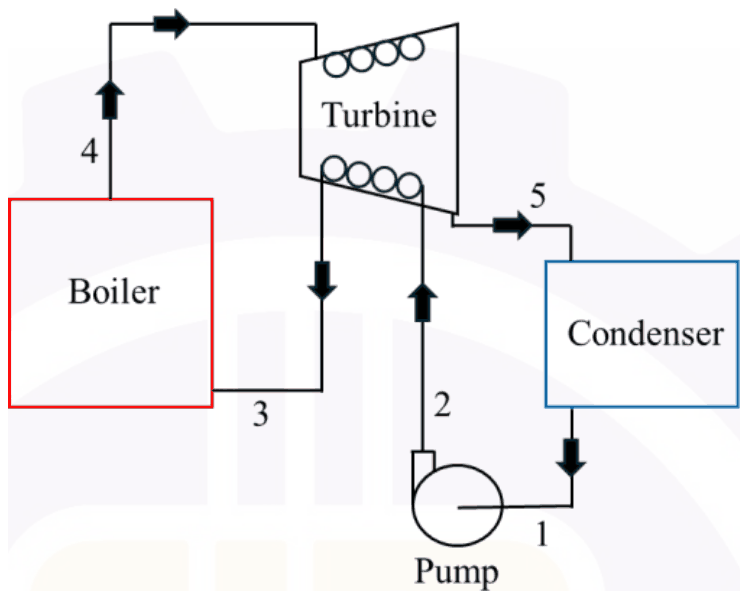
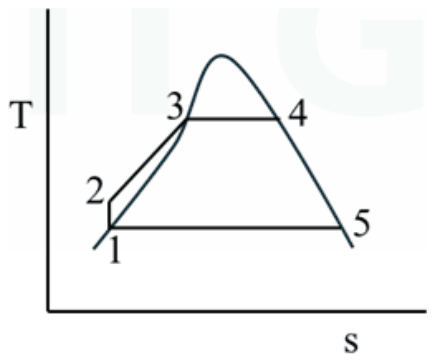
For an ideal regenerative Rankine cycle, as shown in the figure below, which one of the following options is the correct representation of temperature-entropy (T-s) diagram?

Regenerative Rankine cycle: pump 1-2, feed water heated in turbine coils 2-3, boiler 3-4, turbine 4-5, condenser 5-1

Exam Year(s)

GATE ME - 2026,

Answer: A

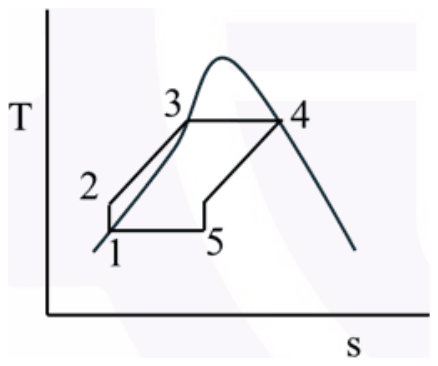
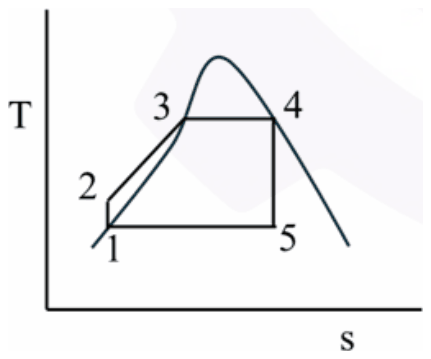
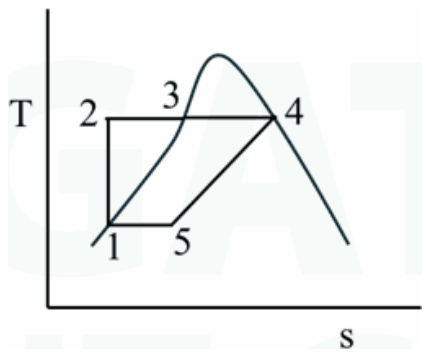
The correct T-s diagram is (A), in which the turbine expansion 4-5 runs parallel to the liquid heating line 2-3.

In the ideal regenerative cycle the feed water from the pump flows through coils in the turbine casing, counter to the steam. Heat passes reversibly from the expanding steam to the water across zero temperature difference, so at every temperature the heat the steam gives up equals the heat the water gains.

On the T-s diagram that makes the expansion curve 4-5 a mirror of the heating curve 2-3, shifted to the right by a constant entropy, so the two are parallel. Diagram (B) shows an isentropic, vertical expansion, which is the simple Rankine cycle without regeneration. Diagram (C) raises the water to the boiler temperature in the pump, which a pump cannot do, and diagram (D) expands along the vapour dome, which is not what internal heat exchange produces.

Please log in or register to report this question.

Answer: C

The correct option is pump work remains same, turbine work output increases, cycle efficiency increases, and moisture content at turbine exit decreases.

Superheating changes only the boiler exit state at the same pressures. The pump still raises the same liquid between the same pressures, so its work is unchanged. The steam enters the turbine hotter, so the expansion delivers more work, and heat is added at a higher mean temperature, which raises the efficiency.

The expansion line also starts further right on the T-s diagram, so the steam leaving the turbine is drier: the moisture content falls, which is the main practical reason for superheating. The options with increasing moisture or changed pump work are wrong.

Please log in or register to report this question.

Loading…

Other Subjects

Tags: Vapour Power Cycles Questions and Answers || Vapour Power Cycles MCQ Questions and Answers || Vapour Power Cycles GK Questions and Answers || Vapour Power Cycles GK MCQ Questions || Vapour Power Cycles Multiple Choice Questions and Answers || Vapour Power Cycles GK || GK on Vapour Power Cycles || Thermodynamics Questions and Answers || Thermodynamics MCQ Questions and Answers || Thermodynamics GK Questions and Answers || GK on Thermodynamics