Machine-translated by Google. Questions are authored in English.
Top

Miscellaneous Logical Puzzles Questions and Answers

Important Instructions

Answer: A

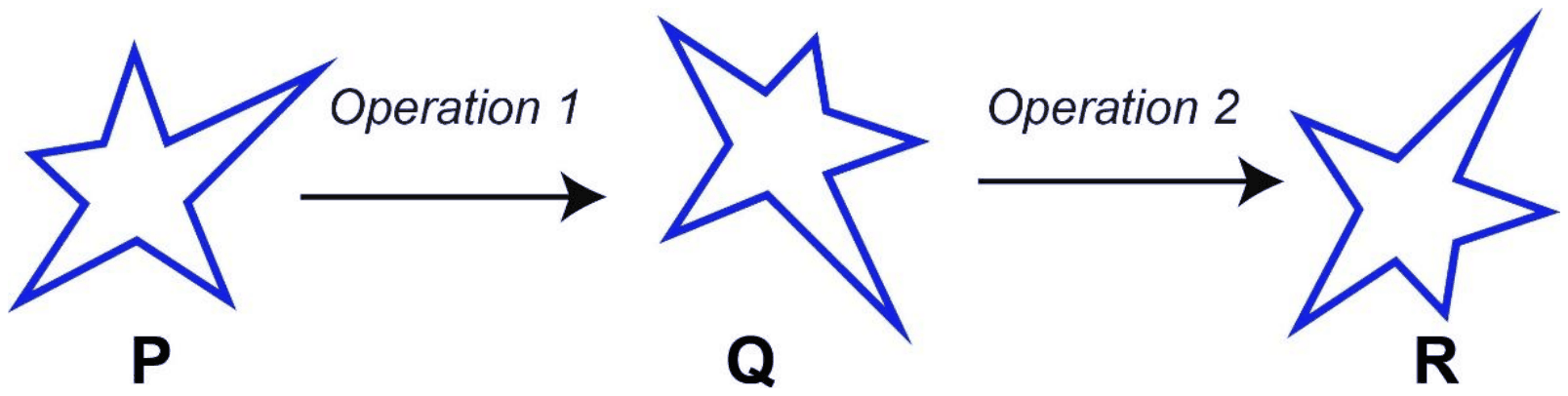
The transformation is a clockwise rotation by 90°, then a reflection along a horizontal line.

Follow the star's one long arm. In P it points to the upper right. In Q it points to the lower right: turning the figure clockwise by 90° carries the upper-right direction to the lower-right, so Operation 1 is a clockwise quarter turn.

In R the long arm points to the upper right again. A reflection in a horizontal line swaps up and down while keeping left and right, which takes the lower-right arm back to the upper right. A reflection in a vertical line would instead send it to the lower left.

A counter-clockwise quarter turn of P would put the long arm at the upper left, not where it is in Q, and a 180° rotation would put it at the lower left. That rules out the other three options.

Please log in or register to report this question.
22.

There are eight bags of rice looking alike, seven of which have equal weight and one is slightly heavier. The weighing balance is of unlimited capacity. Using this balance, the minimum number of weighings required to identify the heavier bag is

Exam Year(s)

GATE Chemistry - 2012, GATE Mathematics - 2012, GATE Life Sciences - 2012, GATE XE - 2012,

Answer: A

The heavier bag can be found in 2 weighings.

Divide the eight bags into groups of 3, 3 and 2.

  1. Weigh 3 against 3. If one side is heavier, the heavy bag is among those 3. If they balance, it is among the 2 left aside.
  2. From 3 suspects, weigh 1 against 1: the heavier one is it, and if they balance it is the third. From 2 suspects, weigh 1 against 1 and the heavier is it.

One weighing has three outcomes (left heavy, right heavy, balance), so two weighings can distinguish 3 × 3 = 9 cases, enough for 8 bags. Three weighings is the halving approach (4 v 4, 2 v 2, 1 v 1), which does not use the balance outcome.

Please log in or register to report this question.
23.

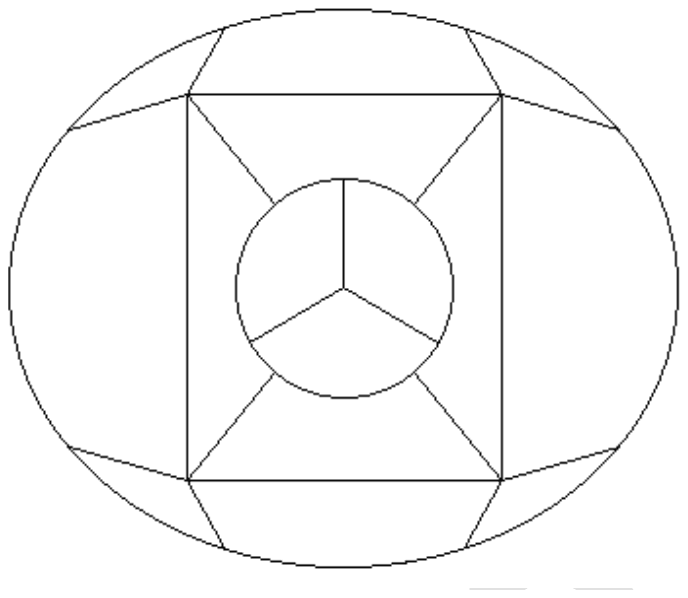
The 15 parts of the given figure are to be painted such that no two adjacent parts with shared boundaries (excluding corners) have the same color. The minimum number of colors required is

An oval enclosing a square; a circle at the centre split into three sectors, the square's diagonals cutting the ring around it into four parts, and lines from the square's corners dividing the outer band into eight parts

Exam Year(s)

GATE Chemistry - 2024,

Answer: A

The minimum number of colours is 4.

The three sectors of the central circle all touch one another, so they need three different colours, say 1, 2 and 3. Each of the four parts in the ring between the circle and the square touches the sectors it borders. The ring parts that straddle a sector boundary touch two sectors and so are forced to take the third sector's colour: the top part, the left part and the right part are therefore forced to three different colours.

The bottom ring part touches the left and right ring parts and the bottom sector, which between them already use all three colours, so a fourth colour is unavoidable. Four colours are enough for the remaining outer parts, so the answer is 4; 3 is too few, and 5 or 6 are more than needed.

Please log in or register to report this question.
24.

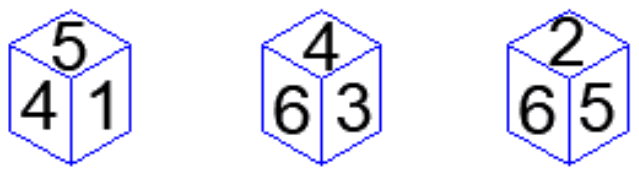
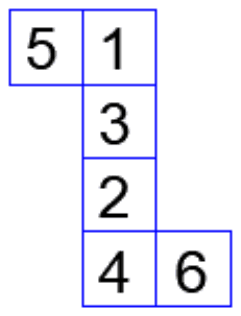
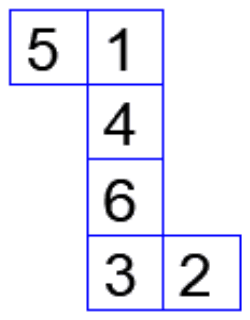
Three different views of a dice are shown in the figure below.

Three views of one die: 5 on top with 4 and 1 on the sides; 4 on top with 6 and 3; 2 on top with 6 and 5

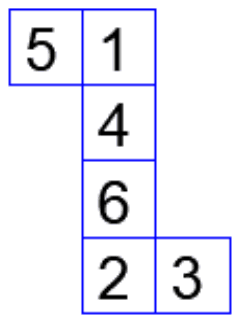
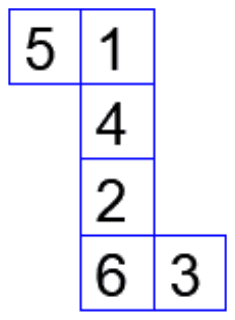
The piece of paper that can be folded to make this dice is

Exam Year(s)

GATE Chemistry - 2024,

Answer: A

The net that folds into this die is (A).

From the three views, 4 is adjacent to 5, 1, 6 and 3, so it is opposite 2. 5 is adjacent to 4, 1, 2 and 6, so it is opposite 3. 6 is adjacent to 4, 3, 2 and 5, so it is opposite 1. The opposite pairs are therefore 4-2, 5-3 and 6-1.

In each net the four squares in a column fold so that alternate squares are opposite, and the two side flaps on opposite sides of the column end up opposite each other. Net (A) has the column 1, 4, 6, 2, giving 1-6 and 4-2, with flaps 5 and 3 opposite: all three pairs match. Net (B) makes 1 opposite 2, net (C) makes 1 opposite 2 and 3 opposite 4, and net (D) makes 4 opposite 3, so they all contradict the views.

Please log in or register to report this question.
25.

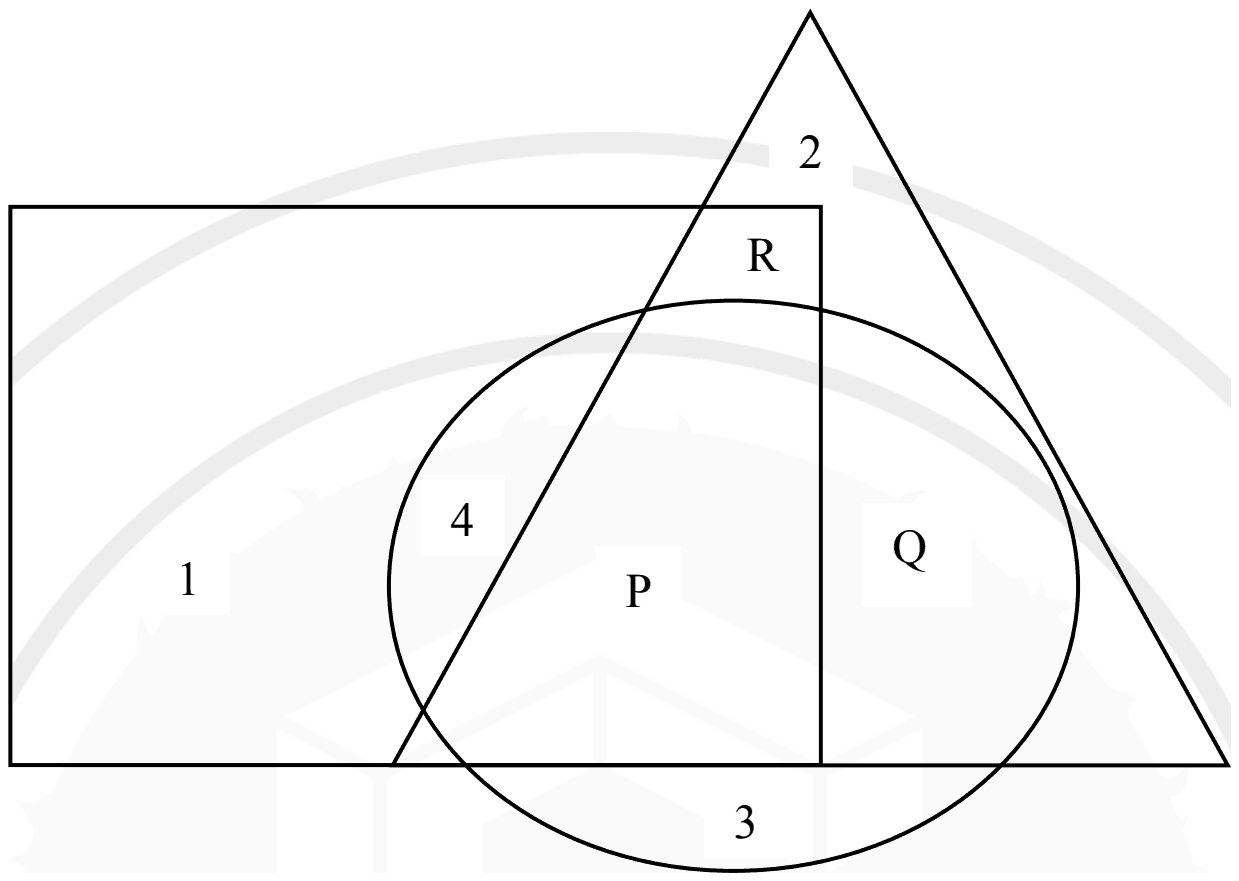
In the given figure, the numbers associated with the rectangle, triangle, and ellipse are 1, 2, and 3, respectively. Which one among the given options is the most appropriate combination of P, Q, and R ?

Overlapping rectangle, triangle and ellipse. Region labels: 1 in the rectangle only, 2 in the triangle only, 3 in the ellipse only, 4 in rectangle and ellipse, P in all three, Q in triangle and ellipse, R in rectangle and triangle.

Exam Year(s)

GATE Chemistry - 2025,

Answer: A

The answer is P = 6; Q = 5; R = 3.

The labelled region 4 shows the rule: it lies inside the rectangle (1) and the ellipse (3) only, and 1 + 3 = 4. So each region carries the sum of the numbers of the shapes containing it.

  • P lies in all three shapes: 1 + 2 + 3 = 6.
  • Q lies in the triangle and the ellipse: 2 + 3 = 5.
  • R lies in the rectangle and the triangle: 1 + 2 = 3.

The other options swap these sums, for example giving P the value 5, which would leave out the rectangle.

Please log in or register to report this question.
26.

Column-I has statements made by Shanthala; and, Column-II has responses given by Kanishk.

Column-IColumn-II
P. This house is in a mess.1. Alright, I won't bring it up during our conversations.
Q. I am not happy with the marks given to me.2. Well, you can easily look it up.
R. Politics is a subject I avoid talking about.3. No problem, let me clear it up for you.
S. I don't know what this word means.4. Don't worry, I will take it up with your teacher.

Identify the option that has the correct match between Column-I and Column-II.

Exam Year(s)

GATE Chemistry - 2025,

Answer: B

The correct match is P - 3; Q - 4; R - 1; S - 2.

Each reply uses a phrasal verb with up that fits one statement:

  • A house in a mess is something to clear up (P-3).
  • A complaint about marks is something to take up with the teacher, that is, raise with the person responsible (Q-4).
  • A subject someone avoids is one you promise not to bring up (R-1).
  • A word you do not know is one you look up in a dictionary (S-2).

The other options pair, for example, the mess with looking it up or the marks with not bringing it up, which make no sense as replies.

Please log in or register to report this question.
27.

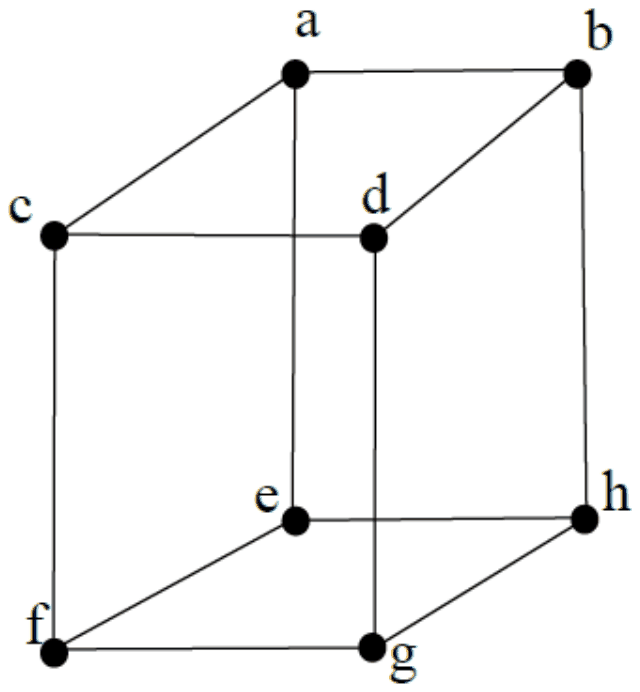
Consider the cube shown below with its 8 corners labelled a, b, c, d, e, f, g, and h. The figure is representative. All corners are to be colored such that any two corners that are connected by an edge must be of different colors. The minimum number of colors required to achieve this is ________

Cube drawn in perspective with corners a and b on the back top edge, c and d on the front top edge, e and h on the back bottom edge and f and g on the front bottom edge; e is below a, h below b, f below c and g below d

Exam Year(s)

GATE Chemistry - 2026,

Answer: D

The minimum number of colours is 2.

The corners and edges of a cube form a bipartite graph: the corners split into two sets of four, and every edge joins a corner of one set to a corner of the other. One colouring that works:

  • colour 1: a, d, f, h
  • colour 2: b, c, e, g

Check any edge: a-b, a-c and a-e each join colour 1 to colour 2, and likewise for every other edge, since along each face the colours alternate around the square and each vertical edge joins a top corner to the corner below it of the other colour.

One colour is impossible because adjacent corners exist, so 2 is the minimum. Three, four or eight colours would also satisfy the rule, but none of them is the minimum.

Please log in or register to report this question.
28.

There are two identical dice with a single letter on each of the faces. The following six letters: Q, R, S, T, U, and V, one on each of the faces. Any of the six outcomes are equally likely.

The two dice are thrown once independently at random.

What is the probability that the outcomes on the dice were composed only of any combination of the following possible outcomes: Q, U and V?

Exam Year(s)

GATE Mathematics - 2022,

Answer: A

The probability is 1/4.

Each die has six equally likely faces, three of which (Q, U, V) are allowed. The dice are independent, so both must show an allowed letter:

\[ \begin{aligned} P &= \frac{3}{6} \times \frac{3}{6} \\ &= \frac{9}{36} = \frac{1}{4} \end{aligned} \]

Counting directly gives the same: 3 × 3 = 9 favourable ordered pairs out of 36. 3/4 is the chance that at least one die shows an allowed letter, which is a weaker event. 1/6 and 5/36 come from counting only particular pairs rather than every combination of Q, U and V.

Please log in or register to report this question.
29.

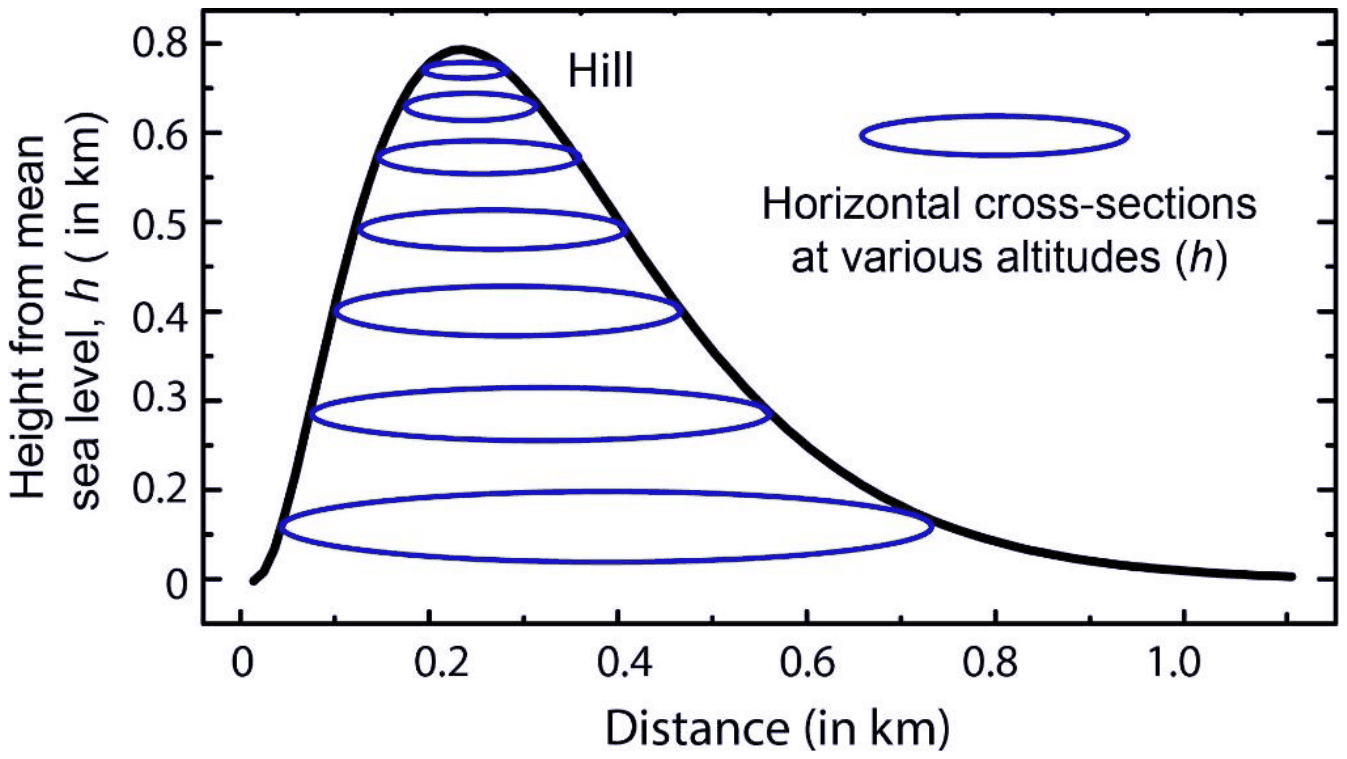
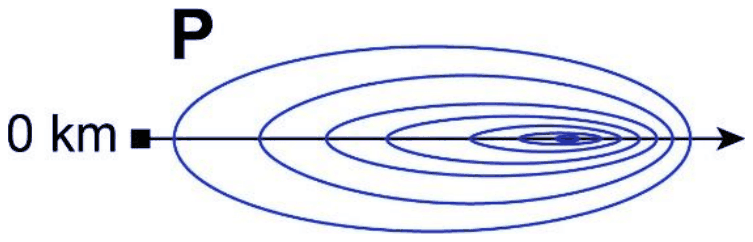
In the given diagram, ovals are marked at different heights (h) of a hill. Which one of the following options P, Q, R, and S depicts the top view of the hill?

Profile of a hill rising steeply from 0 km to a peak of 0.8 km at about 0.22 km, then falling gently to near zero at 1.1 km, with horizontal oval cross-sections drawn at several heights

Exam Year(s)

GATE Mathematics - 2023,

Answer: B

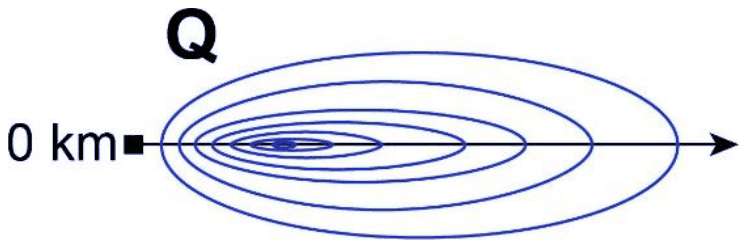
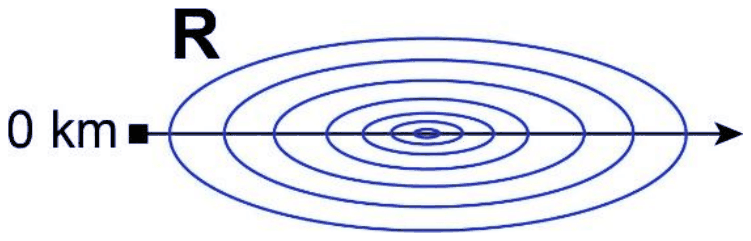
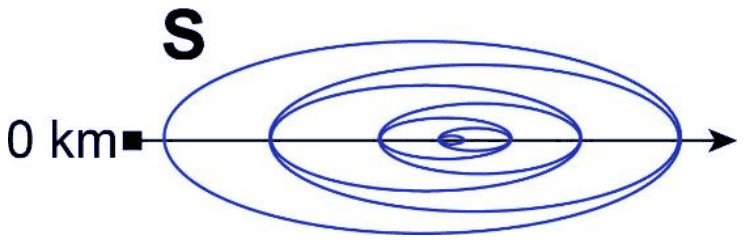
The top view is Q.

The profile rises steeply from 0 km to the peak at about 0.22 km and then slopes away gently to beyond 1 km. Each horizontal cross-section therefore extends a short way on the 0 km side of the peak and a long way on the far side.

Seen from above, the large low ovals reach far to the right while the small high ovals cluster near the peak, close to the 0 km end. The contours are packed tightly on the steep left side and spread out on the gentle right side. Q shows exactly this, with the inner ovals shifted towards 0 km.

P shifts the inner ovals to the right, which would put the steep face on the far side. R is concentric, a symmetric hill, and S has its ovals touching on one side, which does not match the smooth profile.

Please log in or register to report this question.
30.

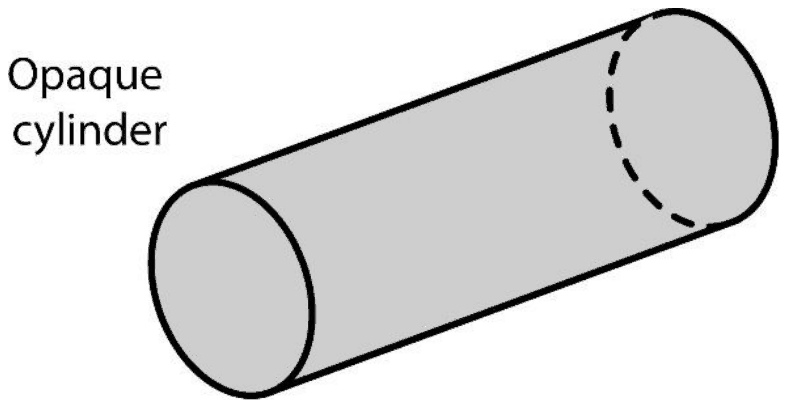
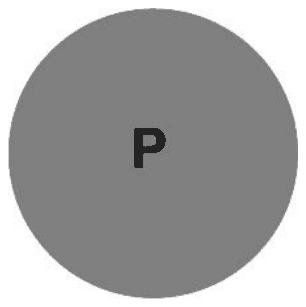
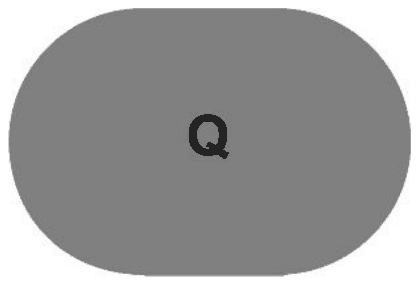
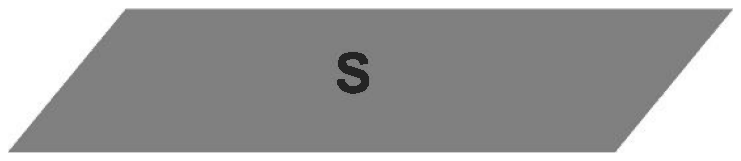
An opaque cylinder (shown below) is suspended in the path of a parallel beam of light, such that its shadow is cast on a screen oriented perpendicular to the direction of the light beam. The cylinder can be reoriented in any direction within the light beam. Under these conditions, which one of the shadows P, Q, R, and S is NOT possible?

A solid circular cylinder drawn in perspective

Exam Year(s)

GATE Mathematics - 2023,

Answer: D

The impossible shadow is S.

With a parallel beam, the shadow is the projection of the cylinder onto the screen. Pointing the axis along the beam gives a circle (P). Turning the axis perpendicular to the beam gives a rectangle (R). At any angle in between, each circular end projects to an ellipse, and the shadow is a band joining two half-ellipses, a rounded shape like Q.

Straight ends appear only when the end circles project edge-on to segments, which happens only when the axis is perpendicular to the beam, and then those segments are perpendicular to the sides, giving a rectangle. A parallelogram with slanted straight ends, S, can therefore never be cast.

Please log in or register to report this question.
Loading…
Tags: Miscellaneous Logical Puzzles Questions and Answers || Miscellaneous Logical Puzzles MCQ Questions and Answers || Miscellaneous Logical Puzzles GK Questions and Answers || Miscellaneous Logical Puzzles GK MCQ Questions || Miscellaneous Logical Puzzles Multiple Choice Questions and Answers || Miscellaneous Logical Puzzles GK || GK on Miscellaneous Logical Puzzles || Reasoning Questions and Answers || Reasoning MCQ Questions and Answers || Reasoning GK Questions and Answers || GK on Reasoning