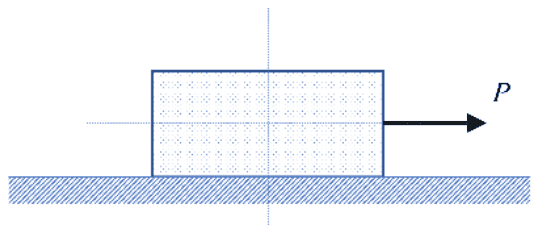
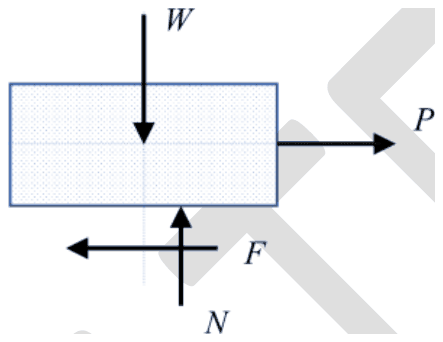
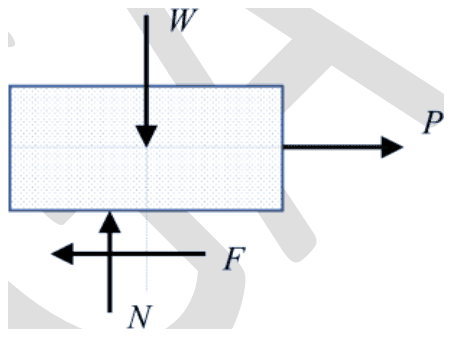
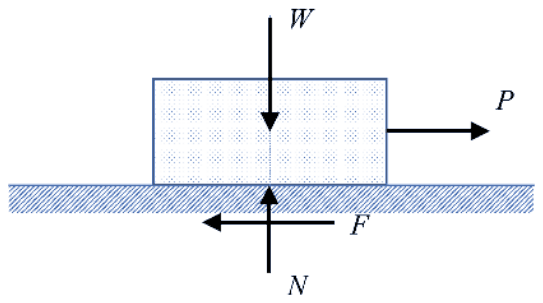
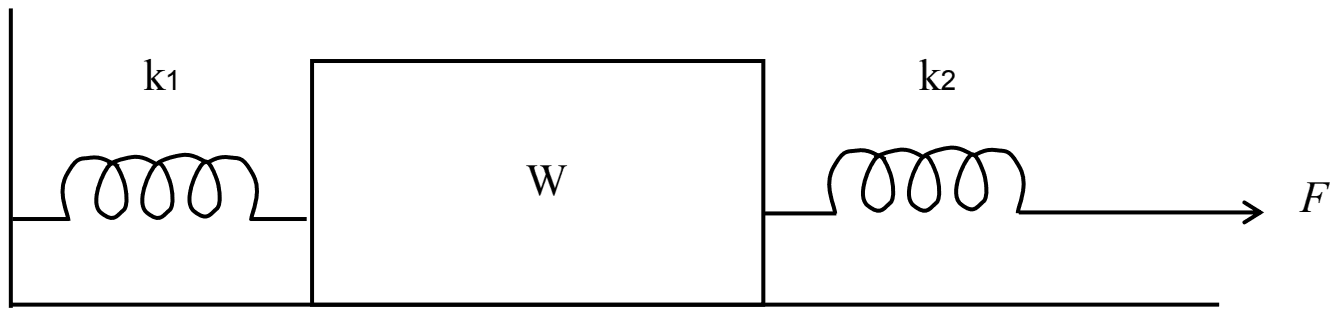
A block of weight W, connected to two springs with spring constants \(k_{1}\) and \(k_{2}\), rests initially on a horizontal frictional surface. The coefficient of static friction between the block and the surface is \(\mu\). Both springs are initially undeformed. The magnitude of force F, applied to the second spring, is now gradually increased. The block will start to slide when F becomes
GATE XE - 2012,
Answer: A
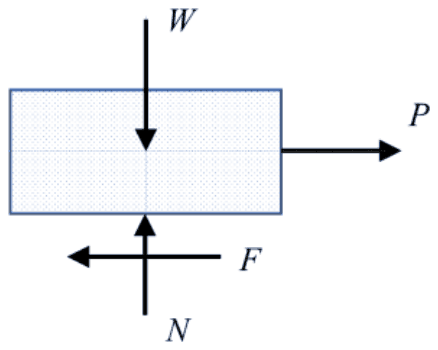
The block starts to slide when F = \(\mu W\).
Spring \(k_{2}\) transmits the full pull F to the block, whatever its stiffness, since it is massless and in series with the applied force. Spring \(k_{1}\) is tied to the wall and is undeformed at the start; it can only exert a force once the block moves and stretches it.
So while the block is at rest, static friction alone resists F, and slipping begins when F reaches the limiting friction \(\mu W\). The options with stiffness ratios would apply only if the block had already been displaced, so that \(k_{1}\) were carrying part of the load.
Please log in or register to report this question.