
Machine-translated by Google. Questions are authored in English.
Top

Kinetics of Particles Questions and Answers

1.

Ranjan is moving with his race car on a circular racetrack of radius 200 m and it is banked at an angle of 10°. If the coefficient of friction between the wheels of the race car and the road is 0.2, then find the optimum speed of the race car to avoid wear and tear on its tyres.

Exam Year(s)

DSSSB JE - 2023,

Answer: B

The speed at which a car needs no friction at all on a banked curve is \(v = \sqrt{rg\tan\theta}\). At this speed the tyres do not rub sideways against the road, which is the optimum speed to avoid wear and tear. With r = 200 m, g = 10 m/s\(^2\) and \(\tan 10^\circ = 0.1763\):

\[ \begin{aligned} v = \sqrt{200 \times 10 \times 0.1763} \\ &= \sqrt{352.7} = 18.78\ \text{m/s} \end{aligned} \]

The given coefficient of friction 0.2 is not used, because it only determines the maximum safe speed (about 27 m/s), not the optimum one. The other options do not follow from either speed.

Please log in or register to report this question.
2.

A horizontal disk has a radial frictionless slot in which a small block is confined to slide. The disk turns anticlockwise about its centre with a constant angular velocity of 3 rad/s. If the block slides along the slot with a constant speed of 0.2 m/s relative to the slot, then the magnitude of Coriolis acceleration in \(\text{m/s}^{2}\) is

Exam Year(s)

GATE ME - 2026,

Answer: A

The Coriolis acceleration is 1.2 \(\text{m/s}^{2}\).

For a body moving with velocity \(v\) relative to a frame rotating at \(\omega\), with \(v\) perpendicular to the rotation axis, the Coriolis component is \(2\omega v\):

\[ \begin{aligned} a_{c} &= 2\omega v = 2 \times 3 \times 0.2 \\ &= 1.2\ \text{m/s}^{2} \end{aligned} \]

0.6 omits the factor 2, 2.4 doubles it again, and 0.3 is neither. The direction is perpendicular to the slot, but the question asks only for the magnitude.

Please log in or register to report this question.
3.

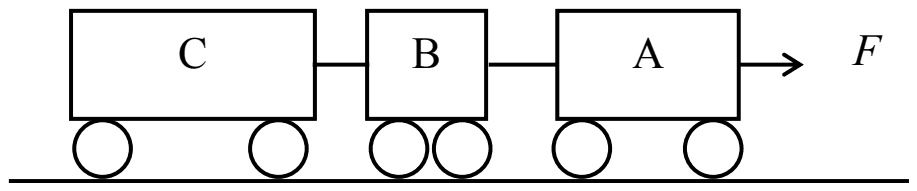
Three connected railway coaches A, B and C of masses \(m_{A}\), \(m_{B}\) and \(m_{C}\), respectively are being pulled by a locomotive with force F over a horizontal track. The coaches may be assumed to move on frictionless wheels with negligible air resistance. The tension in the connector between coaches A and B is

Railway coaches coupled in the order C, B, A with force F pulling coach A forward

Exam Year(s)

GATE XE - 2012,

Answer: D

The tension between A and B is \(F(m_{B} + m_{C})/(m_{A} + m_{B} + m_{C})\).

The whole train accelerates together at

\[ a = \frac{F}{m_{A} + m_{B} + m_{C}} \]

The coupling between A and B is the only horizontal force on the rear part of the train, coaches B and C together, so it must give them this acceleration:

\[ \begin{aligned} T_{AB} &= (m_{B} + m_{C})a \\ &= \frac{F(m_{B} + m_{C})}{m_{A} + m_{B} + m_{C}} \end{aligned} \]

F would be the tension only if B and C were massless. \(Fm_{A}/(\ldots)\) is the net force on A, and \(Fm_{B}/(\ldots)\) is the net force on B alone.

Please log in or register to report this question.

4.

A disk of mass \(m = 0.25\) g and radius \(r = 10\) mm is at rest relative to a mass-less horizontal turntable spinning about a vertical axis at an angular speed of \(\omega = 2\) rad/s. The turntable is assumed to be mounted on frictionless bearings. Another identical, initially non-rotating disk is dropped onto the spinning disk. Friction causes both disks (and the turntable) to eventually rotate at the same angular speed. The eventual angular speed of the disks is

Exam Year(s)

GATE XE - 2012,

Answer: B

The final angular speed is 1 rad/s.

The turntable is massless and its bearings are frictionless, so no external torque acts about the axis and angular momentum is conserved. Friction between the disks is internal.

\[ \begin{aligned} I\omega_{0} &= (I + I)\omega_{f} \\ \omega_{f} &= \frac{\omega_{0}}{2} = \frac{2}{2} = 1\ \text{rad/s} \end{aligned} \]

The mass and radius are not needed, since both disks are identical and their moments of inertia cancel. 2 rad/s would mean the second disk added no inertia, 4 rad/s would violate conservation, and 0.15 rad/s has no basis. Kinetic energy is not conserved: half of it is lost to friction.

Please log in or register to report this question.

5.

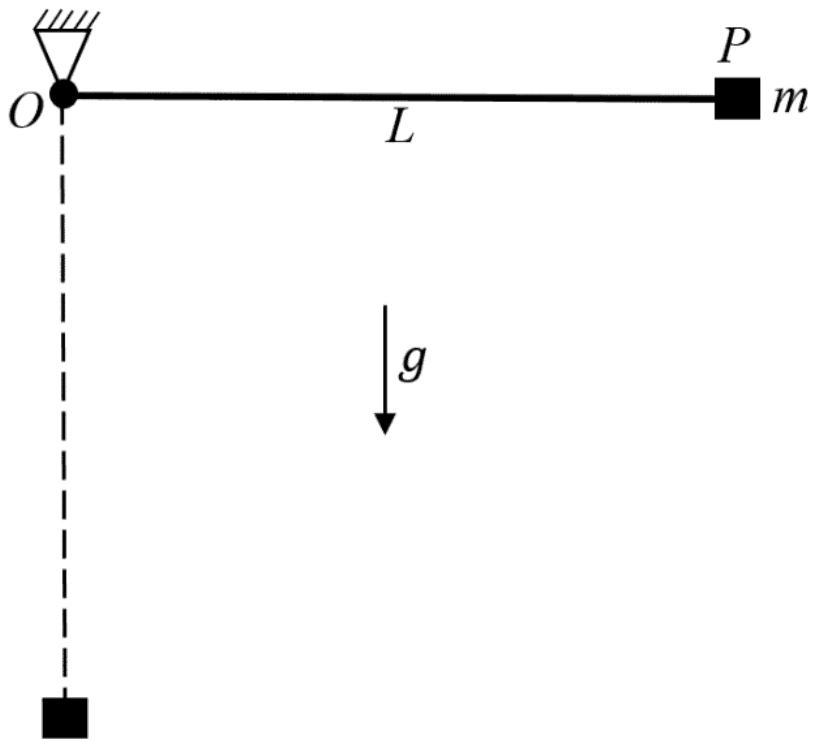
A massless rigid rod \(OP\) of length \(L\) is hinged frictionlessly at \(O\). A concentrated mass \(m\) is attached to end \(P\) of the rod. Initially, the rod \(OP\) is horizontal. Then, it is released from rest. There is gravity as shown. The rod acquires an angular velocity as it swings. The clockwise angular velocity of the rod, when it first reaches the vertical position as shown, is

A rod OP of length L hinged at O, horizontal with the mass m at P; gravity g acts downward; the dashed vertical position shows the mass directly below O

Exam Year(s)

GATE XE - 2023,

Answer: B

The angular velocity is \(\sqrt{\frac{2g}{L}}\).

The hinge is frictionless and the rod massless, so mechanical energy is conserved. Swinging from horizontal to vertical, the mass falls a height \(L\), and in the vertical position it moves on a circle of radius \(L\) with speed \(\omega L\):

\[ \begin{aligned} mgL &= \tfrac{1}{2}m(\omega L)^{2} \\ \omega^{2} &= \tfrac{2g}{L} \\ \omega &= \sqrt{\tfrac{2g}{L}} \end{aligned} \]

\(\sqrt{g/L}\) drops the factor 2 from the kinetic energy, \(2\sqrt{g/L}\) is the speed for a fall of \(2L\), and \(\frac{1}{2}\sqrt{g/L}\) has no consistent derivation.

Please log in or register to report this question.

Loading…
Tags: Kinetics of Particles Questions and Answers || Kinetics of Particles MCQ Questions and Answers || Kinetics of Particles GK Questions and Answers || Kinetics of Particles GK MCQ Questions || Kinetics of Particles Multiple Choice Questions and Answers || Kinetics of Particles GK || GK on Kinetics of Particles || Engineering Mechanics Questions and Answers || Engineering Mechanics MCQ Questions and Answers || Engineering Mechanics GK Questions and Answers || GK on Engineering Mechanics