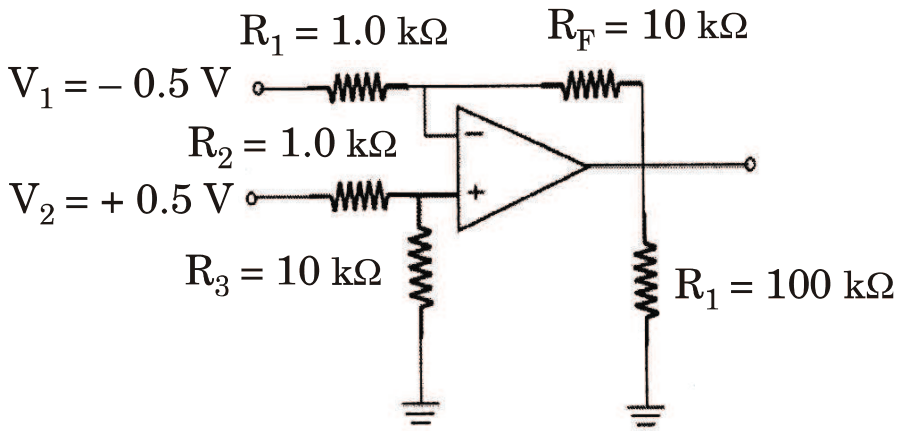
A 5 mV, 1 kHz sinusoidal signal is applied to the input of an op-amp circuit shown below. Find the output voltage :

MH SET - 2020, SET Exam - 2020,
Answer: B
The output is \(\frac{1}{40\pi}(\text{cos}\, 2000\pi t - 1)\) mV.
The circuit is an inverting integrator, \(V_{o} = -\frac{1}{RC}\int_{0}^{t} V_{in}\,dt\), with \(RC = 10^{5} \times 10^{-6} = 0.1\) s. For \(V_{in} = 5\,\text{sin}(2000\pi t)\) mV starting at t = 0:
\[ \begin{aligned} \int_{0}^{t} 5\,\text{sin}(2000\pi t)\,dt \\ &= \frac{5}{2000\pi}(1 - \text{cos}\, 2000\pi t) \\ V_{o} &= -\frac{10 \times 5}{2000\pi}(1 - \text{cos}\, 2000\pi t) \\ &= \frac{1}{40\pi}(\text{cos}\, 2000\pi t - 1)\ \text{mV} \end{aligned} \]
The constant \(-1\) inside the bracket is the integration constant fixed by starting from zero output. The other coefficients correspond to other values of RC (0.05 s gives \(1/20\pi\), 0.15 s gives \(1/60\pi\) and 0.2 s gives \(1/80\pi\)), not to the 100 k\(\Omega\) and 1 \(\mu\)F shown.
Please log in or register to report this question.