
Machine-translated by Google. Questions are authored in English.
Top

Small Oscillations and Normal Modes Questions and Answers

Answer: B

The statement that does NOT apply is the normal coordinates are orthogonal to one another.

Normal coordinates are the combinations of the original coordinates that diagonalise both the kinetic and potential energies at once. In terms of them,

\[ \begin{aligned} T &= \tfrac{1}{2}\sum_{k}\dot{\eta}_{k}^{2} \\ V &= \tfrac{1}{2}\sum_{k}\omega_{k}^{2}\eta_{k}^{2} \end{aligned} \]

so the potential energy is a sum of squares with constant coefficients, each coordinate oscillates independently, and each has its own eigen-frequency \(\omega_{k}\). Those three statements are the defining properties.

Orthogonality is not a property of the coordinates themselves. The mode (eigen)vectors from which they are built are orthogonal only with respect to the kinetic-energy (mass) matrix, not in the ordinary sense, so the key treats this as the statement that does not apply.

Please log in or register to report this question.

2.

The equation of motion for the forced simple harmonic oscillator is

\(\ddot{x}(t) + \omega^{2}x(t) = F\cos(\omega t)\)

where \(x(t = 0) = 0\) and \(\dot{x}(t = 0) = 0\). Which one of the following options is correct?

Exam Year(s)

GATE Physics - 2024,

Answer: A

The solution grows as x(t) ∝ t sin(ωt).

The driving frequency equals the natural frequency, so the system is at resonance. Try x = Ct sin ωt:

\[ \begin{aligned} \ddot{x} &= 2C\omega\cos\omega t - C\omega^{2}t\sin\omega t \\ \ddot{x} + \omega^{2}x &= 2C\omega\cos\omega t \Rightarrow C = \frac{F}{2\omega} \end{aligned} \]

This particular solution also satisfies x(0) = 0 and ẋ(0) = 0, so no homogeneous part is needed: x(t) = (F/2ω) t sin ωt, an oscillation whose amplitude grows linearly in time.

t cos ωt does not satisfy ẋ(0) = 0 and does not solve the equation. The amplitude grows without bound but x(t) is finite at every time, so 'x(t) = ∞' is wrong, and there is no exponential growth for an undamped linear oscillator.

Please log in or register to report this question.

3.

The figure shows a system of two equal masses \(m\) and three massless horizontal springs with spring constants \(k_{1}\), \(k_{2}\), \(k_{1}\). Ignore gravity. The masses can move only in the horizontal direction and there is no dissipation. If \(m = 1\), \(k_{1} = 2\) and \(k_{2} = 3\) (all in appropriate units), the frequencies of the normal modes of the system in the same system of units are

Wall, spring k1, mass m, spring k2, mass m, spring k1, wall in a horizontal line

Exam Year(s)

GATE Physics - 2025,

Answer: A

The normal-mode frequencies are \(\sqrt{2}\) and \(\sqrt{8}\).

With displacements \(x_{1}, x_{2}\), the equations of motion are

\[ \begin{aligned} m\ddot{x}_{1} &= -k_{1}x_{1} - k_{2}(x_{1} - x_{2}) \\ m\ddot{x}_{2} &= -k_{1}x_{2} - k_{2}(x_{2} - x_{1}) \end{aligned} \]

In the symmetric mode (\(x_{1} = x_{2}\)) the middle spring is not stretched, so \(\omega^{2} = \frac{k_{1}}{m} = 2\). In the antisymmetric mode (\(x_{1} = -x_{2}\)) the middle spring is stretched twice as much, so \(\omega^{2} = \frac{k_{1} + 2k_{2}}{m} = 2 + 6 = 8\).

\(\sqrt{6}\) forgets the outer springs in the second mode (it is \(2k_{2}\) alone), and the options with \(\sqrt{3}\) use \(k_{2}\) for the in-phase mode, where the middle spring plays no part.

Please log in or register to report this question.
4.

A simple pendulum of mass m and length l oscillates with a frequency \(\omega_{0}\). A piece breaks off from the pendulum and the mass is reduced to m/2. The frequency of oscillation ω then becomes :

Exam Year(s)

MH SET - 2018, SET Exam - 2018,

Answer: C

The frequency is unchanged: \(\omega = \omega_{0}\).

For small oscillations a simple pendulum has

\[ \omega_{0} = \sqrt{\frac{g}{l}} \]

which depends only on the length and the acceleration due to gravity. The mass cancels, because both the restoring force \(mg\sin\theta\) and the inertia \(ml\) are proportional to m. Halving the mass, with the length the same, therefore leaves the frequency as it was.

Doubling, halving or multiplying by \(\sqrt{2}\) would all require the frequency to depend on m, which it does not; such mass dependence belongs to a spring-mass oscillator, where \(\omega = \sqrt{k/m}\).

Please log in or register to report this question.

5.

For a simple harmonic oscillator the probability of finding the particle, if the measurement is made at random time, is inversely proportional to the speed. If the amplitude of oscillation is A, the probability of finding the particle is :

Exam Year(s)

MH SET - 2018, SET Exam - 2018,

Answer: A

The probability is maximum close to ± A.

The time spent in a small interval \( dx \) is \( dx/|v| \), and for SHM the speed is \( v = \omega\sqrt{A^{2} - x^{2}} \). So

\[ P(x)\,dx = \frac{dx}{\pi\sqrt{A^{2} - x^{2}}} \]

which is smallest at \( x = 0 \), where the particle moves fastest, and rises steeply near the turning points \( \pm A \), where it momentarily stops.

So the probability is a minimum, not a maximum, at zero; it is not constant over [−A, A]; and nothing special happens at ±A/2.

Please log in or register to report this question.

6.

In a critically damped series LCR circuit :

Exam Year(s)

MH SET - 2020, SET Exam - 2020,

Answer: A

For critical damping \(R^{2} = 4L/C\).

The charge in a series LCR circuit obeys \(L\ddot{q} + R\dot{q} + q/C = 0\), with characteristic equation \(Ls^{2} + Rs + 1/C = 0\). Critical damping is the boundary between oscillation and slow decay, where the discriminant is zero:

\[ \begin{aligned} R^{2} - \frac{4L}{C} &= 0 \\ R &= 2\sqrt{\frac{L}{C}} \end{aligned} \]

If \(R^{2}\) is smaller, the circuit oscillates (underdamped), and if larger, it is overdamped. \(R = \sqrt{L/C}\) is half the critical value, and the other forms do not even have the dimensions of resistance squared.

Please log in or register to report this question.

7.

A mass spring system consists of two blocks of mass M and one block of mass m (\(\lt\)M). The blocks are connected with two springs of same spring constant (k), as shown in figure. The system is constraint to move along a straight line on a frictionless horizontal surface. Let V represent the potential energy of the system. Considering that the masses are exhibiting small oscillations, the potential energy matrix (V) is given as :

Three blocks M, m, M in a row on a horizontal surface; the first M is joined to m by a spring k, and m to the second M by a spring k

Exam Year(s)

MH SET - 2023, SET Exam - 2023,

Answer: A

The potential energy matrix is \(\frac12\begin{pmatrix}k & -k & 0\\ -k & 2k & -k\\ 0 & -k & k\end{pmatrix}\).

With displacements \(x_{1}, x_{2}, x_{3}\) of the three blocks, each spring stores energy according to its own stretch:

\[ \begin{aligned} V &= \tfrac{1}{2}k(x_{1} - x_{2})^{2} + \tfrac{1}{2}k(x_{2} - x_{3})^{2} \\ &= \tfrac{1}{2}(kx_{1}^{2} + 2kx_{2}^{2} + kx_{3}^{2}) \\ &\quad - kx_{1}x_{2} - kx_{2}x_{3} \end{aligned} \]

Writing V as \(\frac{1}{2}x^{T}Kx\) puts k, 2k, k on the diagonal and -k for each pair joined by a spring, with 0 for the end blocks, which are not directly connected. The matrix must be symmetric with negative off-diagonal couplings, which rules out the other three. The masses do not enter V; they belong to the kinetic energy matrix.

Please log in or register to report this question.

Answer: C

The potential energy is a homogeneous quadratic function in terms of normal coordinates.

For two coupled pendulums, in terms of the actual displacements \(x_{1}, x_{2}\), the potential energy (for small oscillations) is \(\frac{1}{2}k(x_{1}^{2} + x_{2}^{2}) + \frac{1}{2}k'(x_{1} - x_{2})^{2}\), which contains a cross term \(x_{1}x_{2}\). Normal coordinates \(q_{1} = x_{1} + x_{2}\) and \(q_{2} = x_{1} - x_{2}\) remove the cross term, so the potential becomes a sum of squares, each mode oscillating independently.

The point of the statement is this separation into squares. The other options put the special, diagonal form in the actual coordinates, or deny it in normal coordinates, which is the reverse of what normal coordinates achieve.

Please log in or register to report this question.

9.

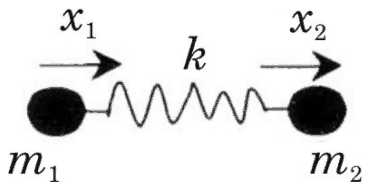
Two masses \(m_{1}\) and \(m_{2}\) are attached to the extreme ends of a massless spring of force constant k as shown in figure below. The system is at rest on a horizontal surface. The vibrational frequency w of the system is :

Two masses m1 and m2 joined by a spring of force constant k, with displacements x1 and x2 both drawn as arrows pointing right

Exam Year(s)

MH SET - 2025, SET Exam - 2025,

Answer: A

The frequency is \(\sqrt{\frac{k(m_{1}+m_{2})}{m_{1}m_{2}}}\).

The equations of motion are \(m_{1}\ddot{x}_{1} = k(x_{2} - x_{1})\) and \(m_{2}\ddot{x}_{2} = -k(x_{2} - x_{1})\). The centre of mass moves uniformly, and the extension \(x = x_{2} - x_{1}\) obeys

\[ \begin{aligned} \ddot{x} &= -k\left(\frac{1}{m_{1}} + \frac{1}{m_{2}}\right)x \\ &= -\frac{k}{\mu}x \\ \mu &= \frac{m_{1}m_{2}}{m_{1} + m_{2}} \end{aligned} \]

So the system oscillates like a single reduced mass \(\mu\) on the spring, with \(w = \sqrt{k/\mu}\), which is the keyed expression. Check: if \(m_{2} \to \infty\) (one end fixed) it reduces to \(\sqrt{k/m_{1}}\).

A difference \(m_{1} - m_{2}\) has no physical basis and would give zero or imaginary frequencies for equal masses, and the inverted forms have the dimensions of time, not frequency.

Please log in or register to report this question.

Loading…

Other Subjects

Tags: Small Oscillations and Normal Modes Questions and Answers