
Machine-translated by Google. Questions are authored in English.
Top

Faults and Fault Systems Questions and Answers

Answer: B

Rake (pitch) is the angle between the strike of the fault plane and the slickenlines, measured on the fault plane.

Rake describes a line that lies within a plane, so it is measured in that plane, from the horizontal strike line to the lineation, between 0° and 180°. A rake near 0° or 180° means strike-slip movement, and a rake near 90° means dip-slip movement.

The angle between magnetic north and strike, on a horizontal surface, is the strike azimuth of the plane. An angle measured in a vertical plane is a plunge, which describes the line relative to the horizontal rather than within the fault plane. Trend and plunge are the two coordinates of the lineation itself; the angle between them is not a defined measurement.

Please log in or register to report this question.
2.

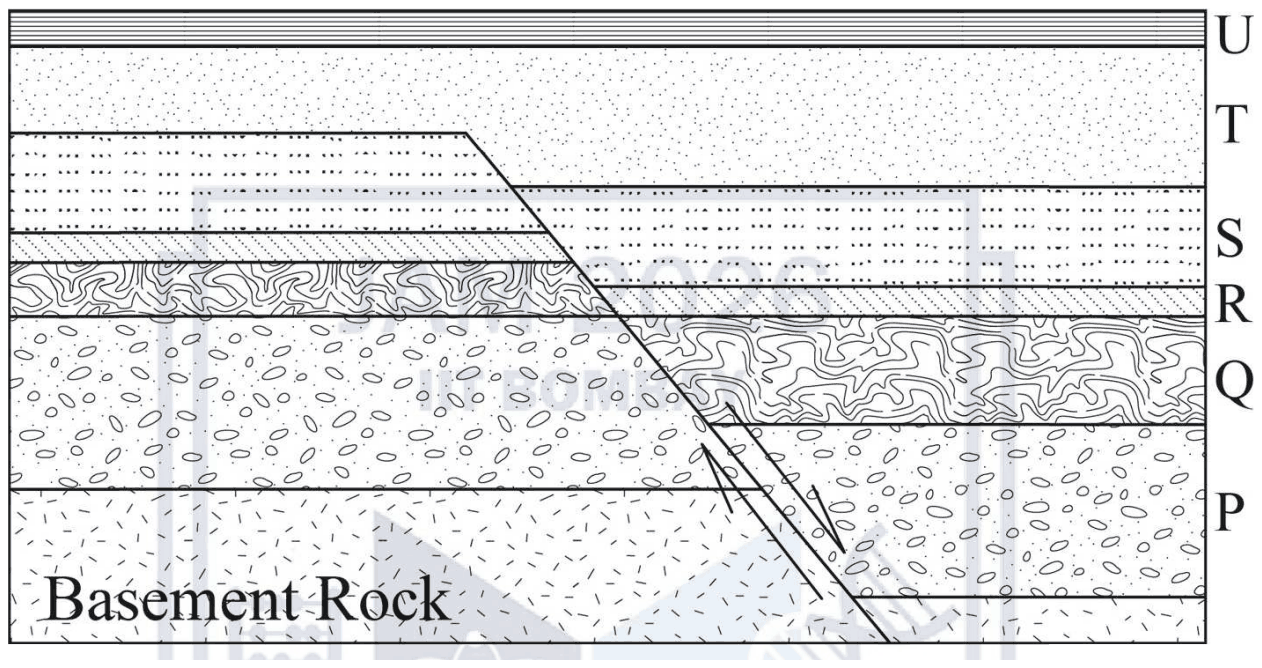
The schematic shows a geological cross-section of a faulted region of sedimentary rocks (beds P to U). Assuming continuous sedimentation, select the beds that record the earliest activation and the latest reactivation of the fault.

Cross-section of sedimentary beds P (lowest) to U (top) on basement rock, cut by a fault that dips down to the right and offsets the beds; the fault tip ends inside bed T.

Exam Year(s)

IIT JAM - 2026,

Answer: A

The beds that record the earliest activation and the latest reactivation are Q and T.

A fault that moves while sediment is being laid down (a growth fault) leaves a tell-tale signature: a bed deposited during movement is thicker on the downthrown block, because the sea floor there is lower and takes more sediment, while a bed deposited when the fault is quiet has the same thickness on both sides. The fault here dips to the right and the right-hand block is the downthrown one.

Bed P, the lowest in the sequence, has the same thickness on both sides and is simply offset, so it was laid down before the fault moved. Bed Q is the first bed that is clearly thicker on the downthrown side, so it records the earliest activation. Beds R and S are of equal thickness on both sides, which means the fault was inactive while they were deposited. Bed T is thicker on the downthrown block again, which marks a later reactivation, and the fault tip dies out inside T. Bed U covers the fault and is of uniform thickness, so the movement had stopped by then.

The other options pair Q or T with a bed that does not change thickness (P, R) or with the sealing bed U, so they are wrong.

Please log in or register to report this question.

3.

The high grade metamorphic rocks are brought over the low grade metamorphic rocks of Lesser Himalaya by a major thrust called :

Exam Year(s)

MH SET - 2018, SET Exam - 2018,

Answer: D

The thrust is the Main Central Thrust.

The Main Central Thrust (MCT) carries the high-grade gneisses and schists of the Higher (Greater) Himalayan Crystallines southward over the low-grade metasediments of the Lesser Himalaya, which is why metamorphic grade appears inverted near it.

The Main Boundary Thrust lies further south and brings Lesser Himalayan rocks over the Siwaliks. The Indus Suture Zone marks where the Indian and Asian plates joined, north of the Himalaya proper, and 'Lesser Himalayan Thrust' is not the name of this structure.

Please log in or register to report this question.

4.

Which one of the following is the oldest thrust of Himalaya ?

Exam Year(s)

MH SET - 2018, SET Exam - 2018,

Answer: B

The oldest Himalayan thrust is the Main Central Thrust.

Deformation in the Himalaya has stepped southwards with time towards the foreland. The Main Central Thrust, which carries the Higher Himalayan crystallines over the Lesser Himalaya, was active mainly in the early Miocene, about 23-20 million years ago. The Main Boundary Thrust, bringing the Lesser Himalaya over the Siwaliks, came later, and the Himalayan Frontal Thrust, at the southern edge of the Siwaliks, is the youngest and is active today.

The Main Boundary Fault is another name used for the Main Boundary Thrust, so it is younger than the MCT as well.

Please log in or register to report this question.

5.

A bed parallel elongation giving rise to tectonic thinning is characteristic of :

Exam Year(s)

MH SET - 2019, SET Exam - 2019,

Answer: A

Bed-parallel elongation causing tectonic thinning is characteristic of an extensional fault.

Structural geology distinguishes faults by two references. 'Normal' and 'reverse' describe movement relative to the horizontal. 'Extensional' and 'contractional' describe the effect on the layering: an extensional fault lengthens the layers it cuts and thins the sequence, whatever its dip. So a fault that produces elongation parallel to bedding and tectonic thinning is, by definition, extensional.

A normal fault usually is extensional too, but not necessarily if the beds are steeply tilted. A thrust fault shortens and thickens the sequence, and 'buckle fault' is not a standard fault type.

Please log in or register to report this question.

6.

One of the following features is not associated with strike-slip fault :

Exam Year(s)

MH SET - 2019, SET Exam - 2019,

Answer: C

The feature not associated with strike-slip faults is the hogback.

A hogback is a sharp ridge formed by differential erosion of a steeply dipping resistant bed, a product of tilted strata rather than of horizontal fault movement.

The other three are typical of active strike-slip faults. Beheaded valleys are stream valleys cut off and offset by fault movement. Sag ponds fill depressions formed where the fault zone pulls apart slightly. Shutter ridges are ridges moved along the fault so that they block or 'shutter' the valleys they come to face.

Please log in or register to report this question.

7.

The major lithotectonic units in the Himalaya are bounded by thrust. Arrange correctly the thrust/fault system from north to south in this context.

(a) MCT
(b) Tethian Fault
(c) MBT
(d) HFT

Exam Year(s)

MH SET - 2020, SET Exam - 2020,

Answer: A

From north to south the order is (b) Tethian Fault, (a) MCT, (c) MBT, (d) HFT.

The Himalaya is divided into belts separated by north-dipping faults, younger and active towards the south:

  • Tethyan (South Tibetan Detachment) fault: between the Tethyan sediments and the Higher Himalayan crystallines.
  • Main Central Thrust: between the Higher Himalaya and the Lesser Himalaya.
  • Main Boundary Thrust: between the Lesser Himalaya and the Siwaliks.
  • Himalayan Frontal Thrust: between the Siwaliks and the Indo-Gangetic plain.

The other orders put the MCT or the MBT north of the Tethyan fault, or the HFT first, reversing the sequence.

Please log in or register to report this question.

8.

The three principal stresses Sv, SH and Sh represent the magnitudes of vertical component of stress, maximum horizontal stress and minimum horizontal stress. According to Anderson's faulting theory, a strike-slip fault movement may be inferred if :

Exam Year(s)

MH SET - 2023, SET Exam - 2023,

Answer: C

A strike-slip fault is inferred when \(S_{H} \gt S_{v} \gt S_{h}\).

Anderson's theory takes one principal stress to be vertical, since the Earth's surface carries no shear stress, and says that faults form in the plane containing the intermediate stress. So the type of fault depends on which stress is vertical:

  • \(S_{v}\) greatest (\(S_{v} \gt S_{H} \gt S_{h}\)): normal fault.
  • \(S_{v}\) intermediate (\(S_{H} \gt S_{v} \gt S_{h}\)): strike-slip fault.
  • \(S_{v}\) least (\(S_{H} \gt S_{h} \gt S_{v}\)): reverse or thrust fault.

So the first option describes thrusting and the fourth normal faulting. The second is impossible, since \(S_{h}\) is by definition the smaller horizontal stress.

Please log in or register to report this question.

9.

Vertical faults have throw but do not have ..........

Exam Year(s)

MH SET - 2023, SET Exam - 2023,

Answer: A

Vertical faults have throw but no Heave.

On a cross-section at right angles to the strike, the dip separation of a fault splits into a vertical component, the throw, and a horizontal component, the heave. When the fault plane is vertical, the displacement in that section is entirely vertical, so the heave is zero while the throw remains.

A vertical fault can still have dip slip, which is then purely vertical, and strike slip along its strike, and its slip direction still has a rake, so those options are wrong.

Please log in or register to report this question.

10.

Transform faults are :

Exam Year(s)

MH SET - 2025, SET Exam - 2025,

Answer: C

Transform faults are strike-slip faults.

A transform fault is a plate boundary where two plates slide past each other horizontally, so the motion is parallel to the strike of the fault. Most offset mid-ocean ridge segments; the San Andreas Fault is a well-known continental example. Lithosphere is neither created nor destroyed at them, which is why they are called conservative boundaries.

Normal faults involve extension and dip-slip movement, typical of rifts and ridges. Reverse and thrust faults involve compression and dip-slip movement, typical of convergent margins. None of these describes the horizontal sliding along a transform.

Please log in or register to report this question.

Loading…

Other Subjects

Tags: Faults and Fault Systems Questions and Answers || Faults and Fault Systems MCQ Questions and Answers || Faults and Fault Systems GK Questions and Answers || Faults and Fault Systems GK MCQ Questions || Faults and Fault Systems Multiple Choice Questions and Answers || Faults and Fault Systems GK || GK on Faults and Fault Systems || Structural Geology Questions and Answers || Structural Geology MCQ Questions and Answers || Structural Geology GK Questions and Answers || GK on Structural Geology