
Machine-translated by Google. Questions are authored in English.
Top

Electrochemistry and Ionic Equilibria Questions and Answers

1.

Calculate the standard free energy change for the given reaction.

\(\mathrm{Ni + Cu^{2+} \to Ni^{2+} + Cu}\)

[ Given: \(E^\circ_{\mathrm{Ni^{2+}/Ni}} = -0.25\) V; \(E^\circ_{\mathrm{Cu^{2+}/Cu}} = 0.34\) V ]

Exam Year(s)

DSSSB AE - 2023,

Answer: C

The cell potential is the reduction potential of the cathode minus that of the anode. Copper is reduced and nickel is oxidised, so


\[ E^\circ_{cell} = 0.34 - (-0.25) = 0.59\ \text{V} \]


Two electrons are transferred (\(n = 2\)), and the Faraday constant is 96500 C/mol.


\[ \begin{aligned} \Delta G^\circ = -nFE^\circ \\ &= -2 \times 96500 \times 0.59 \\ &= -113870\ \text{J mol}^{-1} \end{aligned} \]


The sign is negative because the reaction is spontaneous. The value \(-56935\) comes from using \(n = 1\) and the positive values from the wrong sign. The answer is option C.

Please log in or register to report this question.
2.

At 298 K, the EMF of the cell

Pt | H2(1 bar) | H+(solution) || Cl- | Hg2Cl2 | Hg

is 0.7530 V. The standard potential of the calomel electrode is 0.2802 V. If the liquid junction potential is zero, the pH of the solution is

Exam Year(s)

GATE Chemistry - 2012,

Answer: C

The pH of the solution is 8.0.

The cell has the hydrogen electrode on the left (anode) and the calomel electrode on the right (cathode). With H2 at 1 bar the hydrogen electrode potential is -0.0591 pH, so:

\[ \begin{aligned} E_{cell} &= E_{cal} - E_{H} = 0.2802 + 0.0591\,\text{pH} \\ \text{pH} &= \frac{0.7530 - 0.2802}{0.0591} \\ &= \frac{0.4728}{0.0591} = 8.0 \end{aligned} \]

12.7 is 0.7530 / 0.0591, which forgets to subtract the calomel electrode's potential. 7.4 and 4.7 do not reproduce the measured EMF when substituted back: 0.2802 + 0.0591 × 7.4 = 0.717 V, not 0.7530 V.

Please log in or register to report this question.
3.

For the following reaction

2MnO4- + 5H2C2O4 + 6H+ \(\rightarrow\) 2Mn2+ + 8H2O + 10CO2

E°(MnO4-/Mn2+) = +1.51 V and E°(CO2/H2C2O4) = -0.49 V.
At 298 K, the equilibrium constant is

Exam Year(s)

GATE Chemistry - 2012,

Answer: B

The equilibrium constant is 10338.

Ten electrons are transferred in the balanced equation (2 Mn from +7 to +2). The cell potential is the cathode (permanganate) minus the anode (oxalate) standard potential:

\[ \begin{aligned} E^{\circ}_{cell} &= 1.51 - (-0.49) = 2.00\ \text{V} \\ \log K &= \frac{nE^{\circ}}{0.0591} = \frac{10 \times 2.00}{0.0591} \\ &= 338 \end{aligned} \]

The other exponents do not follow from n = 10 and a cell potential of 2.00 V. A common slip is to subtract the two potentials (1.51 - 0.49 = 1.02 V), which gives log K of about 173, also not an option; 1038 is far too small for a ten-electron reaction with a 2 V driving force.

Please log in or register to report this question.
4.

In an electrochemical cell, Ag+ ions in AgNO3 are reduced to Ag metal at the cathode and Cu is oxidized to Cu2+ at the anode. A current of 0.7 A is passed through the cell for 10 min. The mass (in grams) of silver deposited and copper dissolved, respectively, are:

[Faraday Constant = 96,485 C mol−1, Atomic Weight of Ag = 107.9, Atomic Weight of Cu = 63.55]

Exam Year(s)

GATE Chemistry - 2021,

Answer: A

The masses are 0.469 g of silver and 0.138 g of copper.

Charge passed and moles of electrons:

\[ \begin{aligned} Q &= 0.7 \times 600 = 420\ \mathrm{C} \\ n_{e} &= \frac{420}{96485} = 4.353 \times 10^{-3}\ \mathrm{mol} \end{aligned} \]

Ag+ takes one electron and Cu gives two:

\[ \begin{aligned} m_{\mathrm{Ag}} &= 4.353 \times 10^{-3} \times 107.9 = 0.469\ \mathrm{g} \\ m_{\mathrm{Cu}} &= \frac{4.353 \times 10^{-3}}{2} \times 63.55 = 0.138\ \mathrm{g} \end{aligned} \]

0.069 g of copper divides by 2 twice, and 0.235 g of silver treats Ag+ as if it needed two electrons per atom.

Please log in or register to report this question.
5.

For the following electrochemical cells, liquid junction potentials affect the cell potential (Ecell).

I. Electrode-1 | 0.1 M KCl || 0.1 M NaCl | Electrode-2
II. Electrode-1 | 0.1 M HCl || 0.01 M HCl | Electrode-2
III. Electrode-1 | 0.01 M KCl || 0.01 M HCl | Electrode-2

The correct order of their Ecell at 25 °C is

Exam Year(s)

GATE Chemistry - 2026,

Answer: B

The order is \(\mathrm{II} \gt \mathrm{I} \gt \mathrm{III}\).

The question attributes the differences between the cells to their liquid junctions, so compare the junction potential each adds, taken as the potential of the right-hand solution relative to the left. A junction charges the side towards which the faster ion runs.

  • II (0.1 M HCl | 0.01 M HCl): H+ (transport number about 0.82) diffuses into the dilute side much faster than Cl-, making the right side positive by roughly \(0.64 \times 59\) mV, about +38 mV.
  • I (0.1 M KCl | 0.1 M NaCl): common anion, and K+ is only slightly more mobile than Na+, so the right side is a few millivolts positive.
  • III (0.01 M KCl | 0.01 M HCl): H+ runs leftwards into the KCl far faster than K+ runs right, making the left side positive, a negative contribution of roughly -27 mV.

So Ecell falls in the order II, I, III. The options treating I and III as equal ignore the large biionic junction in III, and \(\mathrm{I} \gt \mathrm{II} \gt \mathrm{III}\) misses that the tenfold HCl gradient in II gives the largest junction of all.

Please log in or register to report this question.

6.

The value of Ka of acetic acid is 1.7 × 10⁻⁵ mol/dm3. The pH of a buffer solution prepared by mixing 100 ml of 0.1 M acetic acid with a solution of 100 ml of 0.2 M sodium acetate is

Exam Year(s)

GATE Life Sciences - 2012,

Answer: C

The pH of the buffer is about 5.1.

After mixing, the total volume is 200 ml, so [acid] = 0.01/0.2 = 0.05 M and [acetate] = 0.02/0.2 = 0.10 M. The Henderson-Hasselbalch equation gives

\[ \begin{aligned} pK_{a} &= -\log(1.7 \times 10^{-5}) = 4.77 \\ pH &= pK_{a} + \log\frac{[\text{A}^{-}]}{[\text{HA}]} \\ &= 4.77 + \log 2 = 5.07 \end{aligned} \]

Because both solutions are diluted into the same volume, only the ratio of moles (0.02 to 0.01) matters. 4.5 is the result of inverting the ratio, and 4.1 or 5.5 do not follow from a pKa of 4.77 with a 2:1 salt-to-acid ratio.

Please log in or register to report this question.

7.

The value of standard half cell potential of Cu+2, Cu couple (E0Cu(+2), Cu) is 0.34 V. A wire of pure copper is immersed into a solution of copper nitrate. If the measured cell potential against standard hydrogen electrode at 298 K is 0.24 V, the molar concentration of copper nitrate is
{Assume activity of Cu+2 = [Cu+2]}.

Exam Year(s)

GATE Life Sciences - 2012,

Answer: A

The copper nitrate concentration is about \(4.1 \times 10^{-4}\) M.

For the half reaction \(\text{Cu}^{2+} + 2e^{-} \rightarrow \text{Cu}\), the Nernst equation at 298 K is

\[ \begin{aligned} E &= E^{0} + \frac{0.0591}{2}\log[\text{Cu}^{2+}] \\ 0.24 &= 0.34 + 0.02955\log[\text{Cu}^{2+}] \\ \log[\text{Cu}^{2+}] &= -0.10/0.02955 = -3.38 \\ [\text{Cu}^{2+}] &= 4.1 \times 10^{-4}\ \text{M} \end{aligned} \]

The measured potential is 0.10 V below the standard value, so the concentration must be well below 1 M. Using n = 1 instead of 2 gives about \(2.0 \times 10^{-2}\) M, a common slip; the other values do not satisfy the equation.

Please log in or register to report this question.

8.

Molar conductance of monobromoacetic acid at infinite dilution is calculated to be x × 10−4 S m2 mol−1 at 25 °C.
The value of x is (round off to the nearest integer)

Given:

ElectrolyteLimiting molar conductance at 25 °C in 10−4 S m2 mol−1
HBr427.95
KBr151.64
CH2BrCOOK112.72

Exam Year(s)

GATE Life Sciences - 2022,

Answer: C

The value of x is 389.

Kohlrausch's law of independent migration lets the limiting molar conductance of a weak acid be built from strong electrolytes. Adding HBr and CH2BrCOOK and subtracting KBr leaves exactly H+ and CH2BrCOO-:

\[ \begin{aligned} \Lambda^{0}_{\text{acid}} &= \Lambda^{0}_{HBr} + \Lambda^{0}_{CH_2BrCOOK} - \Lambda^{0}_{KBr} \\ &= 427.95 + 112.72 - 151.64 \\ &= 389.03 \end{aligned} \]

in units of 10-4 S m2 mol-1, which rounds to 389.

467 is 427.95 + 151.64 - 112.72, which swaps the roles of KBr and the potassium salt, and 164 is 427.95 - 151.64 - 112.72, which subtracts both salts. 195 is about half the correct value. Only the combination that cancels K+ and Br- leaves the acid's own ions.

Please log in or register to report this question.

9.

Which one among the following mixtures gives a buffer solution in water?

Exam Year(s)

GATE Life Sciences - 2023,

Answer: A

The buffer is \(CH_{3}COOH + CH_{3}COONa\).

A buffer needs a weak acid together with its conjugate base (or a weak base with its conjugate acid), so that added \(H^{+}\) is taken up by the base and added \(OH^{-}\) by the acid. Acetic acid is a weak acid and sodium acetate supplies its conjugate base, acetate.

Acetic acid with NaCl has no conjugate base, since chloride is the conjugate base of a strong acid and does not take up protons. NaOH with NaCl is a strong base and a neutral salt. NaOH with sodium acetate is a strong base plus a weak base, with no acid to absorb added base.

Please log in or register to report this question.

10.

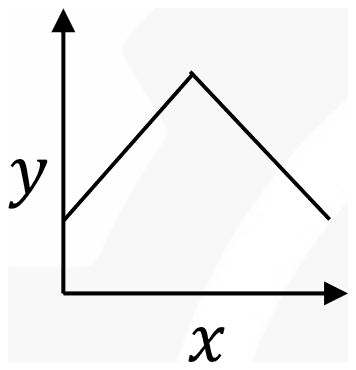
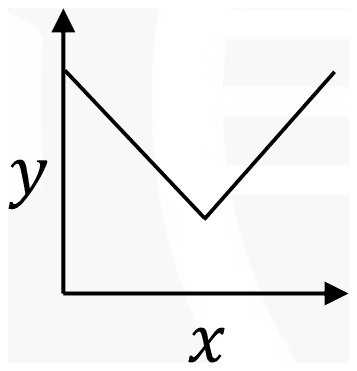
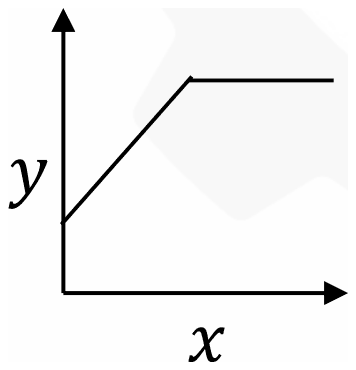
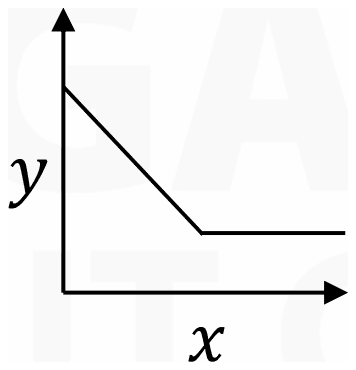
10 mM aqueous HCl is added dropwise to 10 mL of 1 mM aqueous NaOH. The qualitative plot of conductivity (y) against the number of drops of HCl (x) is

Exam Year(s)

GATE Life Sciences - 2026,

Answer: B

The conductivity first falls and then rises, the V-shaped plot in option (B).

At the start the solution holds Na+ and OH-, and OH- has a very high ionic mobility. Each drop of HCl neutralises some OH- (H+ + OH- → H2O) and puts in its place a Cl- ion, which conducts much less. So conductivity drops steadily until the equivalence point (1 mL of the 10 mM acid for 10 mL of 1 mM base).

After that, the extra drops add H+, the most mobile ion of all, together with Cl-, so the conductivity climbs steeply.

Plot (A) has the trend upside down. Plots (C) and (D) level off, which would need the acid to stop adding ions after the equivalence point; excess HCl keeps raising the conductivity.

Please log in or register to report this question.

Loading…

Other Subjects

Tags: Electrochemistry and Ionic Equilibria Questions and Answers