
Machine-translated by Google. Questions are authored in English.
Top

Algebra Questions and Answers

Important Instructions
51.

Consider two functions of time \((t)\),

\[ f(t) = 0.01\, t^{2} \]

\[ g(t) = 4\, t \]

where \(0 \lt t \lt \infty\).

Now consider the following two statements:

(i) For some \(t \gt 0\), \(g(t) \gt f(t)\).
(ii) There exists a \(T\), such that \(f(t) \gt g(t)\) for all \(t \gt T\).

Which one of the following options is TRUE?

Exam Year(s)

GATE CS - 2023,

Answer: C

Both (i) and (ii) are correct.

Compare the two functions by their difference:

\[ \begin{aligned} g(t) - f(t) &= 4t - 0.01t^{2} \\ &= 0.01t\,(400 - t) \end{aligned} \]

For \(0 \lt t \lt 400\) the difference is positive, so \(g(t) \gt f(t)\); for example at t = 1, g = 4 while f = 0.01. That makes statement (i) true.

For \(t \gt 400\) the difference is negative, so taking T = 400 gives \(f(t) \gt g(t)\) for all \(t \gt T\). Statement (ii) is also true: a quadratic with a positive leading coefficient eventually outgrows any linear function, however small its coefficient. The options naming only one statement, or neither, are therefore wrong.

Please log in or register to report this question.
52.

\(f(x)\) and \(g(y)\) are functions of \(x\) and \(y\), respectively, and \(f(x) = g(y)\) for all real values of \(x\) and \(y\). Which one of the following options is necessarily TRUE for all \(x\) and \(y\)?

Exam Year(s)

GATE CS - 2023,

Answer: B

Necessarily, \(f(x) = g(y) =\) constant.

Fix any value \(y_{0}\). Then \(f(x) = g(y_{0})\) for every real \(x\), so \(f\) takes the single value \(c = g(y_{0})\) everywhere: it is constant. Since \(f(x) = g(y)\) for every \(y\) as well, \(g(y) = c\) for all \(y\). Both functions are the same constant.

The constant need not be zero: \(f(x) = g(y) = 5\) satisfies the condition, so 'both equal 0' is not necessary. 'Neither is constant' is the opposite of what was just shown. The last option simplifies to \(2g(y) = 0\), i.e. \(g(y) = 0\), which again is only one special case.

Please log in or register to report this question.
53.

\(\oplus\) and \(\odot\) are two operators on numbers p and q such that

\(p \oplus q = \frac{p^{2} + q^{2}}{pq}\) and \(p \odot q = \frac{p^{2}}{q}\);

If \(x \oplus y = 2 \odot 2\), then x =

Exam Year(s)

GATE Chemistry - 2021,

Answer: B

The answer is x = y.

First evaluate the right-hand side: \(2 \odot 2 = \frac{2^{2}}{2} = 2\). Then

\[ \begin{aligned} \frac{x^{2} + y^{2}}{xy} &= 2 \\ x^{2} - 2xy + y^{2} &= 0 \\ (x - y)^{2} &= 0 \end{aligned} \]

so x = y. Checking a distractor: with x = 2y the left side is (4 + 1)/2 = 2.5, and with x = y/2 it is also 2.5, not 2; x = 3y/2 gives 13/6. Only x = y makes the sum of squares equal to twice the product.

Please log in or register to report this question.
54.

A function, \(\lambda\), is defined by

\[ \lambda(p,q) = \begin{cases} (p-q)^{2}, & \text{if } p \geq q, \\ p+q, & \text{if } p \lt q. \end{cases} \]

The value of the expression \(\frac{\lambda(-(-3+2),(-2+3))}{(-(-2+1))}\) is:

Exam Year(s)

GATE Chemistry - 2021,

Answer: B

The value is 0.

Simplify the arguments first: -(-3 + 2) = 1 and (-2 + 3) = 1. So the numerator is \(\lambda(1, 1)\), and since p = q the first case applies:

\[ \lambda(1,1) = (1 - 1)^{2} = 0 \]

The denominator is -(-2 + 1) = 1, so the expression is 0/1 = 0.

The trap is the case split: with p = q the rule 'if p ≥ q' applies, so the square is used, not the sum. Using the sum by mistake would give 2, which is not offered, and none of -1, 16/3 or 16 can arise once both arguments are seen to equal 1.

Please log in or register to report this question.
55.

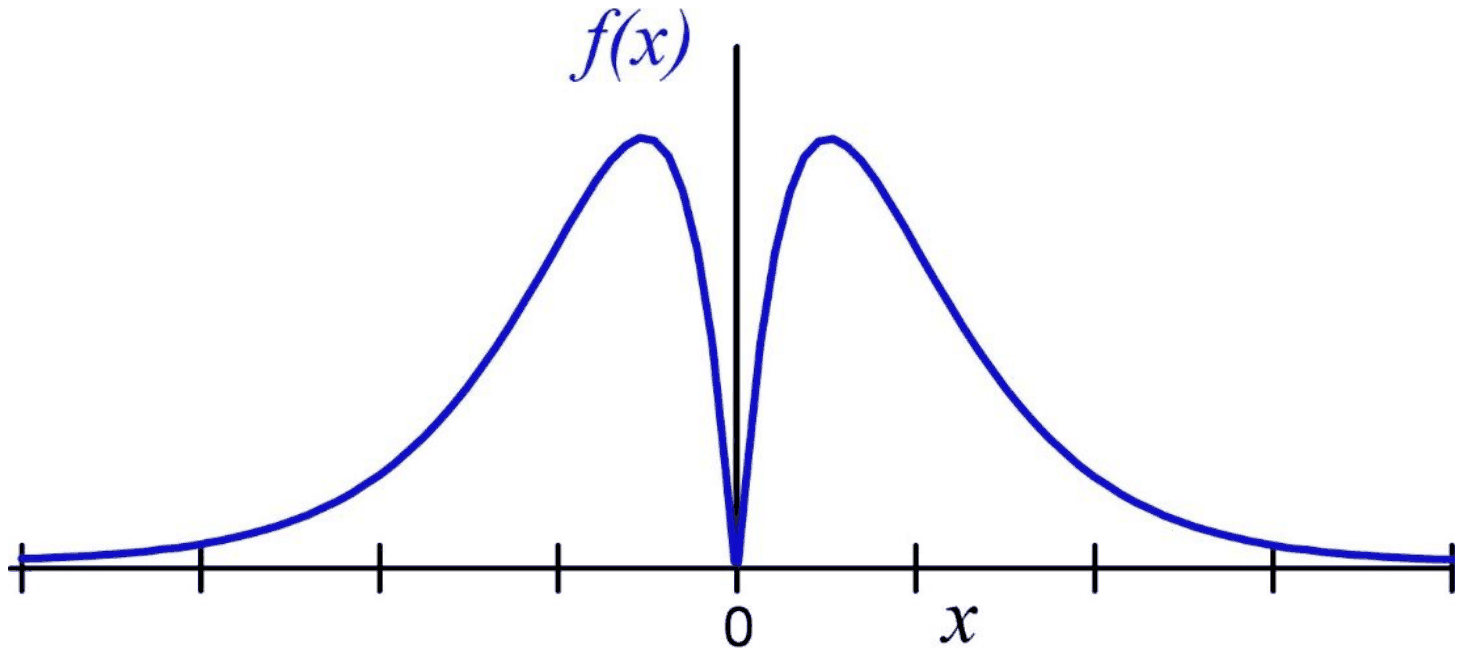
Which one of the following options represents the given graph?

Graph of f(x): zero at x = 0 with a sharp dip there, rising to two equal peaks on either side and falling towards zero as x goes to plus or minus infinity; the curve is symmetric about the f(x) axis and never negative

Exam Year(s)

GATE Chemistry - 2023,

Answer: A

The graph is \(f(x) = x^{2}\,2^{-|x|}\).

Read three features from the graph: it is symmetric about the vertical axis (an even function), it is never negative and touches zero at \(x = 0\), and it decays to zero on both sides.

\(x^{2}\,2^{-|x|}\) has all three: \(x^{2}\) and \(|x|\) are both even, the product is non-negative and zero at the origin, and \(2^{-|x|}\) makes it vanish as \(|x|\) grows, with peaks in between.

\(x\,2^{-|x|}\) is odd, so it would be negative for \(x \lt 0\). \(|x|\,2^{-x}\) and \(x\,2^{-x}\) contain \(2^{-x}\), which grows without bound as x becomes large and negative, so they cannot fall back to zero on the left. Only the first option fits.

Please log in or register to report this question.

56.

Weight of a person can be expressed as a function of their age. The function usually varies from person to person. Suppose this function is identical for two brothers, and it monotonically increases till the age of 50 years and then it monotonically decreases. Let \(a_1\) and \(a_2\) (in years) denote the ages of the brothers and \(a_1 \lt a_2\).

Which one of the following statements is correct about their age on the day when they attain the same weight?

Exam Year(s)

GATE Chemistry - 2025,

Answer: B

The correct statement is \(a_1 \lt 50 \lt a_2\).

Both brothers follow the same weight function w, which is strictly increasing up to 50 and strictly decreasing after. If both ages were below 50, \(a_1 \lt a_2\) would give \(w(a_1) \lt w(a_2)\); if both were above 50, it would give \(w(a_1) \gt w(a_2)\). Either way the weights differ.

Equal weights at different ages are only possible when the ages lie on opposite sides of the peak, one rising and one falling. If one of them were exactly 50 he would be at the unique maximum, which the other, at a different age, cannot match. So the younger brother is under 50 and the elder over 50.

Please log in or register to report this question.
57.

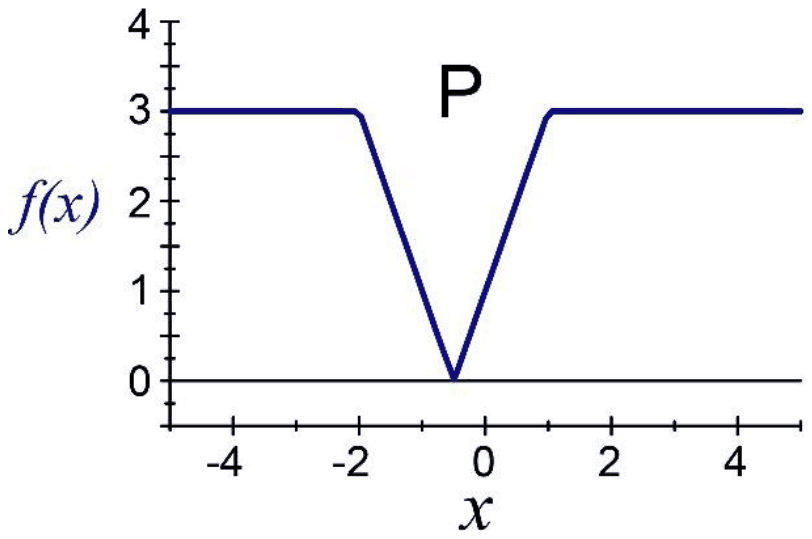
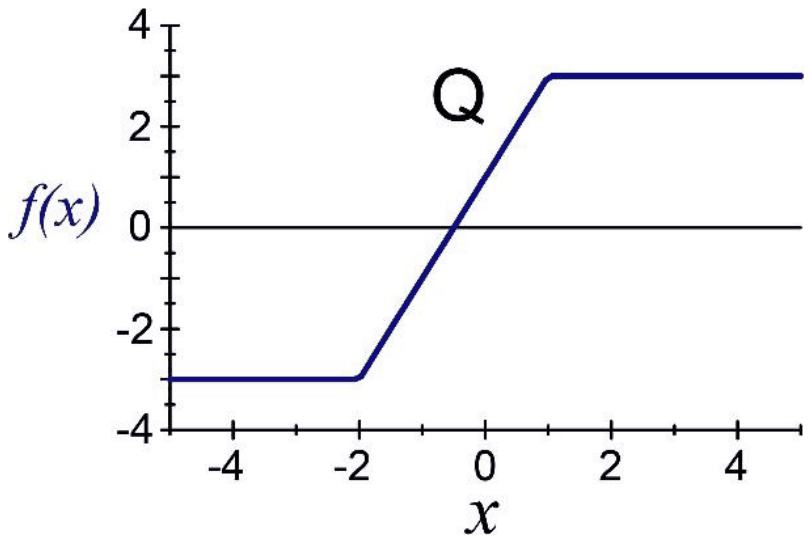
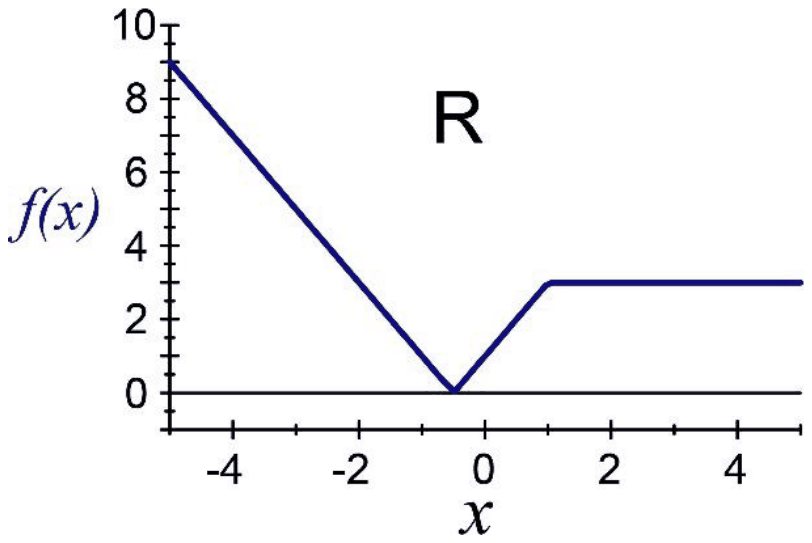
Which one of the given figures P, Q, R and S represents the graph of the following function?

\[ f(x) = \big|\,|x+2| - |x-1|\,\big| \]

Exam Year(s)

GATE Mathematics - 2023,

Answer: A

The graph is P.

Work out \(g(x) = |x+2| - |x-1|\) on the three intervals set by x = -2 and x = 1:

\[ \begin{aligned} x \le -2:&\quad g = -(x+2)+(x-1) = -3 \\ -2 \le x \le 1:&\quad g = (x+2)+(x-1) = 2x+1 \\ x \ge 1:&\quad g = (x+2)-(x-1) = 3 \end{aligned} \]

Taking the absolute value, f is 3 for x up to -2, falls along |2x + 1| to 0 at x = -1/2, rises back to 3 at x = 1, and stays at 3. That is graph P.

Q is the graph of g itself, without the outer absolute value. R and S rise without bound to the left, which f cannot do, since it never exceeds 3.

Please log in or register to report this question.

58.

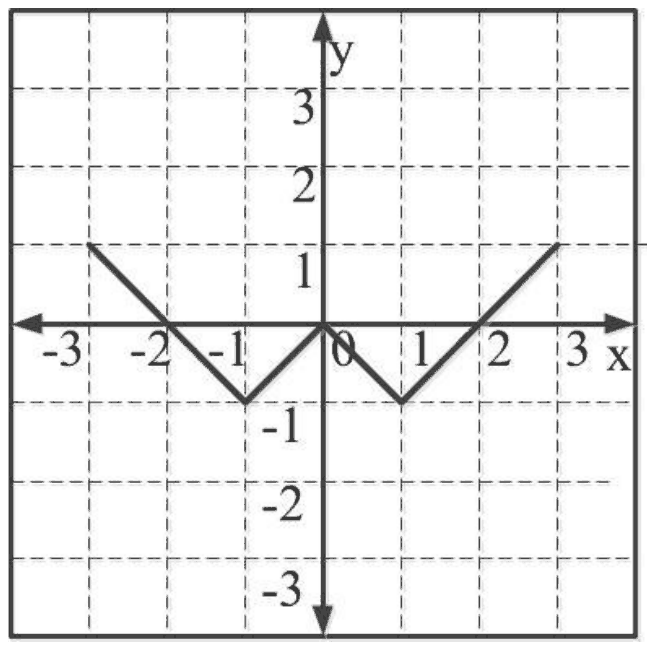
Which of the following functions describe the graph shown in the below figure?

W-shaped graph on a grid from -3 to 3: y = 1 at x = -3 and x = 3, y = 0 at x = -2, 0 and 2, and y = -1 at x = -1 and x = 1, joined by straight lines

Exam Year(s)

GATE ME - 2018,

Answer: B

The graph is \(y = ||x| - 1| - 1\).

Check the plotted points. At x = 0: |0 - 1| - 1 = 0. At x = ±1: |1 - 1| - 1 = -1. At x = ±2: |2 - 1| - 1 = 0. At x = ±3: |3 - 1| - 1 = 1. These are exactly the corners and ends of the W in the figure, and the function is linear between them.

\(y = ||x| + 1| - 2\) gives -1 at x = 0, and \(y = ||x| + 1| - 1\) gives 0 at x = 0 but then rises steadily with no dips. \(y = ||x - 1| - 1|\) is never negative, while the graph dips to -1.

Please log in or register to report this question.

59.

Which one of the following is a representation (not to scale and in bold) of all values of \(x\) satisfying the inequality \(2 - 5x \le -\dfrac{6x-5}{3}\) on the real number line?

Exam Year(s)

GATE ME - 2022,

Answer: C

The solution set is \(x \ge \tfrac{1}{9}\), which is number line (C): a filled dot just to the right of 0 with the bold ray running to the right.

Multiply both sides by 3 (a positive number, so the sign is kept) and collect terms:

\[ \begin{aligned} 3(2 - 5x) &\le -(6x - 5) \\ 6 - 15x &\le -6x + 5 \\ 1 &\le 9x \\ x &\ge \tfrac{1}{9} \end{aligned} \]

The boundary 1/9 is included (the sign is 'less than or equal to'), so the dot is filled, and it lies a little to the right of 0.

Line (A) shows \(x \le 1/9\), the inequality reversed. Line (B) starts at a negative number, as if the boundary were \(-1/9\). Line (D) shows two separate rays, which a linear inequality can never produce.

Please log in or register to report this question.

60.

If \(f(x) = 2\ln\left(\sqrt{e^{x}}\right)\), what is the area bounded by \(f(x)\) for the interval [0, 2] on the \(x\)-axis?

Exam Year(s)

GATE ME - 2022,

Answer: C

The area is 2.

Simplify the function first. Since \(\sqrt{e^{x}} = e^{x/2}\),

\[ \begin{aligned} f(x) &= 2\ln\left(e^{x/2}\right) \\ &= 2 \cdot \frac{x}{2} = x \end{aligned} \]

So the region is the triangle under the line \(y = x\) between \(x = 0\) and \(x = 2\):

\[ \int_{0}^{2} x\,dx = \frac{x^{2}}{2}\Big|_{0}^{2} = 2 \]

Dropping the factor 2 in front of the logarithm gives \(f(x) = x/2\) and an area of 1, and halving once more gives 1/2. 4 is \(x^{2}\) at \(x = 2\), the antiderivative without its division by 2.

Please log in or register to report this question.

Loading…

Other Subjects

Tags: Algebra Questions and Answers || Algebra MCQ Questions and Answers || Algebra GK Questions and Answers || Algebra GK MCQ Questions || Algebra Multiple Choice Questions and Answers || Algebra GK || GK on Algebra || Quantitative Aptitude Questions and Answers || Quantitative Aptitude MCQ Questions and Answers || Quantitative Aptitude GK Questions and Answers || GK on Quantitative Aptitude