
Machine-translated by Google. Questions are authored in English.
Top

Identification of Bacteria Questions and Answers

1.

Bergey's Manual of Systematic Bacteriology groups bacteria into species according to their

Exam Year(s)

GATE Life Sciences - 2012,

Answer: B

The Manual groups bacteria by phylogenetic relationships.

The second edition of Bergey's Manual of Systematic Bacteriology arranges prokaryotes in a phylogenetic framework built mainly on 16S rRNA sequence comparisons, so that taxa reflect evolutionary relatedness.

Nutritional requirements, pathogenic properties and morphology are phenotypic characters. They are still used to describe and identify organisms (Bergey's Manual of Determinative Bacteriology relies on them), but they are not the basis of the classification in the Systematic manual.

Please log in or register to report this question.
2.

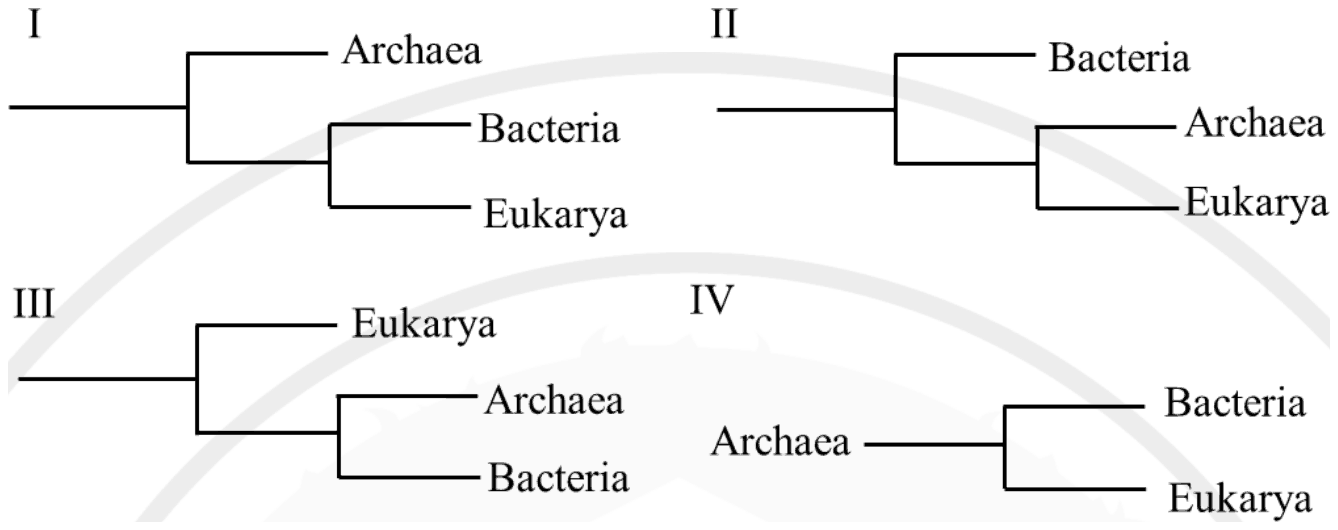
Carl Woese established that short subunit rRNA sequences can be used to reveal evolutionary relationships between various organisms. Based on this, which one of the following options is the established phylogenetic arrangement of the three domains of life?

Four trees. I: Archaea branches first, Bacteria and Eukarya are sisters. II: Bacteria branches first, Archaea and Eukarya are sisters. III: Eukarya branches first, Archaea and Bacteria are sisters. IV: Archaea leads to a node splitting Bacteria and Eukarya

Exam Year(s)

GATE Life Sciences - 2025,

Answer: C

The established arrangement is tree II: Bacteria branch off first, and Archaea and Eukarya are sister groups.

Comparing small-subunit rRNA sequences, Woese showed that the prokaryotes formed two deeply separate groups, Bacteria and Archaea, and proposed the three domains in 1990. Rooting the tree with pairs of genes that duplicated before the last common ancestor places the root on the bacterial branch, so Archaea share a more recent common ancestor with Eukarya than with Bacteria. Archaea resemble eukaryotes in their transcription and translation machinery, including histone-like proteins and similar RNA polymerases.

Tree I makes Bacteria and Eukarya the sister groups, tree III pairs Archaea with Bacteria (the old prokaryote grouping that Woese overturned), and tree IV draws Archaea as the ancestor of the other two, which the rRNA data do not show.

Please log in or register to report this question.

3.

Which one of the following statements about microbiological stains is CORRECT?

Exam Year(s)

GATE Life Sciences - 2026,

Answer: D

The correct statement is India ink is used to visualize capsules.

India ink is a negative stain: its carbon particles colour the background but cannot enter the polysaccharide capsule, which shows as a clear halo around each cell, as with Cryptococcus neoformans.

The acid-fast (Ziehl-Neelsen) stain uses a primary stain, a decolouriser and a counterstain, so it is a differential stain, not a simple one. Endospores resist the Gram stain and need a dedicated spore stain such as the Schaeffer-Fulton method with malachite green. Methylene blue is a basic (cationic) dye, which is why it binds the negatively charged surface of bacterial cells.

Please log in or register to report this question.

4.

Which one of the following options correctly matches the microbial names in Column I with their corresponding sources of epithet in Column II?

Column IColumn II
(P) Klebsiella pneumoniae(i) causes stupor in mice
(Q) Penicillium chrysogenum(ii) forms pus
(R) Salmonella typhimurium(iii) the disease it causes
(S) Streptococcus pyogenes(iv) produces a yellow pigment

Exam Year(s)

GATE Life Sciences - 2026,

Answer: C

The correct matching is R-i; S-ii; P-iii; Q-iv.

  • Salmonella typhimurium: from typhus (Greek typhos, stupor) and murium, of mice, because it causes a typhoid-like illness in mice (i).
  • Streptococcus pyogenes: pyogenes means pus-forming (ii).
  • Klebsiella pneumoniae: named after the disease it causes, pneumonia (iii).
  • Penicillium chrysogenum: chrysogenum means producing gold, for the yellow pigment it secretes (iv).

Each wrong option pairs at least one epithet with an unrelated meaning, for example pneumoniae with stupor in mice or chrysogenum with pus.

Please log in or register to report this question.

5.

Which test is used to differentiate the members of Enterobacteriaceae?

Exam Year(s)

RSMSSB - 2025, RSMSSB Lab Technician - 2025,

Answer: D

The members of Enterobacteriaceae are differentiated by the IMViC test.

IMViC is a set of four biochemical tests: Indole, Methyl red, Voges-Proskauer and Citrate utilisation (the i is added for ease of saying). Their pattern separates the enteric bacteria, for example E. coli (++--) from Klebsiella and Enterobacter (--++).

The catalase test separates staphylococci from streptococci, and the coagulase test identifies Staphylococcus aureus. All Enterobacteriaceae are oxidase negative, so the oxidase test separates the family from organisms such as Pseudomonas but cannot tell its members apart.

Please log in or register to report this question.

6.

Widely used molecular characterisation technique for identification of different strains of bacteria is :

Exam Year(s)

MH SET - 2023, SET Exam - 2023,

Answer: C

The widely used technique is 16S ribosomal RNA genes analysis.

The 16S rRNA gene, about 1,500 base pairs long, is present in all bacteria and combines highly conserved regions, where universal PCR primers bind, with nine variable regions whose sequences differ between taxa. Sequencing it identifies bacteria, including ones that cannot be cultured, and Carl Woese used it to define the three domains of life.

5S rRNA is only about 120 nucleotides long and holds too little information to separate strains reliably. Serological typing depends on antibodies and is not a molecular sequence method. 'Total mRNA genes analysis' is not an identification method; mRNA content varies with growth conditions.

Please log in or register to report this question.

Loading…

Other Subjects

Tags: Identification of Bacteria Questions and Answers || Identification of Bacteria MCQ Questions and Answers || Identification of Bacteria GK Questions and Answers || Identification of Bacteria GK MCQ Questions || Identification of Bacteria Multiple Choice Questions and Answers || Identification of Bacteria GK || GK on Identification of Bacteria || Microbiology Questions and Answers || Microbiology MCQ Questions and Answers || Microbiology GK Questions and Answers || GK on Microbiology