
Machine-translated by Google. Questions are authored in English.
Top

Network Topology Questions and Answers

1.

Find the number of branches and nodes in the given circuit
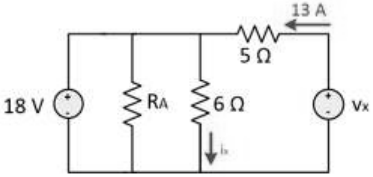
Circuit: an 18 V source, a resistor RA and a 6 ohm resistor (carrying current ix) in parallel on the left; a 5 ohm resistor carrying 13 A in the top wire to a voltage source Vx on the right

Exam Year(s)

DSSSB AE - 2023,

Answer: B

In circuit theory a branch is a single element (or a series group of elements carrying the same current) between two nodes, and a node is a point where two or more elements join. Reading the figure: the bottom wire is one node, the top left wire where the 18 V source, \(R_A\) and the 6 ohm resistor meet is a second node, and the junction between the 5 ohm resistor and the source \(V_x\) is a third. So there are three nodes.


The elements are the 18 V source, \(R_A\), the 6 ohm resistor, the 5 ohm resistor and \(V_x\), five elements, each in its own branch, so there are five branches. The count is 5 branches and 3 nodes, option B.

Please log in or register to report this question.
2.

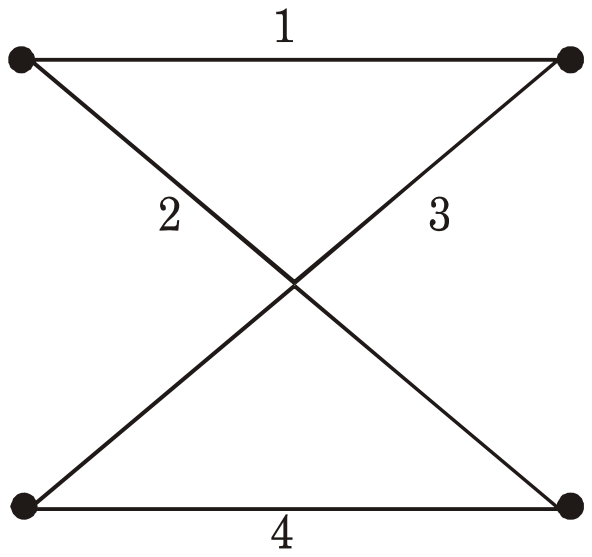
In the graph shown in the following figure, the number of trees (P) and the number of cut sets (Q) are :

Four nodes at the corners of a rectangle; branch 1 joins the top two, branch 4 the bottom two, and branches 2 and 3 are crossing diagonals with no node where they cross

Exam Year(s)

MH SET - 2018, SET Exam - 2018,

Answer: C

The graph has P = 4 trees and Q = 6 cut sets.

The two diagonals cross without a node, so the graph has 4 nodes and 4 branches. Tracing it: top left to top right (1), top right to bottom left (3), bottom left to bottom right (4), and bottom right back to top left (2). It is a single closed loop of four branches.

A tree joins all 4 nodes with 4 - 1 = 3 branches and no loop. Removing any one of the four branches leaves such a tree, so there are 4 trees.

A cut set is a minimal set of branches whose removal splits the graph into two parts. In a single loop, removing one branch leaves it connected, but removing any two branches separates it, so every pair is a cut set: \(\binom{4}{2} = 6\).

Please log in or register to report this question.

3.

If a network contains B branches and N nodes, then the number of mesh current equations would be :

Exam Year(s)

MH SET - 2019, SET Exam - 2019,

Answer: A

The number of mesh equations is B − (N − 1).

For a connected planar network, the number of independent loops (meshes) equals the number of links, the branches not in a tree. A tree joining N nodes has N − 1 branches, so:

\[ \begin{aligned} \text{meshes} &= B - (N - 1) \\ &= B - N + 1 \end{aligned} \]

For example, a network with 5 branches and 4 nodes needs 2 mesh equations. N − 1 itself is the number of independent node equations. B − N − 1 has the wrong sign on the 1, and the other two forms have no basis in network topology.

Please log in or register to report this question.

4.

A network has 10 nodes and 17 branches. The number of different node pair voltages would be :

Exam Year(s)

MH SET - 2021, SET Exam - 2021,

Answer: C

The number of node pair voltages is 45.

A node pair voltage is the voltage between any two nodes, so the count is the number of ways of choosing 2 nodes out of 10:

\[ \binom{10}{2} = \frac{10 \times 9}{2} = 45 \]

The number of branches does not enter this count. It matters for other quantities: the number of independent loops is b - n + 1 = 17 - 10 + 1 = 8, and the number of independent node voltages is n - 1 = 9. Seven is b - n, 17 is the branch count, and 50 does not follow from either figure.

Please log in or register to report this question.

Loading…

Other Subjects

Tags: Network Topology Questions and Answers || Network Topology MCQ Questions and Answers || Network Topology GK Questions and Answers || Network Topology GK MCQ Questions || Network Topology Multiple Choice Questions and Answers || Network Topology GK || GK on Network Topology || Network Analysis Questions and Answers || Network Analysis MCQ Questions and Answers || Network Analysis GK Questions and Answers || GK on Network Analysis