
Machine-translated by Google. Questions are authored in English.
Top

Amino Acids and Proteins Questions and Answers

1.

A tripeptide on treatment with PhNCS (pH = 8.0) followed by heating with dilute HCl afforded a cyclic compound M and a dipeptide. The dipeptide on treatment with PhNCS (pH = 8.0) followed by heating with dilute HCl afforded a cyclic compound N and an acyclic compound O. The CORRECT sequence (from N- to C-terminus) of the tripeptide is
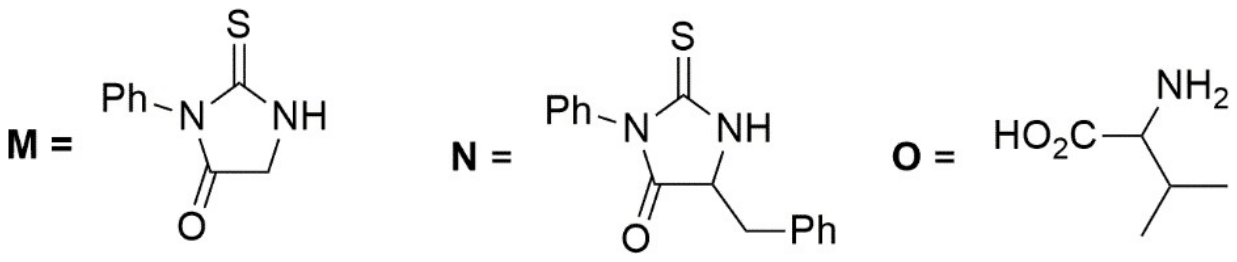
Structures: M is 3-phenyl-2-thioxoimidazolidin-4-one; N is the same ring with a benzyl group at C5; O is valine

Exam Year(s)

GATE Chemistry - 2022,

Answer: A

The tripeptide is glycine-phenylalanine-valine.

PhNCS at pH 8 followed by heating in dilute acid is the Edman degradation: it removes the N-terminal residue as a cyclic phenylthiohydantoin (PTH) and leaves the rest of the chain intact.

M is the PTH with no side chain at C5, so the first residue is glycine. N carries a benzyl group (CH2Ph) at C5, so the second residue is phenylalanine. O is the free amino acid left over, 2-amino-3-methylbutanoic acid, which is valine, the C-terminal residue.

Valine-phenylalanine-glycine reverses the order. Tyrosine would give a PTH with a 4-hydroxybenzyl group, and alanine would be left as a 2-aminopropanoic acid, so those options do not match N and O.

Please log in or register to report this question.
2.

Four proteins (P1, P2, P3 and P4) have 17, 10, 21 and 14 percent hydrophobic amino-acids respectively. The order of precipitation of these proteins using ammonium sulphate will be

Exam Year(s)

GATE Life Sciences - 2012,

Answer: A

The order of precipitation is P3, P1, P4, P2.

Ammonium sulphate precipitates proteins by 'salting out': as the salt concentration rises, the salt ions take up the water that was hydrating the protein surface, and exposed hydrophobic patches on neighbouring protein molecules begin to stick together. The more hydrophobic a protein, the less salt is needed before it aggregates.

Taking the hydrophobic content as the guide, the most hydrophobic protein precipitates first: P3 (21%), then P1 (17%), P4 (14%) and finally P2 (10%). The orders starting with P2 run from least to most hydrophobic, which is backwards, and P3, P1, P2, P4 puts P2 ahead of the more hydrophobic P4.

Please log in or register to report this question.
3.

An amino-acid has one proton donating group in the side chain (R). The pKCOOH, pKNH2 and pKR values for this amino-acid are 2.19, 9.67 and 4.25, respectively. Which one of the following statements about this amino-acid is CORRECT?

Exam Year(s)

GATE Life Sciences - 2012,

Answer: A

The correct statement is Majority of the molecules will have a net charge of -1 at pH of 7.0.

The values describe an acidic amino acid such as glutamate. At pH 7.0 the α-carboxyl (pK 2.19) and the side-chain carboxyl (pK 4.25) are both well below the pH, so both are deprotonated (-1 each), while the amino group (pK 9.67) is protonated (+1). Net charge = -1 + -1 + 1 = -1.

At pH 4.25 the side chain is exactly half dissociated, so half the molecules are 0 and half -1, not a majority at 0. pH 3.22 is the isoelectric point, \((2.19 + 4.25)/2\), where the side chain is still mostly protonated, so 'all deprotonated' is wrong. On titration with base, the group with the lowest pK, the α-COOH, loses its proton first, not the R group.

Please log in or register to report this question.
4.

A mixture of four peptides, PKKRK, RGERV, RYRGV and LVVYP, is loaded onto an ion-exchange column at pH = 7.2. If carboxymethyl (CM) cellulose is used as the stationary phase of this column, then which peptide elutes first?

Exam Year(s)

GATE Life Sciences - 2023,

Answer: D

The first peptide to elute is LVVYP.

Carboxymethyl cellulose carries negatively charged carboxylate groups at pH 7.2, so it is a cation exchanger: positively charged peptides bind, and the least positive peptide passes through first.

At pH 7.2 lysine (K) and arginine (R) side chains are positive, glutamate (E) is negative, and the free amino and carboxyl termini cancel. PKKRK carries about +4, RYRGV about +2, and RGERV about +1, so all three are retained. LVVYP has no charged side chains, a net charge of about zero, so it does not bind and elutes first.

Please log in or register to report this question.
5.

Which one of the following amino acids has more than two acid-base groups?

Exam Year(s)

GATE Life Sciences - 2023,

Answer: D

The amino acid is tyrosine.

Every amino acid has two ionisable groups on its backbone, the \(\alpha\)-carboxyl and the \(\alpha\)-amino group. Tyrosine also has an ionisable side chain: the phenolic hydroxyl, which loses a proton with a pKa of about 10. So it has three acid-base groups.

Alanine (methyl), leucine (isobutyl) and phenylalanine (benzyl) have non-polar side chains with no ionisable group, so each has only the two backbone groups. Phenylalanine is the closest trap, since it differs from tyrosine only by lacking that hydroxyl.

Please log in or register to report this question.

6.

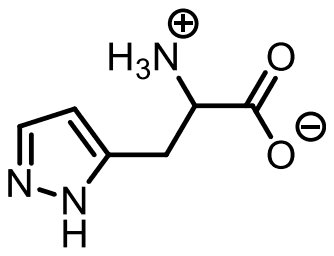
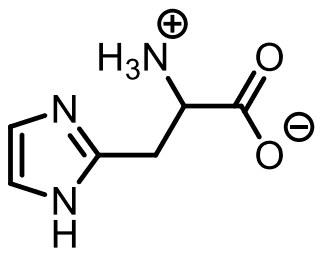
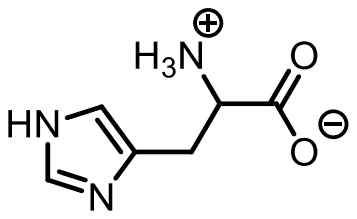
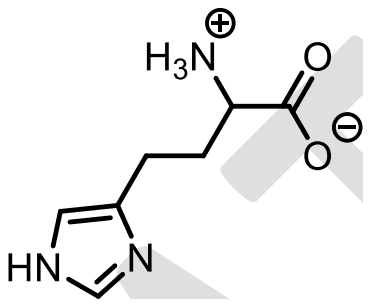
Among the following, the structure representing histidine is

Exam Year(s)

GATE Life Sciences - 2024,

Answer: C

Histidine is structure (C).

Histidine is an alpha-amino acid whose side chain is a CH2 attached to C4 of an imidazole ring, a five-membered ring with nitrogens at positions 1 and 3. (C) shows the zwitterion with exactly that: one CH2 linking the alpha carbon to the imidazol-4-yl ring.

(A) has a pyrazole ring, with its two nitrogens adjacent. (B) attaches the imidazole through C2, the carbon between the two nitrogens. (D) has the right ring but a two-carbon linker, one CH2 too many (homohistidine).

Please log in or register to report this question.

7.

Which one of the following pairs of amino acids is NOT incorporated in a polypeptide chain?

Exam Year(s)

GATE Life Sciences - 2024,

Answer: C

The pair not found in polypeptide chains is ornithine and citrulline.

Ornithine and citrulline are intermediates of the urea cycle. They have no codons and no tRNAs, and they occur as free metabolites rather than as residues of proteins.

The other pairs are residues that do occur in polypeptide chains, created by modifying amino acids after they are built in. 4-Hydroxyproline and 5-hydroxylysine are formed in collagen by vitamin C dependent hydroxylases. γ-Carboxyglutamate is formed in clotting factors such as prothrombin by vitamin K dependent carboxylation. Desmosine is the cross-link formed from four lysine side chains in elastin.

Please log in or register to report this question.

8.

Metabolic intermediates provide the backbone for the synthesis of amino acids. Match the metabolic intermediates listed in Column I with their corresponding amino acids given in Column II.

Column IColumn II
P. α-Ketoglutaratei. Histidine
Q. Ribose 5-phosphateii. Glutamate
R. 3-Phosphoglycerateiii. Aspartate
S. Phosphoenolpyruvateiv. Phenylalanine
v. Serine

Exam Year(s)

GATE Life Sciences - 2024,

Answer: A

The correct match is P-ii; Q-i; R-v; S-iv.

  • α-Ketoglutarate is transaminated or reductively aminated to glutamate.
  • Ribose 5-phosphate, as PRPP, supplies the carbon backbone of histidine.
  • 3-Phosphoglycerate is oxidised and transaminated to serine.
  • Phosphoenolpyruvate, with erythrose 4-phosphate, enters the shikimate pathway to phenylalanine.

Aspartate (iii) is made from oxaloacetate, which is not in Column I, so it is the spare. The last option sends 3-phosphoglycerate to phenylalanine and PEP to serine, the reverse of the two pathways.

Please log in or register to report this question.

9.

Which one of the following is the correct match between the molecular properties listed in Column I and the corresponding biochemical separation methods in Column II?

Column IColumn II
P. Solubilityi. Reverse phase chromatography
Q. Ionic chargeii. Ultracentrifugation
R. Polarityiii. Salting out
S. Molecular sizeiv. Isoelectric focusing
v. Gel electrophoresis

Exam Year(s)

GATE Life Sciences - 2024,

Answer: C

The correct match is P-iii; Q-iv; R-i; S-ii.

  • Solubility: salting out with ammonium sulfate precipitates proteins at different salt concentrations according to their solubility.
  • Ionic charge: isoelectric focusing separates proteins by their isoelectric point in a pH gradient.
  • Polarity: reverse phase chromatography retains molecules on a non-polar stationary phase according to their hydrophobicity.
  • Molecular size: ultracentrifugation separates by sedimentation, which depends on size and mass.

Gel electrophoresis (v) also depends on size and charge, but only one option has the first three pairs right, and it uses ultracentrifugation for size.

Please log in or register to report this question.

10.

Upon hydrolysis of the pentapeptide Glu-Arg-Gly-Phe-Ala (represented from N- to C- terminus) with trypsin, the peptide fragments obtained are

Exam Year(s)

GATE Life Sciences - 2026,

Answer: A

Trypsin gives Glu-Arg and Gly-Phe-Ala.

Trypsin cuts on the carboxyl side of the basic residues lysine and arginine (unless the next residue is proline). In Glu-Arg-Gly-Phe-Ala the only basic residue is Arg at position 2, and it is followed by Gly, so the single cut falls between Arg and Gly.

Glu-Arg-Gly-Phe and Ala is a cut after Phe, which is chymotrypsin's preference for aromatic residues. Glu and Arg-Gly-Phe-Ala cuts on the wrong side of Arg. Glu-Arg-Gly and Phe-Ala cuts after Gly, which no common protease targets.

Please log in or register to report this question.

Loading…
Tags: Amino Acids and Proteins Questions and Answers || Amino Acids and Proteins MCQ Questions and Answers || Amino Acids and Proteins GK Questions and Answers || Amino Acids and Proteins GK MCQ Questions || Amino Acids and Proteins Multiple Choice Questions and Answers || Amino Acids and Proteins GK || GK on Amino Acids and Proteins || Biochemistry Questions and Answers || Biochemistry MCQ Questions and Answers || Biochemistry GK Questions and Answers || GK on Biochemistry