
Machine-translated by Google. Questions are authored in English.
Top

Enzymes and Enzyme Kinetics Questions and Answers

1.

10 micrograms of the enzyme carbonic anhydrase (molecular weight = 30,000 g/mole) removes 300 milligrams of carbon dioxide per minute from the cells. The turnover number of the enzyme is

Exam Year(s)

GATE Life Sciences - 2012,

Answer: B

The turnover number is \(2 \times 10^{7}\ \text{min}^{-1}\).

Turnover number is the number of substrate molecules converted per enzyme molecule per unit time, so work in moles of each:

\[ \begin{aligned} n_{\text{CO}_2} &= \frac{0.300\ \text{g}}{44\ \text{g/mol}} = 6.82 \times 10^{-3}\ \text{mol/min} \\ n_{E} &= \frac{10 \times 10^{-6}\ \text{g}}{30000\ \text{g/mol}} = 3.33 \times 10^{-10}\ \text{mol} \\ k_{cat} &= \frac{6.82 \times 10^{-3}}{3.33 \times 10^{-10}} \approx 2.0 \times 10^{7} \end{aligned} \]

Carbonic anhydrase is famously one of the fastest enzymes, so a value of order \(10^{7}\) per minute (about \(10^{5}\) to \(10^{6}\) per second) is expected. The two \(10^{10}\) values are a thousand or more times too large, the size of error a microgram-milligram slip produces, and 20 per minute is far too slow for this enzyme.

Please log in or register to report this question.
2.

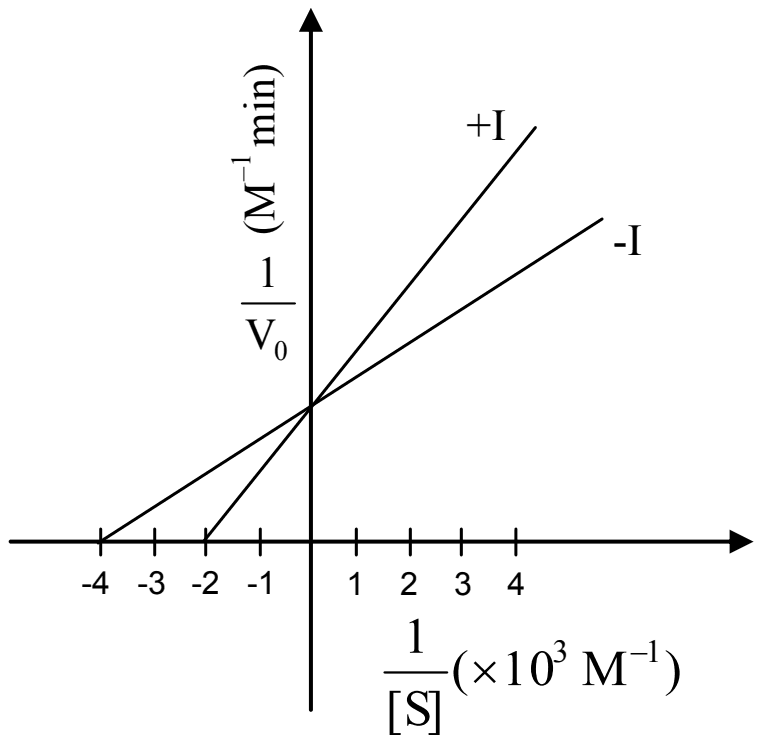
The kinetics of an enzyme in the presence (+I) or absence (-I) of a reversible inhibitor is described in the following graph.

Double reciprocal plot of 1/V0 against 1/[S] in units of 10^3 per M: the -I and +I lines meet on the 1/V0 axis; the -I line cuts the 1/[S] axis at -4 and the +I line at -2

If concentration of the reversible inhibitor in +I experiment was equal to 3.0 × 10⁻³ M, then the dissociation constant for the enzyme-inhibitor complex is

Exam Year(s)

GATE Life Sciences - 2012,

Answer: C

The dissociation constant is \(3 \times 10^{-3}\) M.

Both lines meet on the 1/V0 axis, so Vmax is unchanged and the inhibition is competitive. The x intercepts give \(-1/K_{m}\):

\[ \begin{aligned} K_{m} &= \frac{1}{4 \times 10^{3}} = 0.25\ \text{mM} \\ K_{m}^{app} &= \frac{1}{2 \times 10^{3}} = 0.50\ \text{mM} \end{aligned} \]

For competitive inhibition \(K_{m}^{app} = K_{m}(1 + [I]/K_{i})\):

\[ \begin{aligned} 1 + \frac{[I]}{K_{i}} &= 2 \\ K_{i} &= [I] = 3 \times 10^{-3}\ \text{M} \end{aligned} \]

Doubling Km means the inhibitor is present at exactly its Ki. \(1.5 \times 10^{-3}\) M would correspond to a threefold increase and is not offered; the other options do not fit the twofold shift read from the graph.

Please log in or register to report this question.
3.

The action of which class of enzyme inhibitors can be reversed by adding an excess of substrate?

Exam Year(s)

GATE Life Sciences - 2022,

Answer: B

The inhibition reversed by excess substrate is that of competitive inhibitors.

A competitive inhibitor binds the active site of the free enzyme, competing with the substrate. Raising the substrate concentration outcompetes it, so Vmax is still reached; only the apparent Km rises, by the factor 1 + [I]/Ki.

An uncompetitive inhibitor binds only the enzyme-substrate complex, so more substrate actually creates more of its target and both Vmax and Km fall. Allosteric (non-competitive) inhibitors bind elsewhere and lower Vmax whatever the substrate level. Non-specific inhibitors, such as denaturing agents, inactivate the enzyme and are not overcome by substrate.

Please log in or register to report this question.
4.

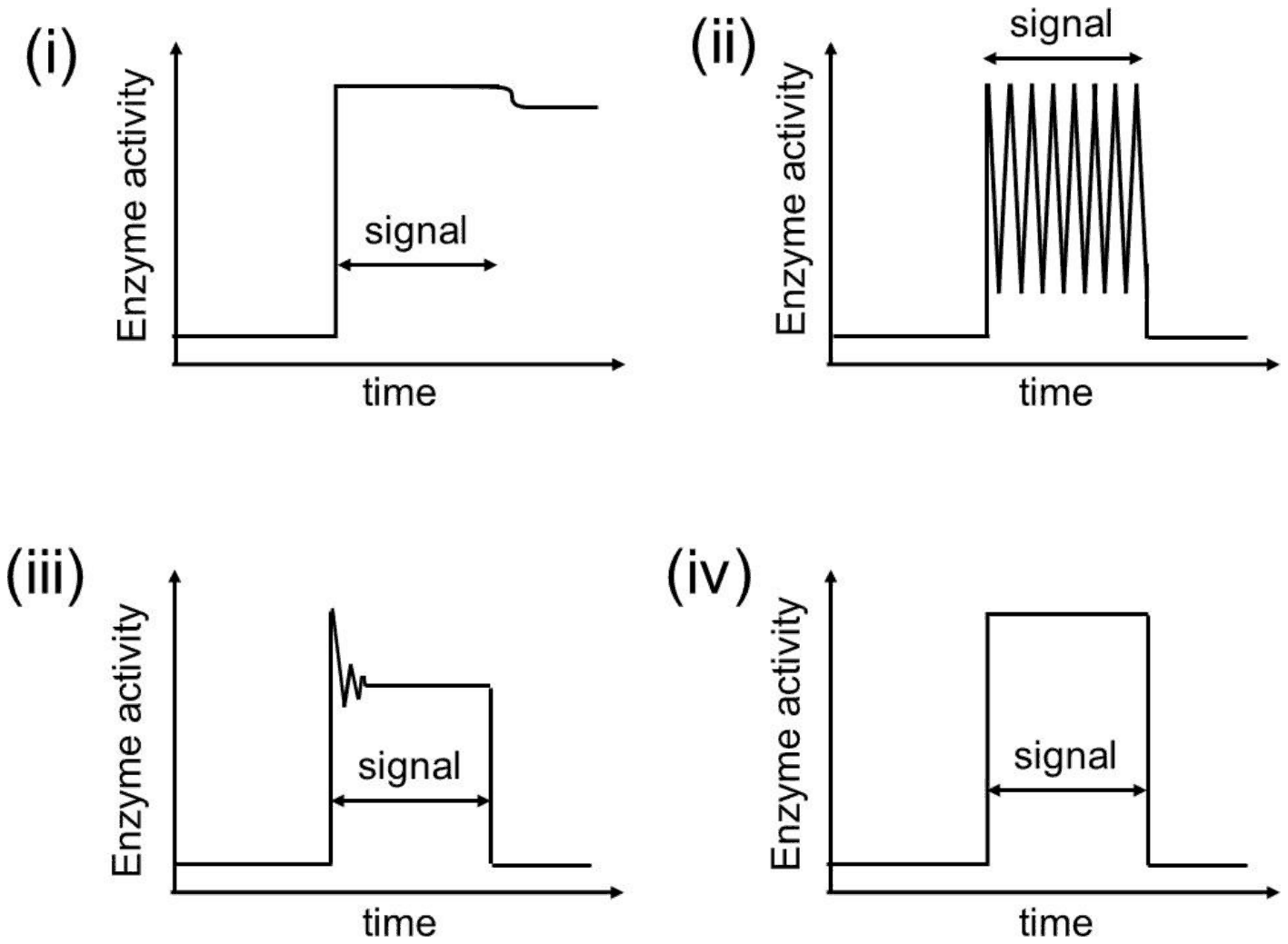
Enzyme activity profiles as a function of time in the absence or presence of different types of feedback mechanisms are shown in the figure below. Match the following feedback mechanisms with the corresponding profiles in the figure.

(p) No feedback mechanism
(q) Negative feedback mechanism with short delay
(r) Negative feedback mechanism with long delay
(s) Positive feedback mechanism

Four enzyme activity versus time plots: (i) stays high after the signal ends; (ii) oscillates during the signal; (iii) overshoots then settles until the signal ends; (iv) a square pulse matching the signal

Exam Year(s)

GATE Life Sciences - 2023,

Answer: B

The match is (p)-(iv); (q)-(iii); (r)-(ii); (s)-(i).

  • No feedback: activity simply follows the signal, a square pulse, profile (iv).
  • Negative feedback with a short delay: the activity overshoots, the feedback quickly pulls it back, and after a few damped wiggles it settles to a steady level until the signal ends, profile (iii).
  • Negative feedback with a long delay: the correction always arrives late, so the system keeps overshooting in both directions and oscillates for as long as the signal lasts, profile (ii).
  • Positive feedback: the active state reinforces itself, so the activity stays high even after the signal is removed, a switch with memory, profile (i).

The other options pair the damped and sustained oscillations the wrong way round, or give the memory curve to the system with no feedback.

Please log in or register to report this question.
5.

An enzyme-catalyzed conversion of a substrate at 298 K proceeds by a Michaelis-Menten mechanism. The Lineweaver-Burk plot for the analysis of the experimental data has an intercept along the y-axis of 0.357 mmol-1 dm3 s and a slope of 2.10 s. The CORRECT Michaelis constant for the reaction is ________ (rounded off to 2 decimal places).

Exam Year(s)

GATE Life Sciences - 2024,

Answer: A

The Michaelis constant is 5.88 mmol dm-3.

The Lineweaver-Burk equation is

\[ \begin{aligned} \frac{1}{v} &= \frac{K_M}{V_{max}} \cdot \frac{1}{[S]} \\ &+ \frac{1}{V_{max}} \end{aligned} \]

so the slope is \(K_M / V_{max}\) and the intercept is \(1/V_{max}\). Dividing removes \(V_{max}\):

\[ \begin{aligned} K_M &= \frac{\text{slope}}{\text{intercept}} = \frac{2.10}{0.357} \\ &= 5.88\ \text{mmol dm}^{-3} \end{aligned} \]

2.80 is \(1/0.357\), the value of \(V_{max}\), not \(K_M\). A Michaelis constant is a concentration, so the units with s-1 are wrong.

Please log in or register to report this question.
6.

Urease enzyme catalyzes the conversion of urea into ammonia and carbon dioxide. Which one of the following organisms expresses urease enzyme?

Exam Year(s)

GATE Life Sciences - 2024,

Answer: C

The organism that expresses urease is Helicobacter pylori.

H. pylori produces large amounts of urease. The ammonia it releases from urea neutralises gastric acid around the bacterium, letting it survive in the stomach and colonise the mucosa; the urea breath test for infection relies on this activity.

Humans, Drosophila and C. elegans do not make urease. Humans excrete urea as the end product of nitrogen metabolism, which is possible only because they cannot break it down.

Please log in or register to report this question.
Answer: C

A competitive inhibitor increases \(K_{m}\) but does not affect \(V_{max}\).

A competitive inhibitor binds the free enzyme at the active site, competing with the substrate. More substrate is needed to reach half-maximal velocity, so the apparent \(K_{m}\) rises by the factor \((1 + [I]/K_{i})\). At very high substrate concentration, however, the substrate outcompetes the inhibitor completely, so the maximal velocity is unchanged.

On a Lineweaver-Burk plot the lines therefore meet on the y-axis (same \(1/V_{max}\)). Lowering both \(K_{m}\) and \(V_{max}\) is the signature of uncompetitive inhibition; changing \(V_{max}\) at all rules out competitive inhibition, and a decrease in \(K_{m}\) never results from competition with the substrate.

Please log in or register to report this question.

8.

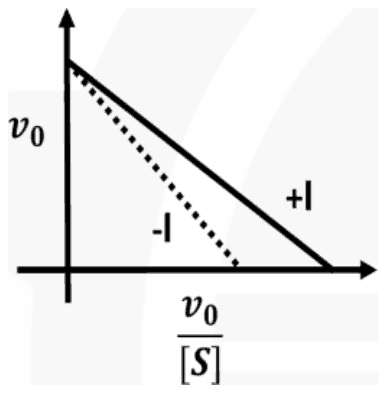
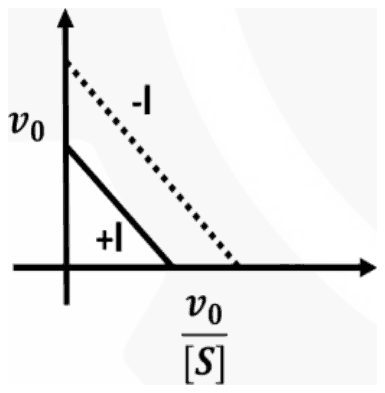
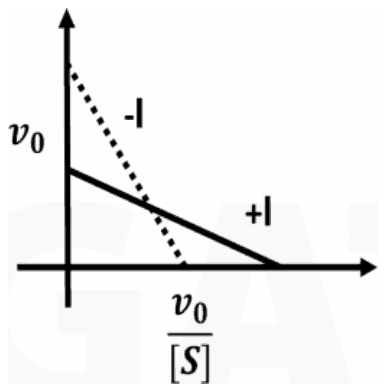
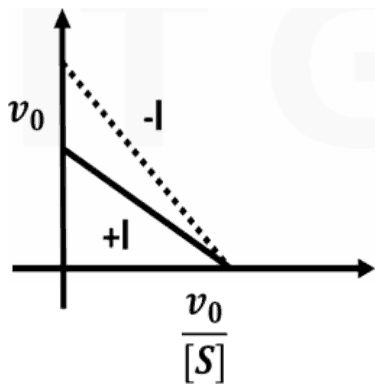
For a simple enzyme that follows Michaelis-Menten kinetics, kinetic data was collected in the absence (dotted line, -I), or presence (solid line, +I) of an uncompetitive inhibitor (I). Which one of the following Eadie-Hofstee plots best describes the expected result?

(\(v_{o}\) = initial velocity, [S] = free substrate concentration)

Exam Year(s)

GATE Life Sciences - 2026,

Answer: D

The expected Eadie-Hofstee plot is (D): the two lines meet on the x-axis, and the inhibited line is lower and less steep.

An Eadie-Hofstee plot graphs \(v_{0}\) against \(v_{0}/[S]\):

\[ v_{0} = V_{max} - K_{m}\frac{v_{0}}{[S]} \]

The y-intercept is \(V_{max}\), the slope is \(-K_{m}\) and the x-intercept is \(V_{max}/K_{m}\). An uncompetitive inhibitor binds only the enzyme-substrate complex and divides both \(V_{max}\) and \(K_{m}\) by the same factor. So the y-intercept falls, the line becomes less steep, and the x-intercept \(V_{max}/K_{m}\) stays where it was.

Plot (B) has parallel lines (same slope, so unchanged \(K_{m}\)), the pattern of a pure non-competitive inhibitor. Plot (A) keeps the y-intercept, as a competitive inhibitor would, but moves the x-intercept the wrong way. Plot (C) changes the x-intercept, so \(V_{max}/K_{m}\) is not conserved.

Please log in or register to report this question.

9.

Researchers measure the activity of an enzyme in the presence of an inhibitor. They observe that

  • Vmax of the enzyme remains unchanged at saturating substrate concentration
  • Km increases compared to uninhibited enzyme

Which type of inhibition is most consistent with these observations?

Exam Year(s)

GATE Life Sciences - 2026,

Answer: A

The observations fit competitive inhibition.

A competitive inhibitor binds the free enzyme at the active site, competing with the substrate. Adding more substrate outcompetes it, so at saturating substrate the enzyme still reaches the same Vmax. But more substrate is needed to reach half that rate, so the apparent Km increases.

Pure non-competitive inhibition lowers Vmax and leaves Km unchanged, because the inhibitor binds enzyme and enzyme-substrate complex equally. An irreversible inhibitor removes active enzyme, which also lowers Vmax. Substrate inhibition is a fall in rate at very high substrate concentration, which is not what was seen.

Please log in or register to report this question.

10.

In the feedback regulation of an enzyme, the end product binds to the

Exam Year(s)

IIT JAM - 2018,

Answer: B

The end product binds to the allosteric site of the enzyme.

In feedback inhibition, the final product of a pathway inhibits an enzyme near the start of the pathway. The product usually looks nothing like that enzyme's substrate, so it binds to a separate regulatory site, the allosteric site, and changes the enzyme's shape to lower its activity. An example is isoleucine inhibiting threonine deaminase.

Binding at the active site would be competitive inhibition by a substrate look-alike. The end product does not bind the enzyme-substrate complex or the substrate itself.

Please log in or register to report this question.

Loading…
Tags: Enzymes and Enzyme Kinetics Questions and Answers || Enzymes and Enzyme Kinetics MCQ Questions and Answers || Enzymes and Enzyme Kinetics GK Questions and Answers || Enzymes and Enzyme Kinetics GK MCQ Questions || Enzymes and Enzyme Kinetics Multiple Choice Questions and Answers || Enzymes and Enzyme Kinetics GK || GK on Enzymes and Enzyme Kinetics || Biochemistry Questions and Answers || Biochemistry MCQ Questions and Answers || Biochemistry GK Questions and Answers || GK on Biochemistry