
Machine-translated by Google. Questions are authored in English.
Top

Fluid Kinematics Questions and Answers

11.

If \(\psi\) is the stream function, the Laplace's equation \(\nabla^{2}\psi = 0\) is true when the flow is

Exam Year(s)

GATE XE - 2012,

Answer: B

\(\nabla^{2}\psi = 0\) holds when the flow is incompressible and irrotational.

A stream function exists for two-dimensional incompressible flow, because defining \(u = \partial\psi/\partial y\) and \(v = -\partial\psi/\partial x\) satisfies continuity automatically. Substituting these into the vorticity gives

\[ \begin{aligned} \omega_{z} &= \frac{\partial v}{\partial x} - \frac{\partial u}{\partial y} \\ &= -\nabla^{2}\psi \end{aligned} \]

so \(\nabla^{2}\psi = 0\) is exactly the condition of zero vorticity. Both conditions are needed: incompressibility for \(\psi\) to exist in this form, and irrotationality for it to satisfy Laplace's equation. Neither alone is enough, and compressible flow does not have this stream function.

Please log in or register to report this question.
12.

In the following equations, u and v are the velocities in the x- and y- directions, respectively and t is time. The flow field that CANNOT be termed as incompressible is

Exam Year(s)

GATE XE - 2012,

Answer: A

The flow that is not incompressible is \(u = x^{3} + xy^{2},\ v = y^{3} + yx^{2}\).

A two-dimensional flow is incompressible when its divergence vanishes, \(\partial u/\partial x + \partial v/\partial y = 0\). For this flow

\[ \begin{aligned} \nabla \cdot \vec{V} &= (3x^{2} + y^{2}) + (3y^{2} + x^{2}) \\ &= 4(x^{2} + y^{2}) \end{aligned} \]

which is not zero except at the origin.

The others pass: 10t - 10t = 0 for the second; in the third u depends only on y and v = 0, so both derivatives vanish; and in the fourth u = 2y, v = 2x give 0 + 0.

Please log in or register to report this question.
13.

In a two-dimensional, incompressible and irrotational flow, stream function (\(\psi = \psi(x, y)\)) and velocity potential (\(\phi = \phi(x, y)\)) exist. The velocities in \(x\) and \(y\) directions are non-zero.

The product of \(\left.\frac{dy}{dx}\right|_{\phi=\text{constant}}\) and \(\left.\frac{dy}{dx}\right|_{\psi=\text{constant}}\), is

Exam Year(s)

GATE XE - 2018,

Answer: A

The product is -1.

Along a line of constant \(\phi\), \(d\phi = u\,dx + v\,dy = 0\), so its slope is \(dy/dx = -u/v\). Along a streamline, \(d\psi = -v\,dx + u\,dy = 0\), so its slope is \(dy/dx = v/u\). Their product is

\[ \left(-\frac{u}{v}\right)\left(\frac{v}{u}\right) = -1 \]

which means the equipotential lines and streamlines cross at right angles everywhere (the flow net). The product would be 0 or infinite only where one velocity component vanished, which the question excludes, and +1 would mean the two families were parallel or mirror images, not orthogonal.

Please log in or register to report this question.

14.

The inviscid flow past a rotating circular cylinder can be generated by the superposition of

Exam Year(s)

GATE XE - 2018,

Answer: D

The flow is built from a uniform flow, a doublet and a vortex.

A uniform flow plus a doublet gives the potential flow past a stationary circular cylinder: the doublet's streamline of zero value is a closed circle. Adding a free vortex at the centre superposes a circulation around the cylinder without changing the circle as a streamline, which models the rotation and produces the Magnus lift (Kutta-Joukowski lift per unit length is ρUΓ).

Uniform flow and a doublet alone describe a non-rotating cylinder. A source or a sink with a uniform flow gives an open half-body, not a closed cylinder, so adding a vortex to them does not represent a rotating cylinder either.

Please log in or register to report this question.

15.

The velocity field and the surface normal vector are given by, \(\vec{V} = u\hat{i} + v\hat{j} + w\hat{k}\) and \(\vec{n} = n_{1}\hat{i} + n_{2}\hat{j} + n_{3}\hat{k}\), respectively. If Euler equations are to be solved, the boundary condition that must be satisfied at the wall is,

Exam Year(s)

GATE XE - 2018,

Answer: A

The wall condition is \(\vec{V} \cdot \vec{n} = 0\).

The Euler equations describe inviscid flow. Without viscosity the fluid can slip along a solid wall, so the only physical requirement is that it does not pass through it: the velocity component normal to the wall must vanish, \(\vec{V} \cdot \vec{n} = 0\) (the no-penetration or slip condition).

\(\vec{V} = 0\) is the no-slip condition, which belongs to the viscous Navier-Stokes equations and cannot be imposed on the lower-order Euler equations. \(\nabla \cdot \vec{V} = 0\) is the incompressibility condition throughout the field, not a boundary condition. \(\vec{V} \times \vec{n} = 0\) would force the flow to be perpendicular to the wall, the opposite of what an inviscid wall allows.

Please log in or register to report this question.

16.

If the stream function (\(\psi(x, y)\)) for a two-dimensional incompressible flow field is given as \(2y(x^{2} - y^{2})\), the corresponding velocity field is

Exam Year(s)

GATE XE - 2018,

Answer: B

The velocity field is \(\vec{V} = 2(x^{2} - 3y^{2})\hat{i} - 4xy\,\hat{j}\).

With \(\psi = 2x^{2}y - 2y^{3}\) and the usual convention \(u = \partial\psi/\partial y\), \(v = -\partial\psi/\partial x\):

\[ \begin{aligned} u &= 2x^{2} - 6y^{2} = 2(x^{2} - 3y^{2}) \\ v &= -4xy \end{aligned} \]

Check: \(\partial u/\partial x + \partial v/\partial y = 4x - 4x = 0\), so the flow is incompressible, as it must be. The option with \(+4xy\) has the wrong sign on v and fails this continuity check. The two options with \(2x^{2}y\) for u are just the stream function's first term, not its derivative.

Please log in or register to report this question.

17.

The velocity field in a two-dimensional, unsteady flow is given by \(\vec{V}(x, y, t) = 2xy^{2}\,\hat{i} + 3xyt\,\hat{j}\) m/s. The magnitude of acceleration of a fluid particle located at x = 1 m, y = 1 m at the time t = 1 s, in m/s2, is

Exam Year(s)

GATE XE - 2018,

Answer: C

The acceleration is 24.1 m/s2.

With \(u = 2xy^{2}\) and \(v = 3xyt\), the material acceleration is the local rate of change \(\partial \vec{V}/\partial t\) plus the convective terms \(u\,\partial\vec{V}/\partial x\) and \(v\,\partial\vec{V}/\partial y\). At \((1, 1, 1)\), \(u = 2\) and \(v = 3\):

\[ \begin{aligned} a_{x} &= 0 + u(2y^{2}) + v(4xy) = 4 + 12 = 16 \\ a_{y} &= 3xy + u(3yt) + v(3xt) = 3 + 6 + 9 = 18 \\ |a| &= \sqrt{16^{2} + 18^{2}} = \sqrt{580} = 24.1 \end{aligned} \]

16.0 and 18.1 are close to the two components on their own, and 34.1 adds them as if they were in the same direction.

Please log in or register to report this question.

18.

In a two-dimensional, incompressible and irrotational flow, fluid velocity (v) in the y-direction is given by \(v = 2x - 5y\). The velocity (u) in the x-direction is

Exam Year(s)

GATE XE - 2018,

Answer: C

The x-velocity is \(u = 5x + 2y\).

Incompressibility requires \(\partial u/\partial x + \partial v/\partial y = 0\). With \(v = 2x - 5y\), \(\partial v/\partial y = -5\), so \(\partial u/\partial x = 5\) and \(u = 5x + f(y)\).

Irrotationality requires \(\partial v/\partial x - \partial u/\partial y = 0\). Here \(\partial v/\partial x = 2\), so \(f'(y) = 2\) and \(f(y) = 2y\) (up to a constant). Hence \(u = 5x + 2y\).

\(u = 5x - 2y\) satisfies continuity but gives vorticity \(2 - (-2) = 4\). \(u = 2x \pm 5y\) gives \(\partial u/\partial x = 2\), which violates continuity.

Please log in or register to report this question.

19.

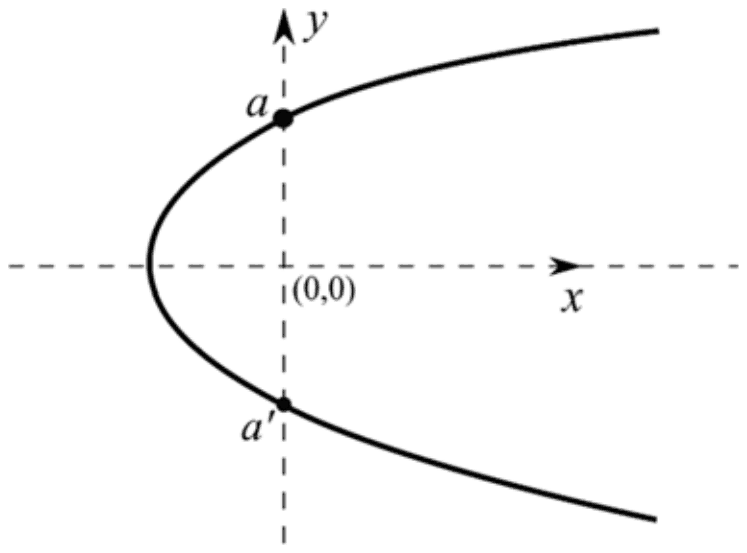
A two-dimensional flow field is described by a combination of a source of strength \(m\) at the origin and a uniform flow, \(U\), in the positive \(x\)-direction such that the velocity potential is given by

\[ \phi = Ux + \frac{m}{2\pi}\ln\sqrt{x^{2} + y^{2}} \]

The stagnation streamline is shown in the figure. Find the distance \(aa'\).

A half-body shaped stagnation streamline opening to the right, crossing the y-axis at a above the origin and at a' below it

Exam Year(s)

GATE XE - 2022,

Answer: D

The distance is \(aa' = \frac{m}{2U}\).

The matching stream function is \(\psi = Uy + \frac{m}{2\pi}\theta\). The stagnation point lies on the negative x-axis (\(\theta = \pi\)), so the stagnation streamline is \(\psi = m/2\). Where it crosses the y-axis, \(\theta = \pi/2\):

\[ \begin{aligned} Uy + \frac{m}{2\pi}\cdot\frac{\pi}{2} &= \frac{m}{2} \\ Uy &= \frac{m}{4},\quad y = \frac{m}{4U} \end{aligned} \]

By symmetry \(a'\) is at \(-m/(4U)\), so \(aa' = m/(2U)\). \(m/U\) is the full width of the half-body far downstream, where the streamline becomes parallel to the x-axis, and \(2m/U\) and \(8m/U\) come from mixing up the factors of \(2\pi\).

Please log in or register to report this question.

20.

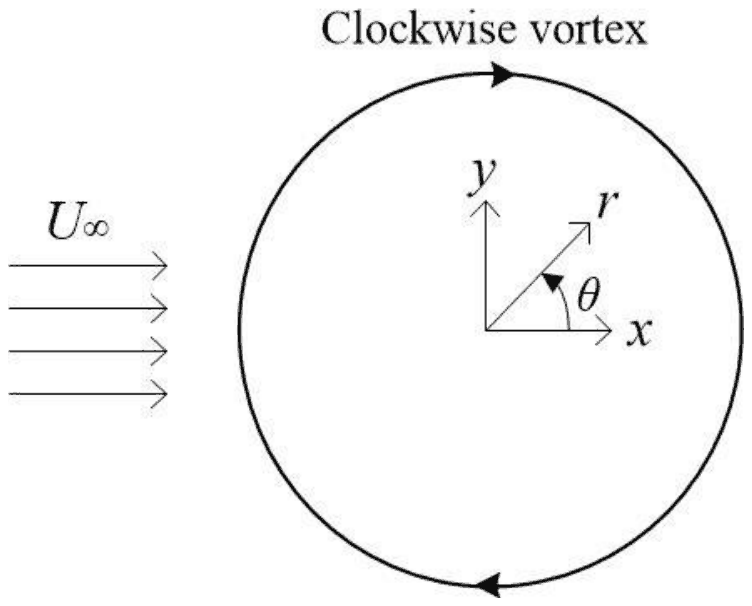
An inviscid steady incompressible flow is formed by combining a uniform flow with velocity \(U_{\infty}\) and a clockwise vortex of strength \(K\) at the origin, as shown in the figure. Velocity potential (\(\phi\)) for the combined flow in polar coordinate \((r, \theta)\) is

A uniform flow U infinity from the left along the x-axis and a clockwise circulating vortex centred at the origin; r and theta are polar coordinates with theta measured anticlockwise from the x-axis

Exam Year(s)

GATE XE - 2023,

Answer: A

The key gives \(\phi = \frac{K\theta}{2\pi} - U_{\infty} r \cos\theta\).

This form uses the sign convention \(\vec{V} = -\nabla\phi\), found in several textbooks. With it, a uniform flow \(U_{\infty}\) in the \(+x\) direction has \(\phi = -U_{\infty}x = -U_{\infty} r\cos\theta\), and a clockwise vortex, whose tangential velocity is \(v_{\theta} = -\frac{K}{2\pi r}\), has

\[ \begin{aligned} v_{\theta} &= -\frac{1}{r}\frac{\partial\phi}{\partial\theta} \\ \Rightarrow \phi &= \frac{K\theta}{2\pi} \end{aligned} \]

Potentials add for combined flows, giving the keyed expression. (With the other convention, \(\vec{V} = \nabla\phi\), every sign flips, \(\phi = U_{\infty}r\cos\theta - \frac{K\theta}{2\pi}\), which describes the same flow.)

The other options cannot be right in either convention. \(U_{\infty} r\sin\theta\) is the stream function of a uniform flow, not its potential, and \(K\ln r\) is the vortex's stream function, while the potential of a vortex depends on \(\theta\).

Please log in or register to report this question.

Loading…
Tags: Fluid Kinematics Questions and Answers || Fluid Kinematics MCQ Questions and Answers || Fluid Kinematics GK Questions and Answers || Fluid Kinematics GK MCQ Questions || Fluid Kinematics Multiple Choice Questions and Answers || Fluid Kinematics GK || GK on Fluid Kinematics || Fluid Mechanics Questions and Answers || Fluid Mechanics MCQ Questions and Answers || Fluid Mechanics GK Questions and Answers || GK on Fluid Mechanics