
Machine-translated by Google. Questions are authored in English.
Top

Aromatic Compounds and Reactions Questions and Answers

21.

Which of the following compound does not exhibit aromaticity?

Exam Year(s)

KEAM - 2025,

Answer: A

The compound that is not aromatic is Cyclohexene.

An aromatic compound must be cyclic, planar and fully conjugated, with (4n + 2) pi electrons spread around the whole ring. Cyclohexene has only one C=C double bond; the other four ring carbons are sp3 hybridised, so there is no continuous ring of p orbitals and no delocalisation. It behaves as an ordinary alkene.

Benzene (6 pi electrons) and naphthalene (10 pi electrons) are aromatic hydrocarbons. Pyridine is aromatic like benzene with one CH replaced by N. Thiophene is a five-membered ring in which a lone pair on sulphur completes a sextet of pi electrons, so it is aromatic too.

Please log in or register to report this question.

22.

The ortho− , para− directing and deactivating group in aromatic electrophilic substitution reaction is

Exam Year(s)

KEAM - 2025,

Answer: C

The ortho, para directing but deactivating group is \(\mathrm{-Cl}\).

Halogens pull in two directions. Chlorine is strongly electronegative, so its -I (inductive) effect withdraws electron density from the ring and makes it less reactive than benzene: it deactivates. But its lone pairs can be donated by resonance (+R) into the ring, which places extra electron density, and stabilises the attack intermediate, at the ortho and para positions. So the electrophile is directed ortho and para.

\(\mathrm{-CH_{3}}\) and \(\mathrm{-OH}\) are also ortho, para directors but they activate the ring. \(\mathrm{-NO_{2}}\) and \(\mathrm{-COOH}\) deactivate the ring and direct to the meta position.

Please log in or register to report this question.
23.

When chlorobenzene is treated with acetyl chloride in the presence of anhydrous AlCl3 , 4-Chloroacetophenone is formed as the major product. It is an example of

Exam Year(s)

KEAM - 2025,

Answer: B

The reaction is an example of Electrophilic substitution.

This is Friedel-Crafts acylation. Anhydrous AlCl3, a Lewis acid, takes chloride from acetyl chloride and generates the acylium ion, CH3CO+, a strong electrophile. The electrophile attacks the aromatic ring and a ring hydrogen is lost, so an acetyl group replaces hydrogen on the ring. Chlorine is an ortho, para director, and the bulky acyl group goes mainly to the less crowded para position, which is why 4-chloroacetophenone is the major product.

The ring is not attacked by a nucleophile or a free radical, and nothing is added across a double bond: the aromatic ring survives intact, so neither kind of addition applies.

Please log in or register to report this question.
24.

When chlorobenzene is treated with Cl2 in the presence of anhydrous FeCl3 catalyst gives a mixture of 1,2-dichlorobenzene and 1,4-dichlorobenzene. This reaction is an example of

Exam Year(s)

KEAM - 2025,

Answer: B

It is an electrophilic substitution reaction.

The Lewis acid FeCl3 polarises Cl2 to generate the electrophile Cl+, which attacks the benzene ring. A hydrogen of the ring is replaced, so the aromatic ring is kept. The chlorine already on the ring is ortho-para directing, giving 1,2- and 1,4-dichlorobenzene.

Nucleophilic substitution would replace the existing chlorine, free-radical substitution occurs in the side chain under light, and an addition reaction would destroy the aromatic system.

Please log in or register to report this question.
Answer: E

The most reactive is the ring with NO2 both ortho and para to Cl (1-chloro-2,4-dinitrobenzene).

Nucleophilic aromatic substitution goes through a negatively charged intermediate formed when the nucleophile adds at the carbon bearing Cl. A nitro group ortho or para to that carbon delocalises the negative charge onto its oxygens by resonance, stabilising the intermediate and speeding the reaction. Two such groups stabilise it more than one.

A single ortho or para nitro group helps, but less. A meta nitro group cannot take the charge by resonance and helps only weakly by induction. A second chlorine at the meta position gives almost no activation.

Please log in or register to report this question.
Answer: C

The major product is the ring with OH, Br ortho to OH and CH3 para to OH (2-bromo-4-methylphenol).

The reactant is p-cresol (4-methylphenol). Both OH and CH3 are ortho/para directors, but OH is by far the stronger activator. Its para position is already taken by CH3, so bromine enters ortho to OH.

The other structures do not fit: bromination of the ring with FeBr3 does not attack the O-H bond (OBr) or the methyl group (CH2Br, which needs light and a radical route); the product cannot lose its CH3 group; and replacing OH with Br is not an electrophilic substitution.

Please log in or register to report this question.

Answer: E

Tropone is a non-benzenoid aromatic compound.

Tropone (cycloheptatrienone) is a seven-membered carbon ring with three C=C bonds and a C=O group. The polarised carbonyl puts a partial positive charge on the ring, which then behaves like the tropylium cation, a planar ring with 6 π electrons that satisfies Huckel's 4n + 2 rule. It is aromatic without containing a benzene ring.

It is not heterocyclic (all ring atoms are carbon), not acyclic, and not benzenoid. 'Alicyclic' is the term for non-aromatic rings.

Please log in or register to report this question.

28.

Match the following:

ReactionType of reaction
(i)C6H5CHO + Con. NaOH, heat(a) Oxidation
(ii)C6H5CHO with HNO3/H2SO4, 273-283 K(b) Reduction
(iii)C6H5COCH3 with NaOX(c) Disproportionation
(iv)C6H5COCH3 with Zn-Hg/HCl(d) Electrophilic substitution
(e) Addition

Exam Year(s)

KEAM - 2026,

Answer: D

The matching is (i)-(c), (ii)-(d), (iii)-(a), (iv)-(b).

(i) Benzaldehyde with concentrated NaOH is the Cannizzaro reaction: one molecule is oxidised to benzoate and another reduced to benzyl alcohol, a disproportionation (c). (ii) Nitration of benzaldehyde with HNO3/H2SO4 at 273-283 K is electrophilic substitution, giving m-nitrobenzaldehyde (d).

(iii) Acetophenone with sodium hypohalite is the haloform reaction, which oxidises the methyl ketone to benzoate (a). (iv) Zn-Hg and HCl is the Clemmensen reduction of C=O to CH2, giving ethylbenzene (b). Addition (e) fits none of them.

Please log in or register to report this question.

29.

Which of the following compound is aromatic?

Exam Year(s)

KEAM - 2026,

Answer: A

Option A, the cycloheptatrienyl (tropylium) cation, is the aromatic one.

An aromatic species is cyclic, planar and fully conjugated, with \(4n + 2\) pi electrons. In the tropylium cation each of the seven carbons is sp2, the empty p orbital on the charged carbon joins the three double bonds in one ring, and there are 6 pi electrons (\(n = 1\)).

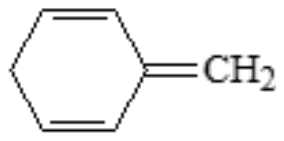
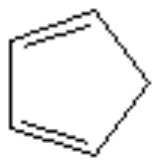
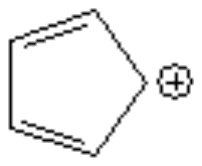
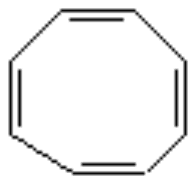
B has an sp3 ring carbon, so the ring is not fully conjugated, and its exocyclic double bond only adds cross-conjugation. C, cyclopentadiene, also has an sp3 carbon. D, the cyclopentadienyl cation, is fully conjugated but has 4 pi electrons, the \(4n\) count that makes it antiaromatic. E, cyclooctatetraene, has 8 pi electrons and puckers into a tub shape, so it is non-planar and non-aromatic.

Please log in or register to report this question.

30.

An organic compound 'A' with the molecular formula C6H4NO2Br is treated with magnesium in dry ether gives an organometallic compound which on treated with CO2 (dry ice) and gives compound 'B'. 'B' on hydrolysis gives 'C'. The name of the products A and C are

Exam Year(s)

KEAM - 2026,

Answer: C

A and C are 3-nitrobromobenzene and 3-nitrobenzoic acid.

A Grignard reagent made from an aryl bromide reacts with CO2, and hydrolysis of the product gives a carboxylic acid with COOH in place of the bromine. So the carbon skeleton and the position of the nitro group are kept: 3-nitrobromobenzene gives 3-nitrobenzoic acid.

This is the only option in which A and C correspond: 2-nitro or 2-bromoaniline cannot give terephthalic acid, the bromo acid would need the nitro group replaced, and 2-nitrobenzoic acid moves the nitro group. (In practice a nitro group reacts with Grignard reagents, so the route is idealised; the question tests the carboxylation step.)

Please log in or register to report this question.

Loading…
Tags: Aromatic Compounds and Reactions Questions and Answers || Aromatic Compounds and Reactions MCQ Questions and Answers || Aromatic Compounds and Reactions GK Questions and Answers || Aromatic Compounds and Reactions GK MCQ Questions || Aromatic Compounds and Reactions Multiple Choice Questions and Answers || Aromatic Compounds and Reactions GK || GK on Aromatic Compounds and Reactions || Organic Chemistry Questions and Answers || Organic Chemistry MCQ Questions and Answers || Organic Chemistry GK Questions and Answers || GK on Organic Chemistry