Machine-translated by Google. Questions are authored in English.
Top

Aromatic Compounds and Reactions Questions and Answers

1.

In the following reaction sequence
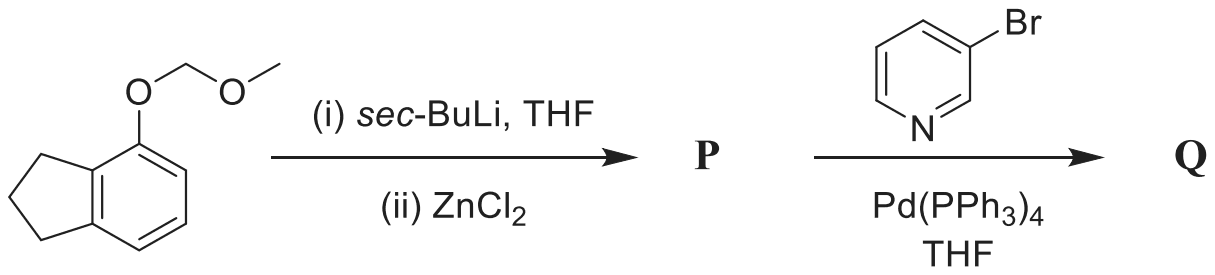
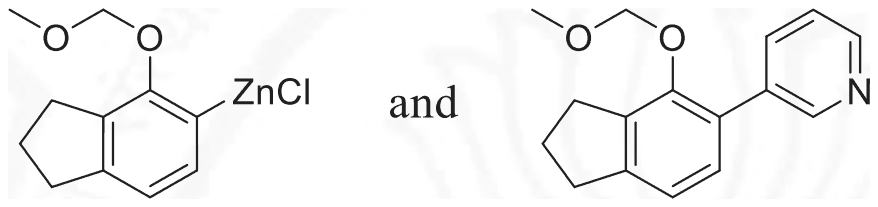
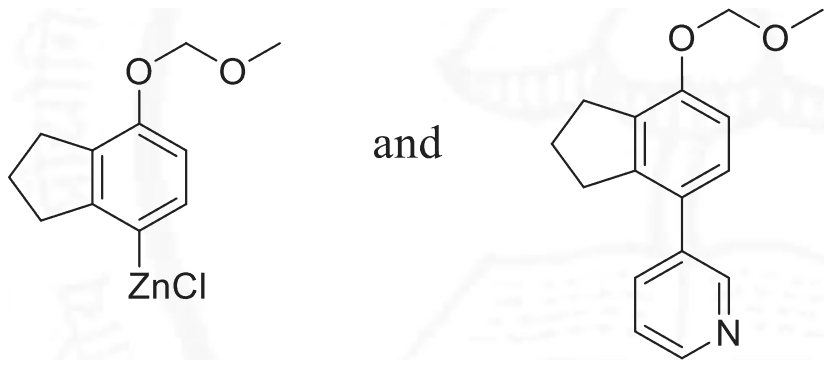
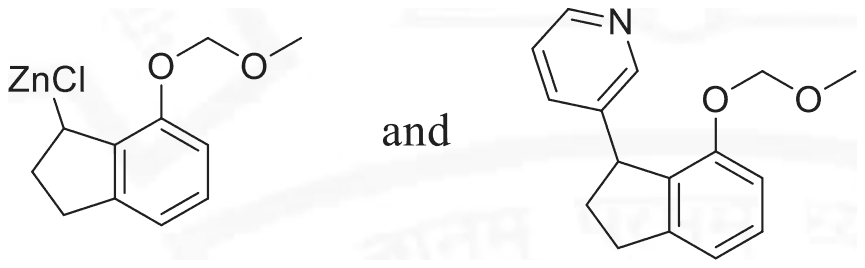
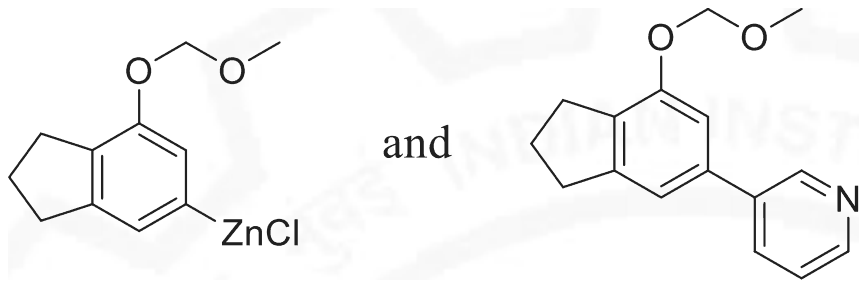
4-(Methoxymethoxy)indane treated with (i) sec-BuLi, THF, (ii) ZnCl2 to give P; P with 3-bromopyridine and Pd(PPh3)4 in THF gives Q

the major products P and Q, respectively, are:
Exam Year(s)

GATE Chemistry - 2021,

Answer: B

The answer is (B): metalation, and then the pyridyl group, ortho to the OMOM group.

The methoxymethyl ether is a strong directing group for ortho-lithiation: its oxygens coordinate sec-BuLi and deliver it to the adjacent ring C-H. Of the two positions ortho to the OMOM group in 4-(methoxymethoxy)indane, one is the ring-fusion carbon, which has no hydrogen, so lithiation occurs at C5. ZnCl2 exchanges Li for ZnCl, giving the arylzinc P.

A Negishi coupling with 3-bromopyridine under Pd(PPh3)4 then joins the pyridin-3-yl group to C5 with retention of position, giving Q.

(A) and (C) metalate positions meta and para to the directing group, which sec-BuLi does not reach, and (D) deprotonates a benzylic CH2, which the directing group does not favour.

Please log in or register to report this question.

2.

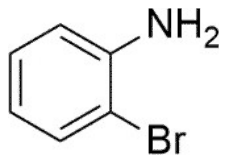
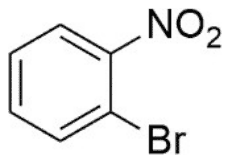
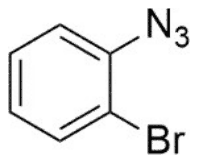
The starting material Y in the following reaction is

Y plus vinylmagnesium bromide (3 equiv) in THF at -40 C gives 7-bromoindole

Exam Year(s)

GATE Chemistry - 2022,

Answer: B

Y is (B), 1-bromo-2-nitrobenzene.

This is the Bartoli indole synthesis: an ortho-substituted nitroarene reacts with three equivalents of a vinyl Grignard reagent at low temperature to give a 7-substituted indole. The first equivalent attacks the nitro oxygen and converts the nitro group to a nitroso group, the second adds to the nitroso compound, a [3,3]-sigmatropic rearrangement forms the new C-C bond, and the third acts as a base. The ortho substituent, here Br, is needed for the rearrangement and ends up at C7 of the indole.

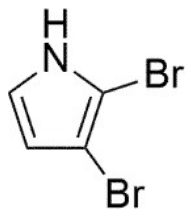
The aniline (A) and the azide (C) do not undergo this reaction with vinyl Grignard reagents, and the dibromopyrrole (D) already contains the five-membered ring, so it cannot supply the benzene ring of the product.

Please log in or register to report this question.
3.

The major product T formed in the following reaction is

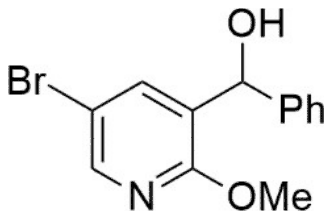
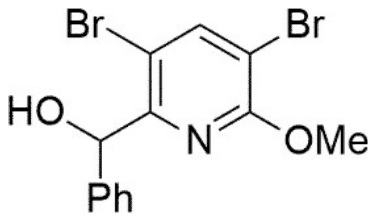
3,5-Dibromo-2-methoxypyridine treated with (a) nBuLi, Et2O, -100 C, then (b) PhCHO, -78 C to give T

Exam Year(s)

GATE Chemistry - 2022,

Answer: A

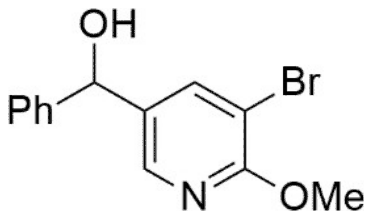
T is (A), the alcohol at C3 next to the methoxy group, with Br kept at C5.

At -100 °C, nBuLi performs a fast bromine-lithium exchange, not a deprotonation. Of the two bromines, the one at C3 is exchanged selectively because the adjacent 2-methoxy oxygen coordinates the lithium and stabilises the 3-pyridyllithium (an ortho-directing effect). Adding benzaldehyde then traps that organolithium as the secondary alcohol ArCH(OH)Ph at C3.

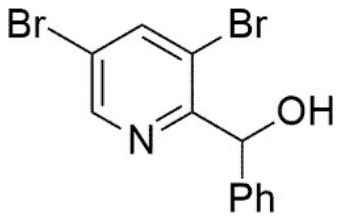
(B) puts the new group at C5, the bromine without a neighbouring donor. (C) and (D) keep both bromines and put the CH(OH)Ph group next to nitrogen, which would need deprotonation of a ring C-H rather than halogen exchange; (C) also loses the methoxy group.

Please log in or register to report this question.
4.

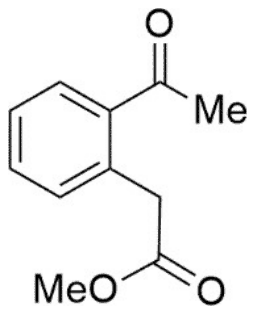
The major product P in the following reaction is

2-(Trimethylsilyl)phenyl triflate plus methyl acetoacetate, CsF (2.5 equiv), MeCN, 80 C, gives P

Exam Year(s)

GATE Chemistry - 2022,

Answer: A

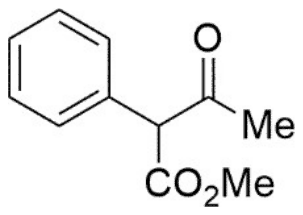
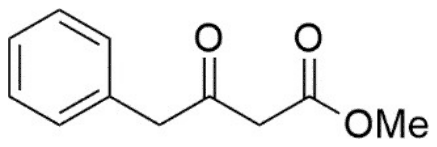
P is (A), methyl 2-(2-acetylphenyl)acetate.

CsF removes the silyl group from 2-(trimethylsilyl)phenyl triflate, and loss of triflate gives benzyne. The enolate of methyl acetoacetate adds its central carbon to one end of the aryne. The aryl anion formed at the adjacent carbon then attacks the ketone carbonyl, closing a four-membered ring (a benzocyclobutenoxide). That strained alkoxide fragments, breaking the bond between the former ketone carbon and the central carbon, so the aryne has been inserted into the C-C single bond of the beta-keto ester: the acetyl group and the CH2CO2Me group end up ortho to each other.

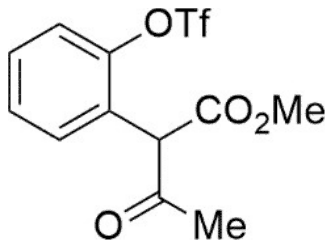
(B) is the simple alpha-arylation product, formed if the aryl anion were protonated before it could attack the ketone. (C) is arylation at the methyl ketone end, which is not the nucleophilic carbon. (D) keeps the triflate, but the triflate is the leaving group that must go for benzyne to form.

Please log in or register to report this question.
5.

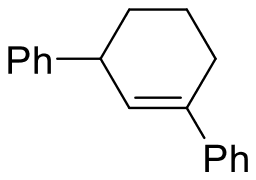
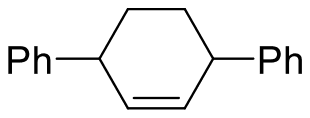
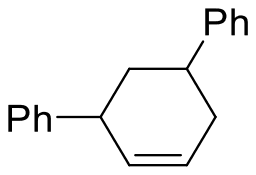
The major product formed in the given reaction is

2-(Trimethylsilyl)phenyl triflate plus 1-phenylcyclohexene, with CsF in CH3CN at room temperature

Exam Year(s)

GATE Chemistry - 2023,

Answer: A

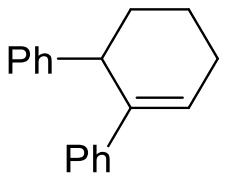
The major product is (A), the 1,6-diphenylcyclohexene.

Fluoride attacks the silicon of 2-(trimethylsilyl)phenyl triflate, and loss of triflate generates benzyne under mild conditions. Benzyne is a reactive enophile, and 1-phenylcyclohexene, with allylic hydrogens, undergoes an aryne ene reaction with it: an allylic hydrogen moves to one aryne carbon while the other aryne carbon bonds to the alkene, and the double bond shifts.

The hydrogen comes from C6, the allylic CH2 next to the phenyl-bearing C1, and the new aryl bond forms at C2, the unsubstituted alkene carbon, which is far less hindered than C1. The double bond moves to C1=C6. The new phenyl (from benzyne plus H) therefore sits on an sp3 carbon next to the vinylic carbon carrying the original phenyl, as in (A).

(B) keeps the double bond where it was and adds the aryl at the other allylic position, which is a substitution, not an ene product. (C) and (D) place the phenyls 1,4 or 1,3 apart, which an ene reaction of this alkene cannot produce.

Please log in or register to report this question.
Answer: B

Q shows [M], [M+2], [M+4] and [M+6] peaks in the ratio 1:3:3:1.

Step 1 is the Kolbe-Schmitt reaction: sodium phenoxide and CO2 give salicylic acid after acidification. In step 2, excess bromine water brominates both positions ortho and para to the strongly activating OH and displaces the carboxyl group (bromodecarboxylation), so Q is 2,4,6-tribromophenol.

Bromine's isotopes 79Br and 81Br are almost equally abundant, so a molecule with three bromines gives a binomial pattern \((1 + 1)^{3}\): peaks at M, M+2, M+4 and M+6 in the ratio 1:3:3:1. One bromine gives 1:1 and two give 1:2:1, the patterns of the other options; 1:1:1:1 matches no isotope distribution.

Please log in or register to report this question.

7.

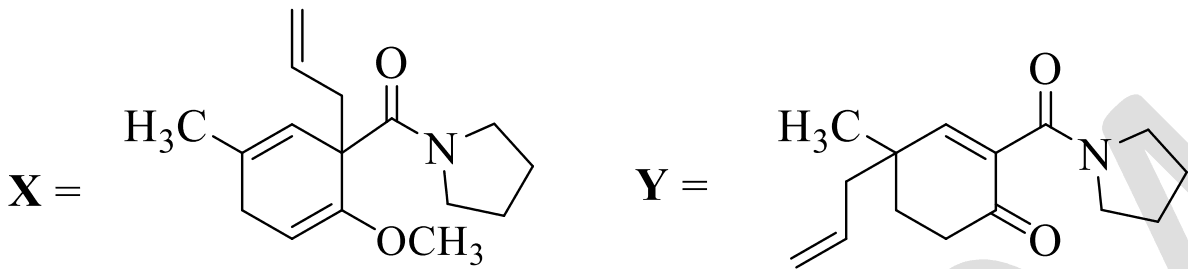
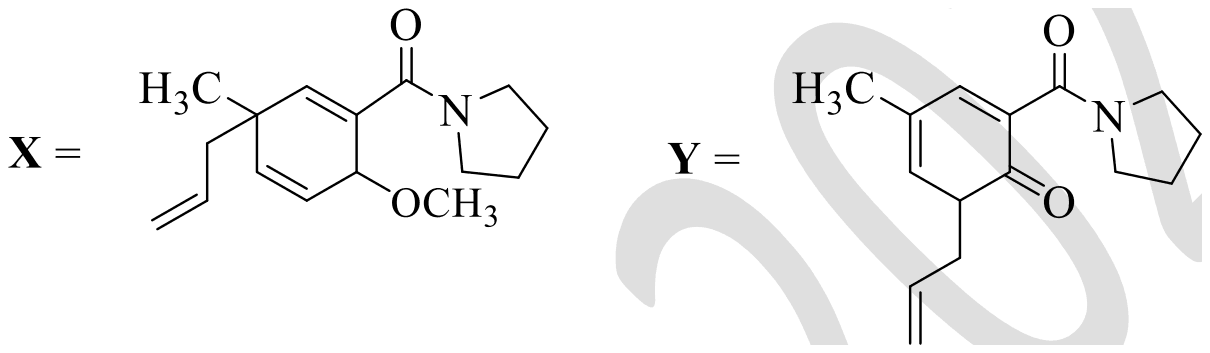
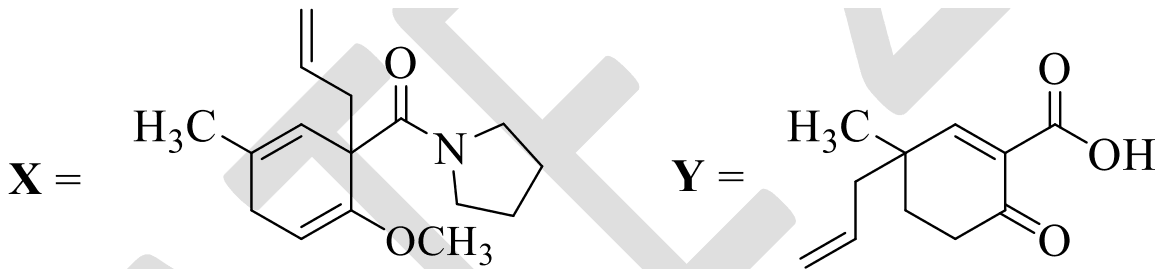
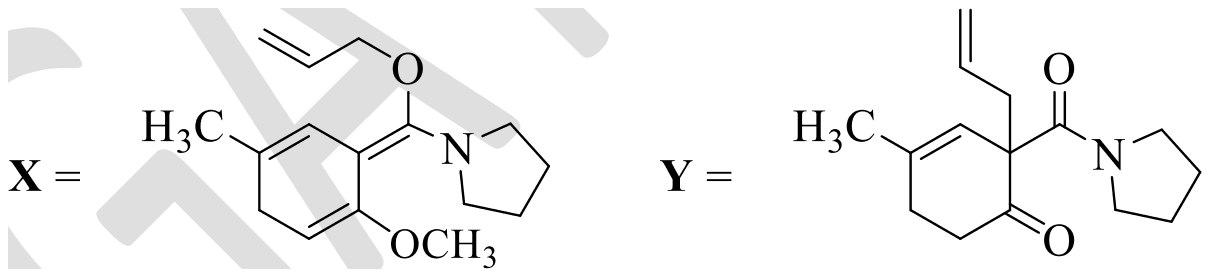
The major products X and Y in the following reaction sequence are

N-(2-methoxy-5-methylbenzoyl)pyrrolidine with 1. Na, NH3 (liquid), THF; 2. allyl bromide, giving X; then 1. aqueous HCl; 2. 1,2-dichloro benzene, reflux, giving Y

Exam Year(s)

GATE Chemistry - 2024,

Answer: A

X and Y are the pair shown in (A).

Step 1 is a Birch reductive alkylation: sodium in liquid ammonia reduces the benzamide to an enolate at the amide-bearing carbon, and allyl bromide alkylates that carbon. X is a 1-allyl-1-carboxamide cyclohexa-2,5-diene in which the methoxy group sits on one ring double bond as an enol ether.

Aqueous HCl hydrolyses the enol ether to a ketone next to the quaternary carbon. Refluxing in 1,2-dichlorobenzene then drives a [3,3]-sigmatropic (Cope) rearrangement of the 1,5-diene formed by the allyl group and the remaining ring double bond: the allyl group moves to the methyl-bearing carbon and a new C=C forms at the amide carbon, conjugated with both carbonyls. That is Y in (A).

(B) and (D) put the allyl group in the wrong place in X (on carbon or on oxygen), and (C) wrongly converts the amide to an acid, which aqueous HCl at this stage does not do.

Please log in or register to report this question.
8.

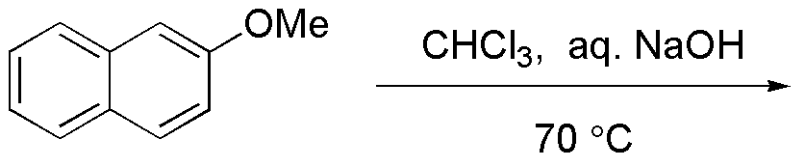
Among the given options, the possible product(s) that can be obtained from the following reaction is/are

2-Methoxynaphthalene treated with CHCl3 and aqueous NaOH at 70 degrees C.

Exam Year(s)

GATE Chemistry - 2025,

Answer: A

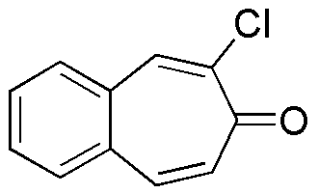
The product is (A), the chloro benzotropone.

Chloroform and aqueous NaOH generate dichlorocarbene. With 2-methoxynaphthalene there is no free OH, so no phenoxide forms and the Reimer-Tiemann route to an aldehyde is closed. Instead the carbene adds to the electron-rich C1=C2 bond to give a dichlorocyclopropane. This opens with loss of chloride to a ring-expanded benzocycloheptatrienyl (benzotropylium) cation, stabilised by the methoxy group, and hydrolysis of that oxocarbenium centre gives the ketone with chlorine on the neighbouring carbon.

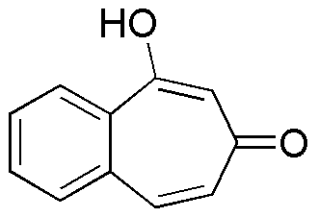
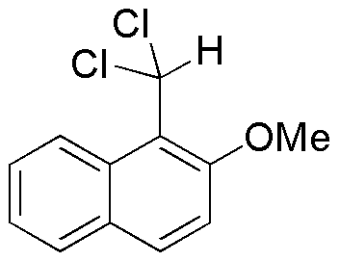
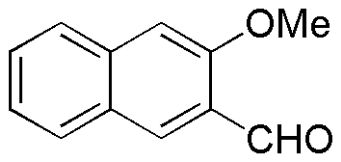
(C) and (D) are Reimer-Tiemann-type products, which need a phenoxide to activate the ring and to hydrolyse CHCl2; (D) also places the CHO at C3. (B) would need the C-Cl carbon to become a C-OH, which the conditions do not bring about.

Please log in or register to report this question.
9.

The major product formed in the following reaction sequences is

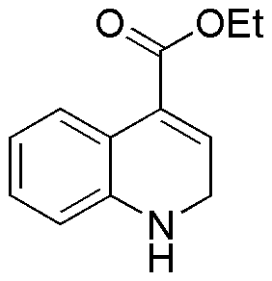
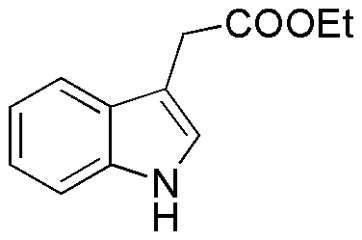
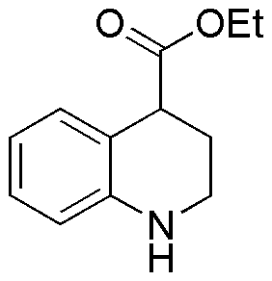
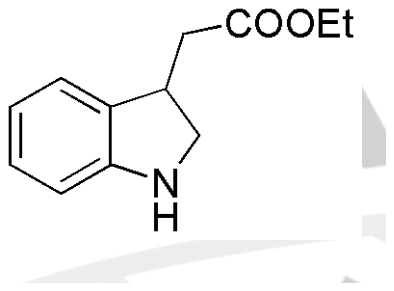
N-Benzyl-2-iodoaniline plus ethyl (E)-4-bromobut-2-enoate, then (i) K2CO3, MeCN; (ii) Pd(PPh3)4, Et3N, DMF; (iii) H2, Pd/C, EtOH/AcOH.

Exam Year(s)

GATE Chemistry - 2025,

Answer: B

The major product is (B), ethyl indole-3-acetate.

(i) K2CO3 lets the secondary amine displace the allylic bromide, giving the N-benzyl-N-(4-ethoxycarbonylbut-2-enyl) aryl iodide. (ii) Pd(0) adds oxidatively to the C-I bond, and an intramolecular Heck reaction closes a five-membered ring (5-exo); beta-hydride elimination and isomerisation give the aromatic indole with a CH2CO2Et group at C3. (iii) H2 over Pd/C in acetic acid removes the N-benzyl group by hydrogenolysis, giving the free N-H indole.

The quinoline-type products (A) and (C) would need a six-membered (6-endo) cyclisation, which the intramolecular Heck reaction does not favour here. (D), the indoline, would need the aromatic indole C2=C3 bond to be hydrogenated, which these mild conditions do not do.

Please log in or register to report this question.
10.

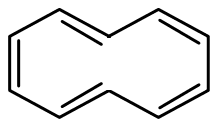
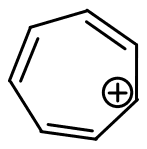
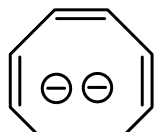
The non-aromatic compound/ion is

Exam Year(s)

GATE Life Sciences - 2012,

Answer: A

The non-aromatic species is (A), the ten-membered ring cyclodecapentaene ([10]annulene).

It has 10 pi electrons, which satisfies the 4n + 2 rule for n = 2, but a planar all-cis ten-membered ring would have very strained bond angles, and the isomer drawn would put two inner hydrogens on top of each other. The ring therefore twists out of plane, the p orbitals cannot overlap all round, and the compound behaves as a non-aromatic polyene.

The cycloheptatrienyl (tropylium) cation (B) has 6 pi electrons in a planar ring and the cyclooctatetraene dianion (C) has 10; both are aromatic. The cyclopentadienyl cation (D) has 4 pi electrons in a planar ring and is antiaromatic, which is different from non-aromatic: it is destabilised by cyclic conjugation rather than simply lacking it.

Please log in or register to report this question.
Loading…
Tags: Aromatic Compounds and Reactions Questions and Answers || Aromatic Compounds and Reactions MCQ Questions and Answers || Aromatic Compounds and Reactions GK Questions and Answers || Aromatic Compounds and Reactions GK MCQ Questions || Aromatic Compounds and Reactions Multiple Choice Questions and Answers || Aromatic Compounds and Reactions GK || GK on Aromatic Compounds and Reactions || Organic Chemistry Questions and Answers || Organic Chemistry MCQ Questions and Answers || Organic Chemistry GK Questions and Answers || GK on Organic Chemistry