
Machine-translated by Google. Questions are authored in English.
Top

Basic Concepts of Polymers Questions and Answers

21.

Which one of the following measures of viscosity is dimensionless?

Exam Year(s)

GATE XE - 2025,

Answer: D

The dimensionless measure is specific viscosity.

Specific viscosity is the fractional increase in viscosity that the dissolved polymer causes, \(\eta_{sp} = (\eta - \eta_{s})/\eta_{s}\), a ratio of two viscosities, so its units cancel.

The others carry units. Reduced viscosity is \(\eta_{sp}/c\) and inherent viscosity is \(\ln(\eta_{rel})/c\); dividing by the concentration c gives both units of volume per mass, such as dL/g. Zero-shear viscosity is an actual viscosity, the limiting value at vanishing shear rate, measured in Pa s.

Relative viscosity \(\eta/\eta_{s}\) is the other dimensionless member of the family, but it is not among the options.

Please log in or register to report this question.
22.

Which one of the following permits the direct determination of intrinsic viscosity of a polymer solution for known molecular weight of the polymer?

Exam Year(s)

GATE XE - 2025,

Answer: D

The relation is the Mark-Houwink equation.

The Mark-Houwink (Mark-Houwink-Sakurada) equation links intrinsic viscosity directly to molecular weight:

\[ [\eta] = K M^{a} \]

where K and a are constants for a given polymer, solvent and temperature. With M known, \([\eta]\) follows at once; used the other way, it is how viscometry gives the viscosity-average molecular weight.

The Flory-Huggins equation describes the free energy of mixing of a polymer solution, not its viscosity. Newton's law of viscosity only defines viscosity as shear stress over shear rate. The Williams-Landel-Ferry equation describes how viscosity or relaxation times shift with temperature above the glass transition.

Please log in or register to report this question.
Answer: D

The glass transition rises with an increase in chain length and decrease in plasticizer content.

The glass transition temperature is set by how easily chain segments can move. Anything that adds free volume or lubricates the chains lowers it; anything that removes free volume or restricts motion raises it.

  • Longer chains (higher molecular weight) have fewer chain ends per unit volume. Chain ends carry extra free volume, so fewer of them raises Tg.
  • Plasticizers are small molecules that sit between chains and increase free volume, so less plasticizer raises Tg.

Every other option includes a change that lowers Tg: more plasticizer, less cross-linking, more branching (which adds chain ends) or weaker inter-chain interactions.

Please log in or register to report this question.
24.

Crystallization is favored in polymer melts when the chain entanglement is _________________ and only polymers with _______________ molecular arrangement can crystallize.

Exam Year(s)

GATE XE - 2025,

Answer: D

The blanks are minimum, ordered.

To crystallize, chain segments must move into place and pack side by side in a regular lattice. Entanglements are knots that tie chains together and restrict this motion, so crystallization is favoured when entanglement is at its minimum. That is why slow cooling or annealing, which gives chains time to disentangle and fold, raises crystallinity.

Only chains with a regular, ordered structure can fit into a lattice: linear chains with a stereoregular (isotactic or syndiotactic) arrangement crystallize, while atactic or randomly copolymerised chains generally remain amorphous.

A random arrangement cannot pack into a crystal, and maximum entanglement hinders the chain motion that crystallization needs, so every other pair has at least one blank wrong.

Please log in or register to report this question.
25.

The ‘unperturbed dimension’ of the polymer chain is represented as,

\[ (\overline{r_{o}^{2}})^{1/2} \propto \bar{l}(n)^{1/2} \]

where,
\((\overline{r_{o}^{2}})^{1/2}\) = root-mean square end-to-end distance
\(\bar{l}\) = average length of a segment
\(n\) = number of segments in the chain

Using the above information, root-mean square end-to-end distance of a branched polyethylene would be _________________ when compared with that of the linear polyethylene of the same molecular weight and the same number of segments.

Exam Year(s)

GATE XE - 2025,

Answer: C

The root-mean-square end-to-end distance of the branched polyethylene is lower.

The relation \((\overline{r_{o}^{2}})^{1/2} \propto \bar{l}\,n^{1/2}\) applies to the segments that lie along the path between the two chain ends. In a linear chain all n segments are on that path. In a branched chain of the same molecular weight, some segments sit in side branches, so the main chain from end to end has fewer segments and a smaller end-to-end distance. Branched molecules are more compact for the same mass, which is also why they show a lower intrinsic viscosity.

'Same' would hold only if every segment were in the backbone, and 'higher' reverses the effect. 'Exactly √2 times' has no basis: the factor depends on how much of the chain is in branches.

Please log in or register to report this question.

26.

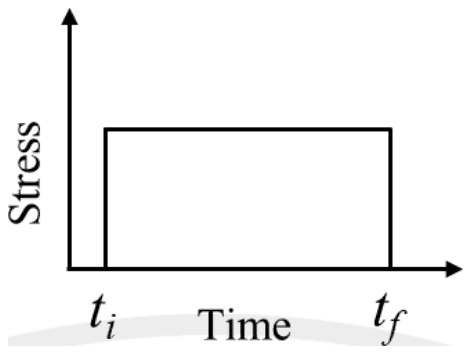
During material testing, stress is applied from time \(t_{i}\) to \(t_{f}\) as shown below:

Stress versus time: a constant stress applied at ti and removed at tf

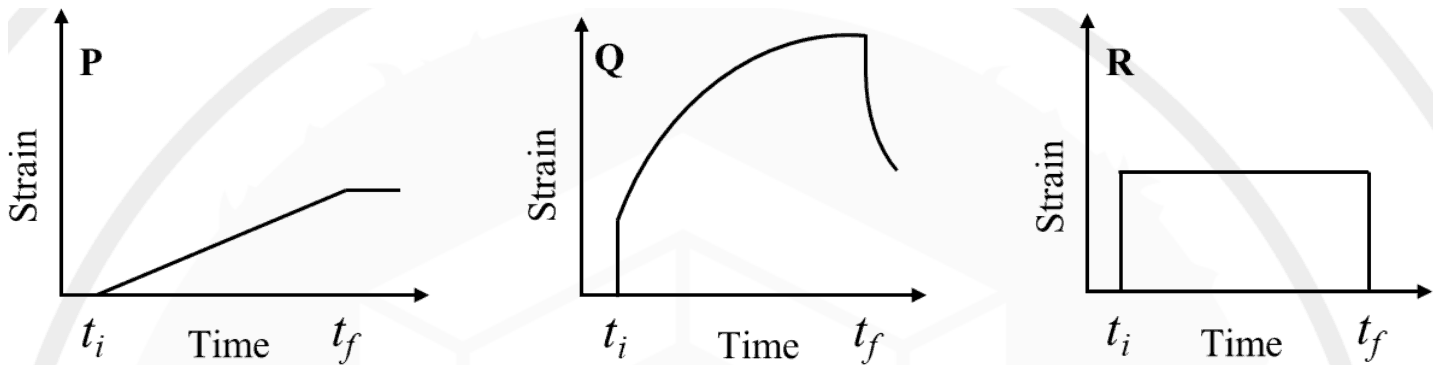
The corresponding strain responses for three different materials are shown in plots P, Q and R.

Strain versus time: P rises linearly from ti and stays constant after tf; Q jumps at ti, rises along a curve, then drops partly and recovers gradually after tf; R jumps at ti, stays constant and drops to zero at tf

Choose the option(s) where the strain response is correctly mapped to its material class.

Exam Year(s)

GATE XE - 2025,

Answer: D

The correct mapping is P- purely viscous; Q- viscoelastic; R- purely elastic.

  • P: under a constant stress the strain grows linearly with time and stays where it is when the stress is removed. That is a Newtonian dashpot, flow without recovery: purely viscous.
  • Q: the strain jumps at once, then keeps creeping upward under load; on unloading it drops partly at once and then recovers gradually. The instant parts are elastic and the time-dependent parts viscous: viscoelastic.
  • R: the strain appears instantly, stays constant while the stress is held and vanishes instantly when it is removed: purely elastic, a Hookean spring.

The other options give the linear creep of P to an elastic solid, which would not creep at all, or call the step response R viscoelastic, though it shows no time dependence.

Please log in or register to report this question.

27.

Which one of the following is NOT a rotational rheometer?

Exam Year(s)

GATE XE - 2026,

Answer: C

The capillary rheometer is not rotational.

A capillary rheometer forces the melt through a fine die by a piston or gas pressure and obtains viscosity from the pressure drop and the flow rate. It is a pressure-driven instrument and reaches the high shear rates found in extrusion and injection moulding.

The cone and plate, parallel plate and concentric cylinder (Couette) rheometers all shear the sample between a fixed and a rotating member, measuring torque against angular speed, so they are rotational rheometers.

Please log in or register to report this question.

28.

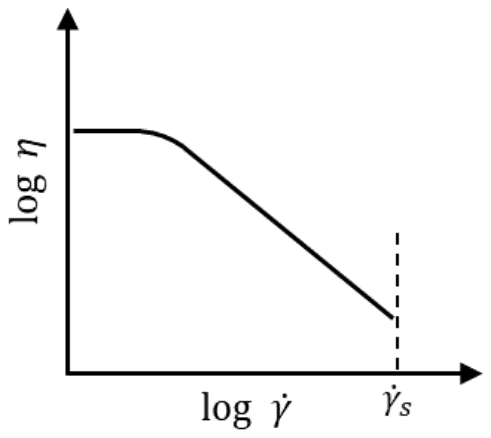
The variation of steady shear viscosity \((\eta)\) of a polymer melt with shear rate \((\dot{\gamma})\) is shown in the figure, where \(\dot{\gamma}_{s}\) is the upper limit of the applied shear rate.

Log of viscosity against log of shear rate: a flat plateau at low shear rate, then a straight line falling steadily up to the limit gamma dot s

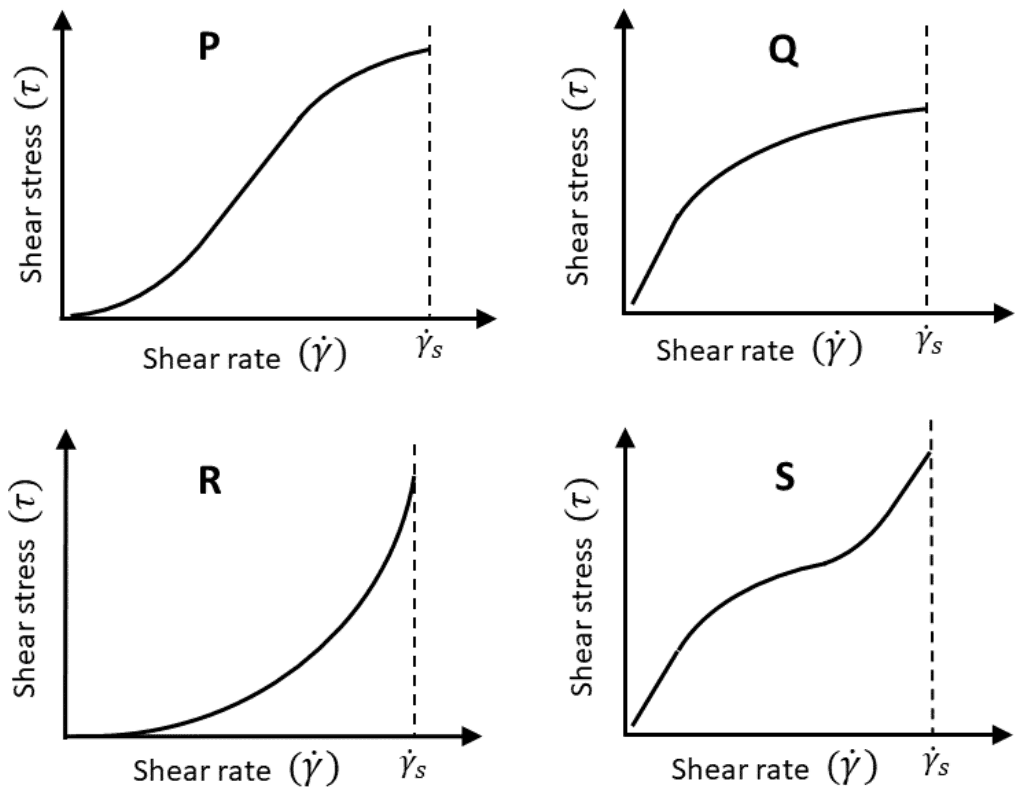
Which one of the following figures, labeled P, Q, R and S, shows the most appropriate variation of shear stress \((\tau)\) with shear rate for the same polymer melt?

Four plots of shear stress against shear rate: P starts flat and curves upward then levels off (S-shaped); Q rises linearly at first then bends over, increasing ever more slowly; R curves upward ever more steeply; S rises, flattens, then rises steeply again

Exam Year(s)

GATE XE - 2026,

Answer: B

The right shear stress curve is Q.

The viscosity curve shows a Newtonian plateau at low shear rate, where viscosity is constant, followed by shear thinning, where viscosity falls as a power of the shear rate. Since \(\tau = \eta\dot{\gamma}\):

  • on the plateau, \(\tau\) rises linearly with \(\dot{\gamma}\);
  • in the shear-thinning region, \(\tau = K\dot{\gamma}^{n}\) with n less than 1, so \(\tau\) keeps rising but ever more slowly.

Curve Q, a straight start bending over into a flattening rise, matches. R curves upward, which is shear thickening. P starts with zero slope, which would mean zero viscosity at low shear rate, and S's late steep rise would need the viscosity to increase again, which the viscosity curve does not show.

Please log in or register to report this question.

29.

Select the correct option to match the Characterization technique with the Information that is obtained using these techniques.

Characterization techniqueInformation
PDifferential scanning calorimetryISpherulite size
QInfrared spectroscopyIILoss modulus
RDynamic mechanical thermal analysisIIIFunctional groups
SOptical microscopyIVEnthalpy of crystallization

Exam Year(s)

GATE XE - 2026,

Answer: C

The correct matching is P-IV ; Q-III ; R-II ; S-I.

  • Differential scanning calorimetry measures heat flow, so the area of the crystallisation peak gives the enthalpy of crystallisation (IV).
  • Infrared spectroscopy identifies functional groups from their characteristic absorption bands (III).
  • Dynamic mechanical thermal analysis applies an oscillating load and measures the storage and loss moduli and tan delta (II).
  • Optical microscopy, usually between crossed polarisers, shows spherulites and their size (I).

Option A swaps DMTA and microscopy; options B and D swap DSC and IR.

Please log in or register to report this question.

30.

The DP of a polymer with average molecular weight of 25000 g/mol and monomer weight of 254 g/mol will be :

Exam Year(s)

MH SET - 2019, SET Exam - 2019,

Answer: C

The degree of polymerization is about 98.

The degree of polymerization is the number of monomer units in an average chain, found by dividing the average molecular weight of the polymer by the molecular weight of the repeating unit:

\[ \mathrm{DP} = \frac{25000}{254} \approx 98.4 \approx 98 \]

The other values do not follow from these numbers: 88 and 78 would require repeat units of about 284 and 320 g/mol, and 68 one of about 368 g/mol.

Please log in or register to report this question.

Loading…

Other Subjects

Tags: Basic Concepts of Polymers Questions and Answers || Basic Concepts of Polymers MCQ Questions and Answers || Basic Concepts of Polymers GK Questions and Answers || Basic Concepts of Polymers GK MCQ Questions || Basic Concepts of Polymers Multiple Choice Questions and Answers || Basic Concepts of Polymers GK || GK on Basic Concepts of Polymers || Polymer Chemistry Questions and Answers || Polymer Chemistry MCQ Questions and Answers || Polymer Chemistry GK Questions and Answers || GK on Polymer Chemistry