
Machine-translated by Google. Questions are authored in English.
Top

Instrumental Methods of Analysis Questions and Answers

1.

A metal chelate that can be used for separation and quantitative analysis of aluminium ions by gas chromatography is

Exam Year(s)

GATE Chemistry - 2012,

Answer: D

The chelate is that of trifluoroacetylacetone.

Gas chromatography needs a compound that vaporises without decomposing. Trifluoroacetylacetone (Htfa) forms a neutral tris chelate, Al(tfa)3, in which the fluorinated β-diketonate ligands wrap the metal and leave a non-polar, volatile, thermally stable molecule. Fluorinated β-diketonates are the standard reagents for GC of metal ions such as Al, Be and Cr.

EDTA gives charged, involatile complexes. Ethylene glycol is not a useful chelating agent for Al3+ in this sense, and dinonyl phthalate is a common GC stationary phase (a liquid coating), not a chelating ligand.

Please log in or register to report this question.

2.

From a carboxymethyl-cellulose column at pH 6.0, arginine, valine and glutamic acid will elute in the order

Exam Year(s)

GATE Chemistry - 2012,

Answer: D

The order of elution is glutamic acid, valine, arginine.

Carboxymethyl-cellulose carries -CH2COO- groups, so it is a cation exchanger: it holds positively charged molecules and lets negative ones through. What matters is each amino acid's net charge at pH 6.0, which follows from its isoelectric point:

  • glutamic acid, pI about 3.2: net negative, repelled by the column, elutes first;
  • valine, pI about 6.0: near zero net charge, weakly held, elutes next;
  • arginine, pI about 10.8: net positive, bound strongly, elutes last.

The orders starting with arginine would be right for an anion exchanger such as DEAE-cellulose, which is the usual confusion here.

Please log in or register to report this question.
3.

For the titration of a 10 mL (aq) solution of CaCO3, 2 mL of 0.001 M Na2EDTA is required to reach the end point. The concentration of CaCO3 (assume molecular weight of CaCO3 = 100) is

Exam Year(s)

GATE Chemistry - 2012,

Answer: D

The concentration of CaCO3 is 2 × 10⁻⁵ g/mL.

EDTA binds Ca2+ in a 1:1 ratio, so the moles of CaCO3 equal the moles of EDTA used:

\[ \begin{aligned} n &= 2\ \text{mL} \times 0.001\ \text{mol/L} \\ &= 2 \times 10^{-3}\ \text{L} \times 10^{-3}\ \text{mol/L} = 2 \times 10^{-6}\ \text{mol} \\ m &= 2 \times 10^{-6} \times 100 = 2 \times 10^{-4}\ \text{g} \end{aligned} \]

That mass is in 10 mL of solution, so the concentration is 2 × 10⁻⁴ g / 10 mL = 2 × 10⁻⁵ g/mL.

2 × 10⁻⁴ g/mL forgets to divide by the 10 mL volume. The 5 × values do not follow from the 1:1 Ca2+-EDTA stoichiometry with these volumes.

Please log in or register to report this question.
Answer: A

The order is FeCl2•4H2O > K2[Fe(CN)5(NO)] > FeCl3•6H2O.

Quadrupole splitting measures the electric field gradient at the iron nucleus, which comes mainly from an unsymmetrical distribution of the iron's own d electrons, with a smaller contribution from unequal ligands.

  • FeCl2•4H2O: high-spin Fe(II), d6. The sixth electron sits alone in the t2g set, a strongly asymmetric distribution, giving a large splitting (about 3 mm/s).
  • Nitroprusside: low-spin Fe(II), a symmetric t2g6 shell, but one NO+ ligand differs sharply from the five cyanides, so the ligand field gradient gives a moderate splitting (about 1.7 mm/s).
  • FeCl3•6H2O: high-spin Fe(III), d5, a spherical half-filled shell, so the splitting is small.

The other orders either put the spherical d5 ion above another or rank the ligand-only gradient of nitroprusside above the high-spin Fe(II) salt.

Please log in or register to report this question.
Answer: A

In DTA, the temperature differences between the sample and reference are measured as a function of temperature.

Differential thermal analysis heats a sample and an inert reference together at a programmed rate and records the temperature difference between them. An endothermic event (melting, dehydration) makes the sample lag behind the reference and an exothermic one makes it run ahead, giving peaks in the difference.

Measuring the difference in heat flow into sample and reference is differential scanning calorimetry (DSC). Measuring the change in mass with temperature is thermogravimetric analysis (TGA). A glass transition is a change in heat capacity, so it shows as a step in the baseline, not as a sharp peak.

Please log in or register to report this question.

6.

The number of νS=O stretching vibration band(s) observed in the IR spectrum of the high-spin [Mn(dmso)6]3+ complex (dmso: dimethylsulfoxide) is

Exam Year(s)

GATE Chemistry - 2022,

Answer: B

The spectrum shows two bands with intensity ratio 1:2.

High-spin Mn(III) is d4, t2g3eg1, with an odd electron in the eg set, so the complex is Jahn-Teller distorted: typically elongated along one axis. The six dmso ligands are then no longer equivalent. Two sit on the long axial bonds and four on the shorter equatorial bonds.

The S=O stretch of the O-bound dmso depends on how strongly the oxygen is held, so the two sets give two separate ν(S=O) bands, with intensities in proportion to the numbers of ligands, 2 axial to 4 equatorial, that is 1:2.

A single band would mean an undistorted octahedron with six equivalent ligands, which a high-spin d4 ion does not have. A 1:1 ratio would need equal numbers in the two sets, and six bands would need every ligand to be different.

Please log in or register to report this question.

7.

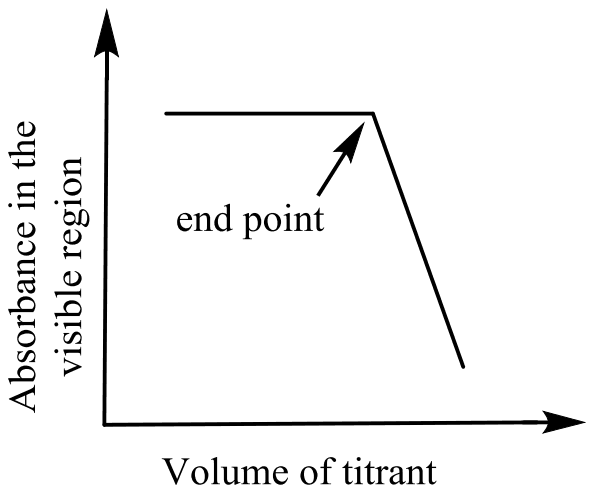
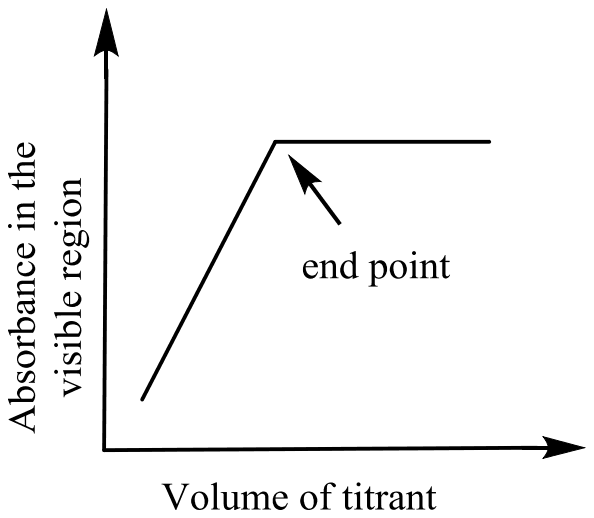
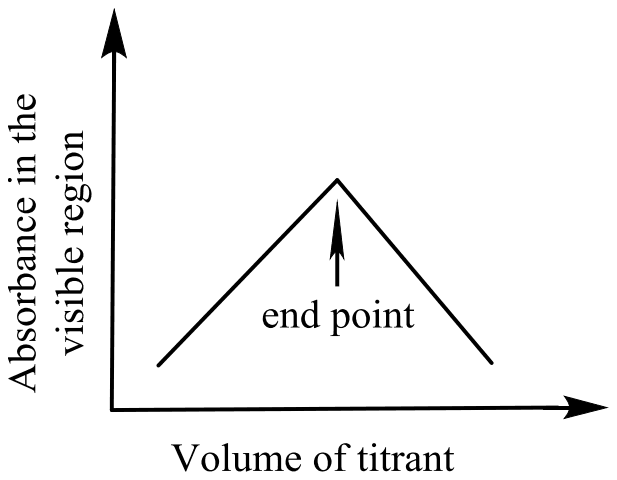
Which plot represents a spectrophotometric titration, where the titrant alone absorbs light in the visible region?

Exam Year(s)

IIT JAM - 2018,

Answer: A

The correct plot is (A).

In a spectrophotometric titration the absorbance is measured in the visible region as titrant is added. If only the titrant absorbs, the added titrant is consumed by the analyte until the end point, so the absorbance stays at its low baseline. After the end point the excess titrant accumulates and the absorbance rises linearly with volume. The graph is flat and then rises, with the end point at the break, as in (A).

(B) and (C) start with a high absorbance, which would need the analyte or product to absorb. (D) rises and then falls, which suits a case where a coloured species forms and then is used up, not a titrant that is only absorbing after the end point.

Please log in or register to report this question.

8.

'Layer Test' is used to identify

Exam Year(s)

KEAM - 2025,

Answer: A

The layer test identifies Bromide (and iodide).

Chlorine water added to a bromide solution liberates bromine, which dissolves in a layer of an organic solvent such as carbon tetrachloride or chloroform and colours it orange-brown (iodide gives violet).

Chloride cannot be displaced by chlorine, so it gives no coloured layer; fluoride, potassium and water are not identified this way.

Please log in or register to report this question.

9.

In gas chromatography, the basis of separation of the components is the difference in :

Exam Year(s)

MH SET - 2018, SET Exam - 2018,

Answer: D

Separation in gas chromatography rests on differences in partition coefficient.

The sample is carried through the column by an inert gas (the mobile phase), and each component distributes itself between the gas and the stationary liquid or solid phase. The partition (distribution) coefficient K = Cstationary/Cmobile decides how long a component is held back: a component with a larger K spends more time in the stationary phase and elutes later, so components with different K values leave the column at different retention times.

Molecular weight influences volatility and hence K, but it is not itself the basis; two compounds of equal mass can still separate. Conductivity and molarity play no part in the separation (a thermal conductivity detector only detects what has already separated).

Please log in or register to report this question.

10.

The normality of a solution is determined by four separate titrations, the results being 0.2041, 0.2049, 0.2039 and 0.2043. The average deviation for the results is :

Exam Year(s)

MH SET - 2018, SET Exam - 2018,

Answer: A

The average deviation is 0.0003.

First find the mean, then the mean of the absolute deviations from it:

\[ \begin{aligned} \bar{x} &= \frac{0.2041 + 0.2049 + 0.2039 + 0.2043}{4} \\ &= \frac{0.8172}{4} = 0.2043 \end{aligned} \]

The deviations are |0.2041 - 0.2043| = 0.0002, 0.0006, 0.0004 and 0, which sum to 0.0012:

\[ \bar{d} = \frac{0.0012}{4} = 0.0003 \]

0.2043 is the mean itself, not a deviation. 0.0006 is the largest single deviation, and 0.0009 does not follow from any standard measure of these data.

Please log in or register to report this question.

Loading…

Other Subjects

Tags: Instrumental Methods of Analysis Questions and Answers