Machine-translated by Google. Questions are authored in English.
Top

Molecular Biology Techniques Questions and Answers

1.

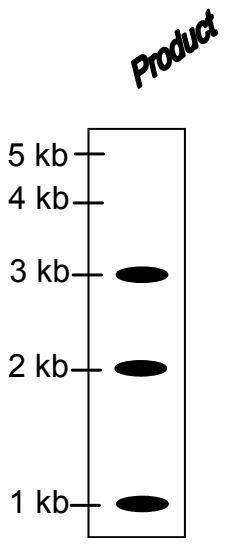
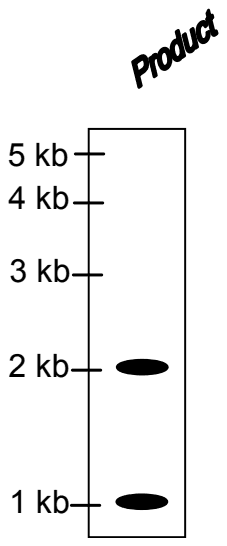
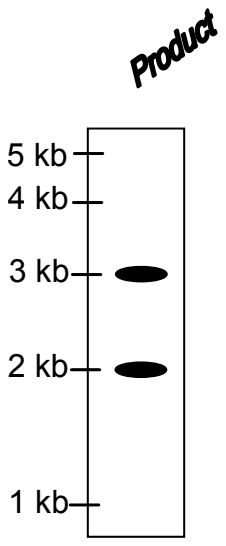
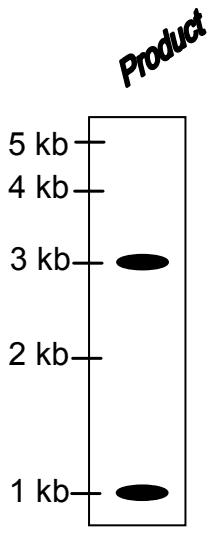
The figure below is a schematic of a linear double stranded DNA containing the indicated restriction sites. The DNA was completely digested with PvuII and EcoRI. The products were purified and added to an appropriately buffered reaction mixture containing dNTP mix, α-32P dATP, and Klenow fragment of E. coli DNA polymerase I. The Klenow reaction products were analyzed by gel electrophoresis and autoradiography. Which of the following products depicts the expected result?
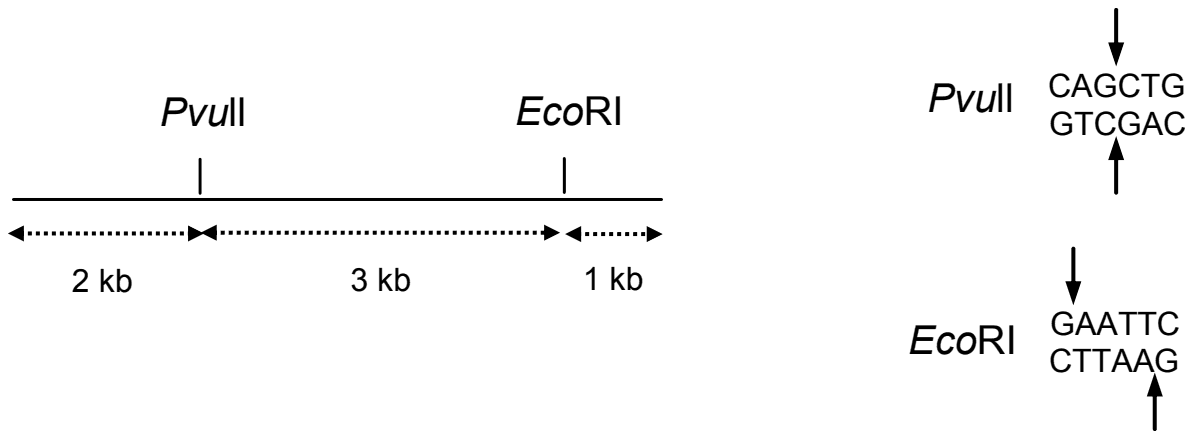
DNA map: PvuII site 2 kb from the left end, EcoRI 3 kb further, 1 kb to the right end; PvuII cuts CAG/CTG, EcoRI cuts G/AATTC

Exam Year(s)

GATE Life Sciences - 2012,

Answer: A

The expected result is (A): labelled bands at 3 kb and 1 kb only.

Digestion gives three fragments: 2 kb (left end to PvuII), 3 kb (PvuII to EcoRI) and 1 kb (EcoRI to right end). PvuII cuts CAG/CTG in the middle, leaving blunt ends. EcoRI cuts G/AATTC, leaving a 5' overhang of AATT with a recessed 3' end opposite it.

Klenow fragment fills in a recessed 3' end using the overhang as template; filling in the AATT overhang incorporates two dA residues, including the labelled α-32P dATP. Blunt ends offer nothing to fill. So only fragments carrying an EcoRI end become labelled: the 3 kb and the 1 kb fragments. The 2 kb fragment has a blunt PvuII end and the original end of the DNA, so it stays unlabelled and is invisible on the autoradiograph, which rules out B, C and D.

Please log in or register to report this question.

2.

Which of the following statements are TRUE on transgene approach?

P. T-DNA integration occurs mainly through non-homologous recombination
Q. The Gateway cloning depends on recombination technology as opposed to standard uses of restriction enzymes and DNA ligase
R. The localization of β-glucuronidase (GUS) activity as a result of expression of GUS reporter gene can be visualized in a histochemical assay using the X-gal
S. The green fluorescent protein gene (GFP) is isolated from the bacterium Photinus pyralis

Exam Year(s)

GATE Life Sciences - 2012,

Answer: A

The true statements are P, Q.

P is true: Agrobacterium T-DNA integrates into the plant genome mainly by illegitimate (non-homologous) recombination, at essentially random sites. Q is true: Gateway cloning moves inserts between vectors by site-specific recombination at att sites, using the phage lambda integrase system rather than restriction enzymes and ligase.

R is false: GUS activity is detected histochemically with X-Gluc (5-bromo-4-chloro-3-indolyl glucuronide); X-gal is the substrate for β-galactosidase. S is false: GFP comes from the jellyfish Aequorea victoria; Photinus pyralis is the firefly that supplies the luciferase gene.

Please log in or register to report this question.

3.

Select the technique most appropriate to demonstrate that lactose induces the synthesis of β-galactosidase enzyme.

Exam Year(s)

GATE Life Sciences - 2012,

Answer: B

The most appropriate technique is the Western Blot.

The claim is about synthesis of the enzyme, a protein. A Western blot separates cell proteins by electrophoresis and detects β-galactosidase with a specific antibody, so comparing cells grown with and without lactose shows directly whether the protein appears on induction.

A Northern blot or quantitative PCR (on cDNA) would show an increase in lacZ mRNA, which demonstrates transcription rather than synthesis of the protein. A Southern blot detects DNA, and the gene is present whether or not it is induced.

Please log in or register to report this question.

4.

If all the nucleotides have equal probability of occurrence in a 4 Mbp long DNA sequence, then how many times will the site of EcoRI, restriction endonuclease occur?

Exam Year(s)

GATE Life Sciences - 2012,

Answer: A

The EcoRI site is expected to occur about 976 times.

EcoRI recognises the six-base sequence GAATTC. With each base equally likely, the chance that a given position starts this sequence is \((1/4)^{6} = 1/4096\):

\[ \begin{aligned} \frac{4 \times 10^{6}}{4^{6}} &= \frac{4000000}{4096} \\ &\approx 976 \end{aligned} \]

\(4^{6}\) (4096) is the average spacing between sites, not the number of sites. \(6^{4}\) puts the base and exponent the wrong way round, and 1000 is a rough round number rather than the calculated value.

Please log in or register to report this question.

5.

Purification of 6×His-tagged protein using Ni-NTA column is an example of ________

Exam Year(s)

GATE Life Sciences - 2022,

Answer: A

It is an example of affinity chromatography.

Nickel ions held on the column by nitrilotriacetic acid (NTA) bind the imidazole side chains of the six consecutive histidines of the tag. The tagged protein is retained by this specific interaction while other proteins wash through, and it is then eluted with imidazole or a low pH. This is immobilised metal affinity chromatography (IMAC), a form of affinity chromatography.

Separation does not rest on hydrophobic surface patches (hydrophobic-interaction chromatography), on net charge (ion-exchange chromatography) or on molecular size (size-exclusion chromatography).

Please log in or register to report this question.

6.

With reference to virulence (vir) region of nopaline type Ti plasmid of Agrobacterium tumefaciens, match Group-I (vir gene) and Group-II (coded protein) in CORRECT combination.

Group-IGroup-II
P. vir AI. Single strand T-DNA binding protein
Q. vir BII. Topoisomerase
R. vir EIII. Membrane protein, channel for T-DNA
S. vir DIV. Sensor protein, constitutive expression

Exam Year(s)

GATE Life Sciences - 2022,

Answer: B

The correct combination is P-IV, Q-III, R-I, S-II.

  • vir A encodes the membrane sensor kinase that detects plant phenolics such as acetosyringone; it is expressed constitutively at a low level, so it can sense the wound signal (IV).
  • vir B encodes the proteins of the type IV secretion apparatus, the membrane channel through which the T-strand leaves the bacterium (III).
  • vir E encodes VirE2, the single-strand DNA binding protein that coats the T-strand in the plant cell (I).
  • vir D encodes VirD1, which has topoisomerase-like activity, and VirD2, the endonuclease that nicks the border repeats (II).

Option A swaps vir E and vir D, option C misplaces vir B, and option D puts DNA binding on the sensor gene vir A.

Please log in or register to report this question.

7.

Match Group-I (selection agent) and Group-II (gene) in CORRECT combination.

Group-IGroup-II
P. KanamycinI. pmi
Q. HygromycinII. bar
R. PhosphinothricinIII. nptII
S. MannoseIV. ptxD
V. dhfr
VI. hpt

Exam Year(s)

GATE Life Sciences - 2022,

Answer: A

The correct combination is P-III, Q-VI, R-II, S-I.

  • Kanamycin is detoxified by neomycin phosphotransferase II, encoded by nptII (III).
  • Hygromycin B is inactivated by hygromycin phosphotransferase, hpt (VI).
  • Phosphinothricin (glufosinate) is acetylated and inactivated by phosphinothricin acetyltransferase, encoded by bar (II).
  • Mannose is used for positive selection: cells carrying phosphomannose isomerase, pmi (I), can convert mannose-6-phosphate to fructose-6-phosphate and grow on it.

The extra genes are distractors: ptxD (phosphite dehydrogenase) is used with phosphite, and dhfr (dihydrofolate reductase) with methotrexate. Options B, C and D each pair at least one agent with one of these or with the wrong gene.

Please log in or register to report this question.

8.

A linear DNA fragment of 5 kilobase (kb) when completely digested with EcoRI produces 2.5 kb, 1.5 kb, and 1 kb fragments. Complete digestion of the same 5 kb fragment with XbaI produces 3.5 kb and 1.5 kb fragments. Which one of the following sets of fragments will be obtained if the 5 kb fragment is fully digested with EcoRI and XbaI simultaneously?

Exam Year(s)

GATE Life Sciences - 2023,

Answer: C

The double digest gives 2 kb, 1.5 kb, 1 kb, and 0.5 kb.

EcoRI cuts the 5 kb fragment twice (three pieces), and XbaI cuts it once, 1.5 kb from one end. Place the EcoRI pieces in the order 1, 2.5, 1.5 kb, so EcoRI cuts at 1 kb and 3.5 kb. An XbaI cut at 1.5 kb from the left end then falls inside the 2.5 kb piece and splits it into 0.5 and 2 kb.

\[ 1 + 0.5 + 2 + 1.5 = 5\ \text{kb} \]

Whatever the order of the pieces, a double digest can never give fewer fragments than EcoRI alone, so the two-fragment answers (3 and 2 kb, 2 and 1 kb) are impossible. Every cut lies a whole number of 0.5 kb steps from the ends (the pieces are 1, 1.5, 2.5 and 3.5 kb), so pieces of 0.75 and 0.25 kb cannot arise either. The set 2, 1.5, 1 and 0.5 kb is the only option that fits both single digests.

Please log in or register to report this question.

9.

Match the tasks given in Group I with the associated techniques conventionally used as listed in Group II.

Group IGroup II
P. Ploidy analysis1. RNA sequencing
Q. Profiling DNA methylation2. Exome sequencing
R. Identifying non-coding RNAs3. Fluorescence in situ hybridization
S. Identifying SNPs4. Bisulfite sequencing
T. Satellite DNA isolation5. Density-gradient centrifugation

Exam Year(s)

GATE Life Sciences - 2023,

Answer: B

The match is P-3; Q-4; R-1; S-2; T-5.

  • Ploidy can be counted with fluorescence in situ hybridization, by the number of signals a chromosome-specific probe gives in each nucleus.
  • Bisulfite sequencing converts unmethylated cytosines to uracil while methylated ones remain, so it profiles DNA methylation.
  • RNA sequencing reads the whole transcriptome, including non-coding RNAs.
  • Exome sequencing reads all exons, a standard way to identify single nucleotide polymorphisms in genes.
  • Satellite DNA has a different base composition and so forms separate 'satellite' bands in density-gradient centrifugation.

The other options misassign at least one technique, for example using density-gradient centrifugation for methylation profiling.

Please log in or register to report this question.

10.

Which of the following selectable marker genes is/are used for herbicide tolerance during genetic transformation of plants?

Exam Year(s)

GATE Life Sciences - 2024,

Answer: B

The herbicide tolerance marker is bar.

The bar gene from Streptomyces hygroscopicus encodes phosphinothricin acetyltransferase, which inactivates the herbicide phosphinothricin (glufosinate, the active ingredient of Basta). Transformed plant cells survive on media or sprays containing it.

hpt confers resistance to the antibiotic hygromycin and nptII to kanamycin, so both are antibiotic markers. pmi (phosphomannose isomerase) is a positive selection marker that lets cells grow on mannose. Of the four, only bar applies, so this multiple-select question has a single correct choice.

Please log in or register to report this question.

Loading…
Tags: Molecular Biology Techniques Questions and Answers || Molecular Biology Techniques MCQ Questions and Answers || Molecular Biology Techniques GK Questions and Answers || Molecular Biology Techniques GK MCQ Questions || Molecular Biology Techniques Multiple Choice Questions and Answers || Molecular Biology Techniques GK || GK on Molecular Biology Techniques || Molecular Biology Questions and Answers || Molecular Biology MCQ Questions and Answers || Molecular Biology GK Questions and Answers || GK on Molecular Biology