
Machine-translated by Google. Questions are authored in English.
Top

Main Group Elements Questions and Answers

1.

Among the following substituted silanes, the one that gives cross-linked silicone polymer upon hydrolysis is

Exam Year(s)

GATE Chemistry - 2012,

Answer: B

The silane is CH3SiCl3.

Hydrolysis turns each Si-Cl bond into Si-OH, and the silanols condense into Si-O-Si links. The number of chlorines decides how many links each silicon can make:

  • CH3SiCl3 gives CH3Si(OH)3, which can form three Si-O-Si links: a three-dimensional, cross-linked network.
  • (CH3)2SiCl2 forms two links per silicon: linear chains or rings of silicone.
  • (CH3)3SiCl forms one link: it caps chains, giving only the dimer (CH3)3Si-O-Si(CH3)3.
  • (CH3)4Si has no Si-Cl bond and does not hydrolyse.

Please log in or register to report this question.
2.

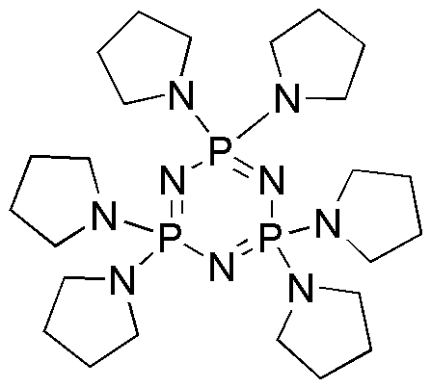
In cyclophosphazenes, (NPX2)3 (X = F, Cl, Br and Me), the strength of P-N π-bond varies with X in the order

Exam Year(s)

GATE Chemistry - 2017,

Answer: A

The P-N π-bond strength varies as F \(\gt\) Cl \(\gt\) Br \(\gt\) Me.

The π component of the P-N bond in a phosphazene comes from donation of nitrogen lone-pair density towards phosphorus (classically described as dπ-pπ bonding; in modern terms, into P-X σ* orbitals). The more electronegative the groups on phosphorus, the more positive and electron-hungry the phosphorus becomes and the better it accepts this density. So the π bonding is strongest for X = F, weaker for Cl and Br, and weakest for the electron-releasing methyl group.

This follows the electronegativity order F \(\gt\) Cl \(\gt\) Br \(\gt\) C and shows up as shorter P-N bonds in (NPF2)3 than in (NPCl2)3. Any order that puts Me first, or Br ahead of F, reverses that trend.

Please log in or register to report this question.
3.

Reaction of LiAlH4 with one equivalent of Me3N·HCl gives a tetrahedral compound, which reacts with another equivalent of Me3N·HCl to give compound N. The compound N and its geometry, respectively, are:

Exam Year(s)

GATE Chemistry - 2021,

Answer: C

N is AlH3(NMe3)2, trigonal bipyramidal.

Me3N·HCl delivers HCl: the first equivalent converts LiAlH4 into LiCl, H2 and AlH3, which is captured by trimethylamine as the tetrahedral adduct AlH3·NMe3. The second equivalent supplies another amine ligand, and aluminium expands to five-coordination: AlH3(NMe3)2.

With five electron pairs and no lone pair, the shape is trigonal bipyramidal, the two bulky amines axial and the three hydrides equatorial. VSEPR gives no pentagonal arrangement for five bonding pairs, and LiAlH4NMe3 or Li2AlH4Cl would not form once HCl has destroyed the AlH4− ion.

Please log in or register to report this question.
4.

The reaction of Ph3PCl2 with PhNH2 primarily produces

Exam Year(s)

GATE Chemistry - 2023,

Answer: A

The product is Ph3P=NPh.

This is the Kirsanov reaction. The amine nitrogen attacks phosphorus in Ph3PCl2, displacing chloride, and the two N-H hydrogens leave with the two chlorides as HCl (usually taken up by a base):

\[ \begin{aligned} &\mathrm{Ph_{3}PCl_{2} + PhNH_{2}} \\ &\rightarrow \mathrm{Ph_{3}P{=}NPh + 2HCl} \end{aligned} \]

The three P-Ph bonds are untouched, so the product is the iminophosphorane (phosphine imide) with all three phenyls on phosphorus. PhP=NPh, PhCl2P=NPh and Ph2ClP=NPh would all require breaking P-C bonds, which does not happen under these conditions, and PhP=NPh does not even keep phosphorus's valence.

Please log in or register to report this question.
5.

The number of shared corners of the constituent SiO4 units in orthosilicate, pyrosilicate, cyclic silicate and sheet silicate, respectively, are

Exam Year(s)

GATE Chemistry - 2023,

Answer: A

The numbers of shared corners are 0, 1, 2 and 3.

  • Orthosilicates (SiO44−, e.g. olivine) contain isolated tetrahedra: no shared corners.
  • Pyrosilicates (Si2O76−) join two tetrahedra through one bridging oxygen: one shared corner per tetrahedron.
  • Cyclic silicates (e.g. Si6O1812− in beryl) link tetrahedra in rings, each sharing two corners.
  • Sheet silicates (Si2O52−, e.g. mica, talc) share three corners per tetrahedron in a two-dimensional net.

The other options scramble this sequence; note that three-dimensional silicates such as quartz share all four corners, one more than the sheets.

Please log in or register to report this question.

6.

The reaction of XeF2 with HN(SO2F)2 at 273 K in CF2Cl2 solvent yields

Exam Year(s)

GATE Chemistry - 2024,

Answer: D

The products are FXeN(SO2F)2 + HF.

XeF2 reacts with the strong N-H acid imidobis(sulfuryl fluoride), HN(SO2F)2, by replacing one fluorine with the N(SO2F)2 group and releasing HF. The product FXeN(SO2F)2, made by DesMarteau in the 1970s, was the first compound with a xenon-nitrogen bond. The low temperature (273 K) and inert CF2Cl2 solvent keep it from decomposing.

The other options would require XeF2 to be oxidised to XeF4 or XeO2, or the N-H acid to be broken down to NH3 or N2, none of which happens under these mild conditions.

Please log in or register to report this question.

Answer: C

X is Na2B2(O2)2(OH)4·nH2O and Y is PhCONH2.

Borax treated with NaOH and hydrogen peroxide gives sodium perborate, whose anion is a six-membered ring of two boron atoms bridged by two peroxo (O-O) groups, each boron also carrying two OH groups: [B2(O2)2(OH)4]2-. The formula NaB(O)(OH)2 has no peroxide and is not perborate.

In water, perborate releases hydroperoxide, which adds to nitriles and converts them to primary amides (as in the Radziszewski reaction), so benzonitrile gives benzamide. Hydrolysis all the way to benzoic acid would need much harsher conditions, which rules out the PhCOOH options.

Please log in or register to report this question.

8.

The phosphazene compound that acts as a superbase is

Exam Year(s)

GATE Chemistry - 2025,

Answer: C

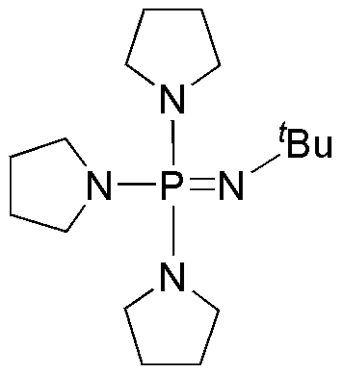
The superbase is structure (C), the phosphazene tBuN=P(NC4H8)3.

This is a Schwesinger-type P1 phosphazene base. Protonation occurs at the imino nitrogen of P=N, and the resulting cation is strongly stabilised because the positive charge is spread over phosphorus and the three electron-donating pyrrolidino nitrogens. The bulky tert-butyl group keeps it non-nucleophilic. Such bases are far stronger than amines such as DBU.

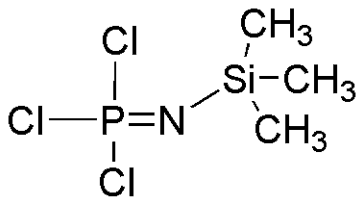
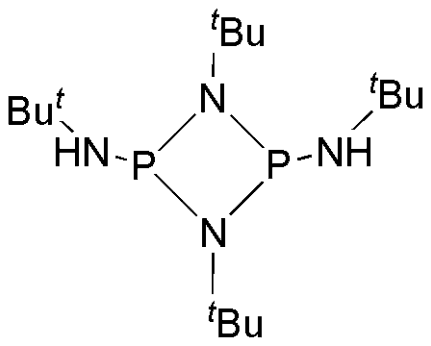
(A) is a cyclotriphosphazene: its ring nitrogens are part of a delocalised P-N ring and are only weakly basic. (B) carries three electron-withdrawing chlorines on phosphorus and a silyl group on nitrogen; it is a monomer used to make polyphosphazenes, not a base. (D) is a cyclodiphosphazane with P-N single bonds and no imino nitrogen to protonate.

Please log in or register to report this question.

Answer: C

The Rochow-Müller reaction is Si:Cu (9:1) + 2 MeCl at 300 °C.

In this direct process, used industrially for silicones, methyl chloride is passed over silicon mixed with a copper catalyst at about 300 °C. The main product is dimethyldichlorosilane, Me2SiCl2, the monomer for polydimethylsiloxane.

Iron is not the catalyst of the process, so the Si:Fe option is wrong. The reactions of SiCl4 with dimethylzinc or methylmagnesium bromide are laboratory routes to methylchlorosilanes through organometallic reagents; they are not the Rochow-Müller process.

Please log in or register to report this question.

Answer: B

The order is \(LiO_{2} \lt NaO_{2} \lt KO_{2} \lt RbO_{2}\).

These are superoxides, containing the large \(O_{2}^{-}\) anion. A large anion is stabilised best by a large cation, because the lattice energy gained is then favourable and the cation polarises the anion less. Going down the group, the cation grows from \(Li^{+}\) to \(Rb^{+}\), so the superoxides become steadily more stable.

That is why potassium, rubidium and caesium form superoxides directly on burning in air, while lithium forms the normal oxide \(Li_{2}O\) and sodium the peroxide. The decreasing order, and the orders that change direction part way, contradict this steady trend.

Please log in or register to report this question.

Loading…

Other Subjects

Tags: Main Group Elements Questions and Answers