
Machine-translated by Google. Questions are authored in English.
Top

Metamorphic Facies and Grades Questions and Answers

1.

The figure shows chemogenic mineral projections for Facies P and Facies Q. Which one of the following reactions best represents change from Facies P to Facies Q?
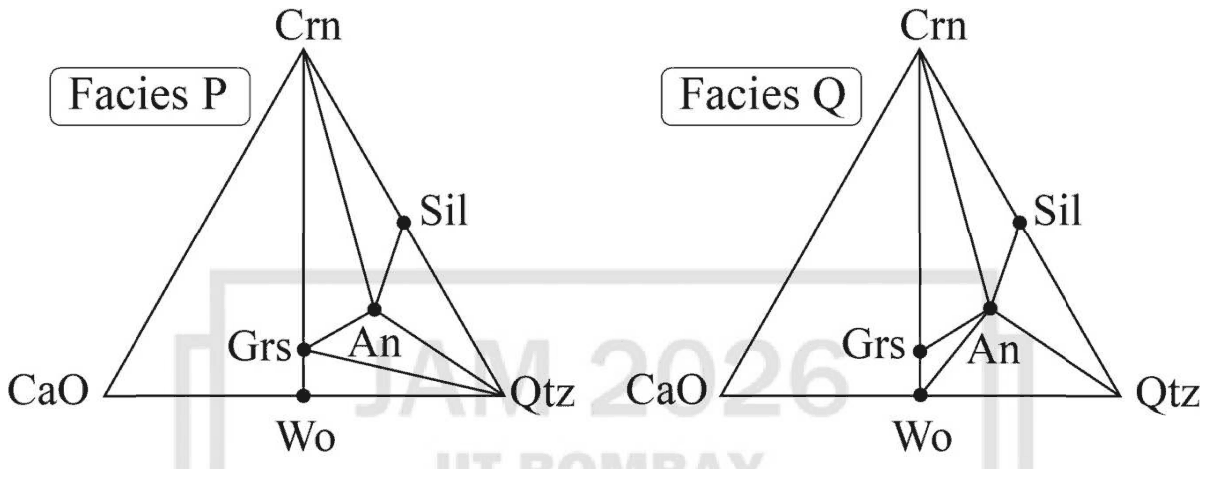
Two triangles labelled Facies P and Facies Q with corners CaO, Crn and Qtz, Wo on the CaO-Qtz side, Sil on the Crn-Qtz side and Grs and An inside; tie-lines Crn-Grs-Wo, Crn-An, An-Sil, Grs-An and An-Qtz in both; Facies P also has Grs-Qtz and Facies Q has Wo-An instead

Crn: Corundum; Grs: Grossular; Wo: Wollastonite; An: Anorthite; Sil: Sillimanite; Qtz: Quartz

Exam Year(s)

IIT JAM - 2026,

Answer: D

The change from Facies P to Facies Q is best represented by Grs + Qtz = Wo + An.

In a chemographic diagram, a reaction shows up as a tie-line switch. Facies P has a grossular-quartz tie-line; in Facies Q it has gone and a wollastonite-anorthite tie-line crosses its place. The four minerals at the ends of the two crossing tie-lines are the reactants and products. The reaction balances:

\[ \begin{aligned} &\text{Ca}_3\text{Al}_2\text{Si}_3\text{O}_{12} + \text{SiO}_2 \\ &= 2\,\text{CaSiO}_3 + \text{CaAl}_2\text{Si}_2\text{O}_8 \end{aligned} \]

This is the reaction by which grossular and quartz give way to wollastonite and anorthite at higher temperature.

Wo + An = Sil + Qtz involves tie-lines that do not change. An + Sil = Wo cannot balance, since wollastonite contains no aluminium. Wo + Crn = Grs is chemically possible because grossular lies on the Crn-Wo line, but that line is present in both facies, so it is not the change shown.

Please log in or register to report this question.

Answer: D

The incorrect statement is that a reaction forming Q from P at constant pressure will require an input of heat.

The P-Q boundary slopes up towards higher pressure, so at any fixed pressure Q lies on the low-temperature side and P on the high-temperature side. Forming Q from P at constant pressure therefore means crossing the boundary on cooling: P is the high-entropy phase, and the reaction releases heat rather than absorbing it.

The other statements fit the diagram. The P-Q boundary is sloping, not horizontal, so two coexistence points at different temperatures must be at different pressures. P, Q and liquid meet at a single invariant point. The Q-liquid curve rises with pressure, so Q melts at a higher temperature at higher pressure.

Please log in or register to report this question.

3.

Find the odd one out :

Exam Year(s)

MH SET - 2018, SET Exam - 2018,

Answer: D

The odd one out is Hypersthene - Greenschist.

Each pair matches an index mineral with a metamorphic facies or rock. Omphacite, a sodic pyroxene, with garnet makes eclogite (spelt 'Eelogite' in the paper); glaucophane, a blue sodic amphibole, defines the blueschist facies; and laumontite is a zeolite characteristic of the zeolite facies.

Hypersthene (orthopyroxene) is the hallmark of the high-temperature granulite facies. The greenschist facies is low grade and is marked by chlorite, epidote and actinolite, so hypersthene does not belong with it.

Please log in or register to report this question.

4.

Glaucophane-Lawsonite association is characteristic of :

Exam Year(s)

MH SET - 2018, SET Exam - 2018,

Answer: A

Glaucophane with lawsonite is characteristic of the blueschist facies.

Glaucophane is a blue sodic amphibole and lawsonite a hydrous calcium aluminium silicate. Together they are stable only at high pressure and low temperature, the conditions found in subduction zones, where cold oceanic crust is carried rapidly to depth. The blue colour of glaucophane gives the facies its name.

Amphibolite and granulite facies form at moderate to high temperatures, where hornblende and plagioclase or pyroxenes are typical. Eclogite facies is defined by garnet and omphacite at still higher pressure; lawsonite can occur in low-temperature eclogites, but the glaucophane-lawsonite pair is the diagnostic blueschist assemblage.

Please log in or register to report this question.

5.

Two pyroxene granulites in which garnet is not present indicate :

Exam Year(s)

MH SET - 2018, SET Exam - 2018,

Answer: A

Garnet-free two-pyroxene granulites indicate low pressure granulite metamorphism.

Granulites of mafic composition consist of orthopyroxene, clinopyroxene and plagioclase. As pressure increases, garnet appears by reaction of pyroxene and plagioclase, giving garnet-clinopyroxene granulites in the high-pressure part of the facies. The absence of garnet therefore points to the low-pressure part of the granulite facies.

High-pressure granulites are recognised precisely by garnet. Amphibolite facies lacks orthopyroxene, so a two-pyroxene rock is not amphibolite facies, and contact metamorphism at high temperature produces hornfelses (pyroxene-hornfels facies) rather than regional granulites.

Please log in or register to report this question.

6.

Presence of stishovite in a rock indicates :

Exam Year(s)

MH SET - 2019, SET Exam - 2019,

Answer: D

Stishovite indicates the vicinity of a meteoric impact crater.

Stishovite is a very dense polymorph of SiO\(_{2}\) in which silicon is in six-fold coordination. It forms only at pressures above about 8-10 GPa, which are not reached in the Earth's crust. In nature it is found in rocks shocked by meteorite impacts, as at Meteor Crater, Arizona, where it was first found in nature in 1962.

Divergent boundaries, volcanic calderas and ordinary subduction-zone rocks at crustal levels do not reach such pressures, so stishovite at the surface is diagnostic of impact.

Please log in or register to report this question.

7.

................... terrains are represented as deep crustal rocks that have been technically exhumed of hot and dry magmatism.

Exam Year(s)

MH SET - 2019, SET Exam - 2019,

Answer: B

The key's answer is granulite terrains.

Granulite-facies rocks form at high temperature, typically 700-900 °C or more, and moderate to high pressure in the deep crust, under 'dry' conditions with low water activity in which hydrous minerals give way to pyroxenes. Granulite terrains such as those of southern India are therefore exposures of deep crustal rocks that have been tectonically exhumed, and their hot, dry conditions are often linked with underplating magmatism.

Greenstone belts are low-grade volcanic-sedimentary sequences of upper crustal origin. Gneiss and metasedimentary rocks describe texture and parent rock and do not specifically denote deep, hot and dry crust.

Please log in or register to report this question.

8.

The characteristic assemblage of granulite facies is :

Exam Year(s)

MH SET - 2020, SET Exam - 2020,

Answer: D

The characteristic granulite-facies assemblage is orthopyroxene-plagioclase-garnet.

The granulite facies represents high temperatures (above about 700°C) and moderate to high pressures in the deep crust, where hydrous minerals break down. In mafic and intermediate rocks this gives anhydrous assemblages with orthopyroxene (hypersthene), plagioclase, garnet and clinopyroxene; orthopyroxene is the diagnostic mineral.

Omphacite-garnet-lawsonite indicates eclogite or blueschist conditions of high pressure and low temperature. Hornblende-plagioclase-garnet is an amphibolite-facies assemblage, and scapolite-plagioclase-quartz reflects metasomatism of calcareous rocks rather than a facies.

Please log in or register to report this question.

9.

The Dharwar craton have experienced a regional metamorphism from north towards south grading into :

Exam Year(s)

MH SET - 2020, SET Exam - 2020,

Answer: B

The Dharwar craton grades from greenschist through amphibolite to granulite facies from north to south.

Across Karnataka and Tamil Nadu the craton shows a progressive increase in metamorphic grade southwards: greenschist-facies schist belts in the north, amphibolite-facies gneisses in the middle, and charnockites and other granulite-facies rocks in the south, across the transition zone near Kabbaldurga and Krishnagiri. This tilted section exposes progressively deeper crust southwards.

Blueschist and eclogite are high-pressure rocks of subduction zones and do not form this regional sequence, and the Barrovian zones are a sequence of mineral zones in pelitic rocks rather than this craton-scale facies change.

Please log in or register to report this question.

10.

At the highest pressure of bluleschist facies, a jadeite pyroxene may form from albite making the beginning of the transition to ................. facies.

Exam Year(s)

MH SET - 2021, SET Exam - 2021,

Answer: C

The transition is to the eclogite facies.

In the blueschist facies, rocks are under high pressure but low temperature, as in subduction zones. At the highest pressures albite breaks down to jadeite pyroxene plus quartz, and as pressure rises further the basaltic rocks recrystallise to the garnet plus omphacite assemblage of the eclogite facies.

Greenschist and amphibolite are medium-pressure facies reached by heating at moderate depth, and granulite is a high-temperature facies of the deep crust, where albite would remain stable as plagioclase rather than form jadeite.

Please log in or register to report this question.

Loading…

Other Subjects

Tags: Metamorphic Facies and Grades Questions and Answers || Metamorphic Facies and Grades MCQ Questions and Answers || Metamorphic Facies and Grades GK Questions and Answers || Metamorphic Facies and Grades GK MCQ Questions || Metamorphic Facies and Grades Multiple Choice Questions and Answers || Metamorphic Facies and Grades GK || GK on Metamorphic Facies and Grades || Petrology Questions and Answers || Petrology MCQ Questions and Answers || Petrology GK Questions and Answers || GK on Petrology