
Machine-translated by Google. Questions are authored in English.
Top

Step Growth Polymerisation Questions and Answers

1.

The diamine used for the synthesis of nylon 6,4 is

Exam Year(s)

GATE XE - 2012,

Answer: B

Nylon 6,4 is made with hexamethylene diamine.

In the naming of nylons made from a diamine and a diacid, the first number gives the carbon atoms in the diamine and the second the carbon atoms in the diacid. Nylon 6,4 therefore uses a six-carbon diamine, hexamethylene diamine H2N(CH2)6NH2, and a four-carbon diacid, succinic acid.

Tetramethylene diamine has four carbons and is used for nylon 4,6, the reverse naming. Phenylene diamine gives aromatic polyamides (aramids such as Kevlar), and cyclohexane-1,4-diamine is a cyclic diamine that does not fit the 6,4 numbering.

Please log in or register to report this question.
Answer: B

Nylon 6 is made from caprolactam.

Caprolactam is a seven-membered cyclic amide. Its ring-opening polymerisation gives a polyamide whose repeat unit, -NH(CH2)5CO-, contains six carbon atoms, hence the single number 6.

Adipic acid with hexamethylene diamine gives nylon 6,6, and sebacic acid with the same diamine gives nylon 6,10; the two numbers count the carbons in the diamine and the diacid. Caprolactone is the cyclic ester, and its ring opening gives the polyester polycaprolactone, not a nylon.

Please log in or register to report this question.
3.

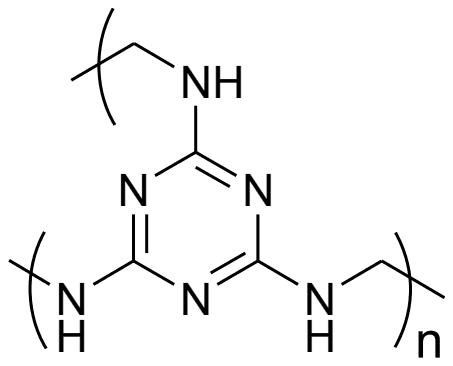
Consider the structure of a crosslinked polymer shown in the figure. From the options given, identify the monomers that are used in the synthesis of the polymer.

Repeat unit of a crosslinked polymer: a triazine ring whose three carbons each carry an NH group, each NH joined to a CH2 bridge leading to the next unit

Exam Year(s)

GATE XE - 2023,

Answer: C

The monomers are Melamine and Formaldehyde.

The repeat unit is a triazine ring carrying three NH groups, which is melamine (2,4,6-triamino-1,3,5-triazine) after condensation. The NH groups are linked to neighbouring units through single \(CH_{2}\) bridges. A methylene bridge between amino nitrogens is exactly what formaldehyde supplies: it first forms methylol groups (\(-NH-CH_{2}OH\)), which then condense with other amino groups, releasing water, to give \(-NH-CH_{2}-NH-\) crosslinks. This is melamine-formaldehyde resin.

Benzaldehyde would leave a phenyl-substituted bridge, acetone a \(C(CH_{3})_{2}\) bridge, and ethanol cannot form a bridge at all, so none of them fits a plain \(CH_{2}\) link.

Please log in or register to report this question.

4.

Phenol-formaldehyde resin is prepared by

Exam Year(s)

GATE XE - 2024,

Answer: A

Phenol-formaldehyde resin is made by condensation polymerization.

Phenol and formaldehyde react step by step, the methylol groups condensing with phenol rings to form methylene and ether bridges and releasing water at each step. A reaction that links monomers while eliminating a small molecule is a condensation (step-growth) polymerization; it gives the novolac and resol resins behind Bakelite.

Cationic and anionic polymerizations are chain-growth additions across double bonds with no by-product, and ring-opening polymerization needs a cyclic monomer such as a lactam or lactone.

Please log in or register to report this question.

5.

Match the Polymer with the most suitable Monomer combinations from which it is synthesized.

PolymerMonomer combinations
PPolyurethane1Maleic acid and propylene glycol
QEpoxy2Pyromellitic anhydride and p,p′-diamino diphenyl ether
RPolyimide3Epichlorohydrin and bisphenol A
SPolyester4Hexamethylene diisocyanate and tetramethylene glycol

Exam Year(s)

GATE XE - 2025,

Answer: A

The match is P-4; Q-3; R-2; S-1.

  • Polyurethane forms by the addition of a diisocyanate to a diol: hexamethylene diisocyanate and tetramethylene glycol (4).
  • Epoxy resin is made from epichlorohydrin and bisphenol A (3), the classic diglycidyl ether of bisphenol A.
  • Polyimide (as in Kapton) is made from pyromellitic dianhydride and 4,4′-diaminodiphenyl ether (2).
  • Unsaturated polyester is made from maleic acid (or anhydride) and propylene glycol (1).

The other options swap the epoxy and polyimide monomers or give polyurethane the anhydride-amine pair, which forms an imide, not a urethane link.

Please log in or register to report this question.

Answer: A

Resol is made from phenol with an excess of formaldehyde in presence of a base catalyst.

Under basic conditions with excess formaldehyde (typically a formaldehyde to phenol ratio above 1), phenol is methylolated at several positions, giving a low-molecular-weight resin rich in reactive methylol groups. Resols are 'one-stage' resins: on heating they cure by themselves without any added crosslinker.

Excess phenol with an acid catalyst gives novolac, a 'two-stage' resin that needs hexamethylenetetramine to cure. Excess phenol with base, or excess formaldehyde with acid, are not the standard routes to either, and an equimolar mixture at neutral pH reacts only slowly.

Please log in or register to report this question.

7.

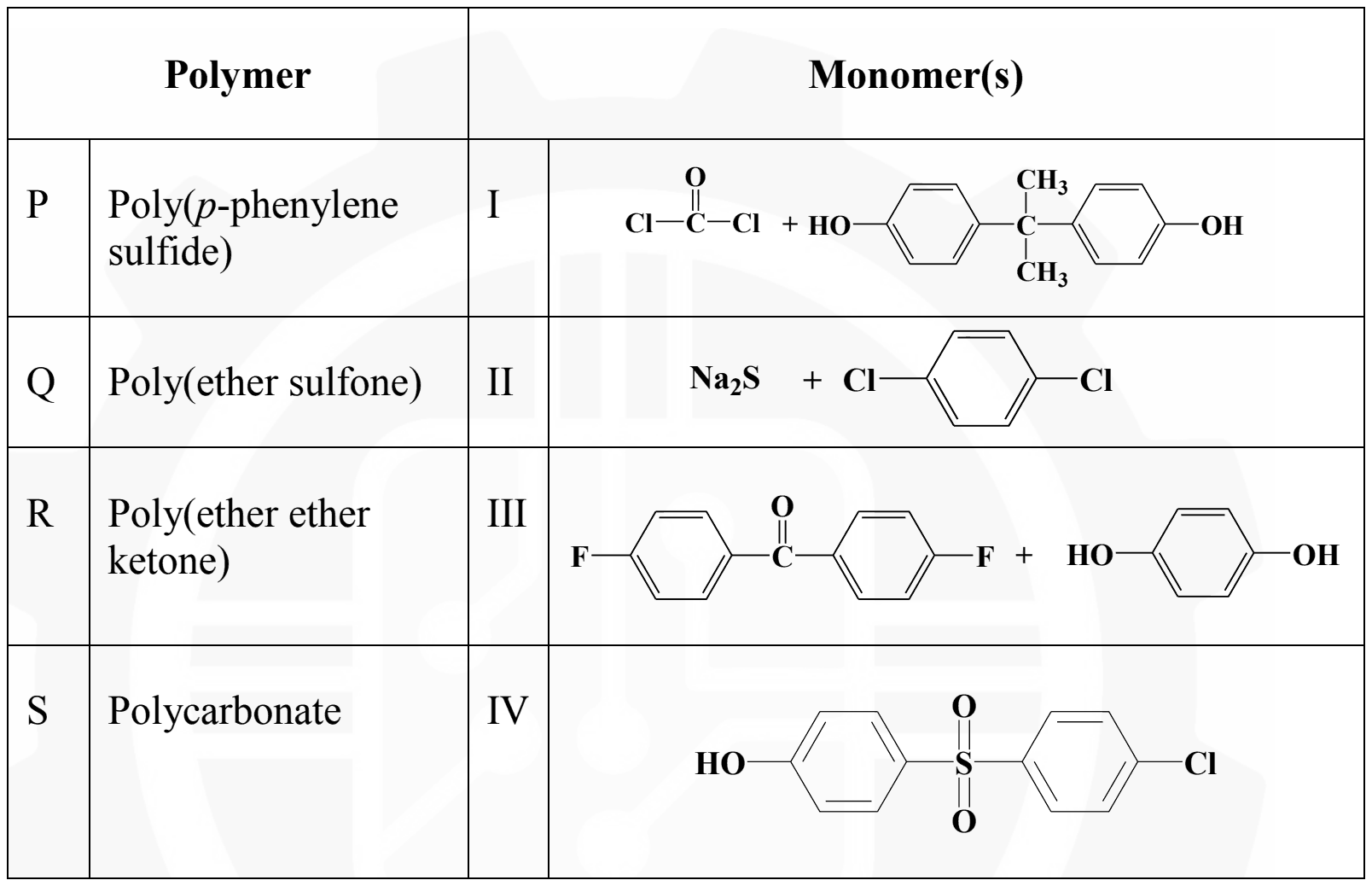
Select the correct option to match the Polymer to its most suitable Monomer(s) from the table given below:

Table. Polymers: P poly(p-phenylene sulfide), Q poly(ether sulfone), R poly(ether ether ketone), S polycarbonate. Monomers: I phosgene plus bisphenol A; II sodium sulfide plus p-dichlorobenzene; III 4,4-difluorobenzophenone plus hydroquinone; IV 4-chloro-4-hydroxydiphenyl sulfone

Exam Year(s)

GATE XE - 2026,

Answer: A

The correct matching is P-II ; Q-IV ; R-III ; S-I.

  • Poly(p-phenylene sulfide) is made from sodium sulfide and p-dichlorobenzene, joining benzene rings through sulfur (II).
  • Poly(ether sulfone) comes from the self-condensation of 4-chloro-4'-hydroxydiphenyl sulfone, which forms ether links between sulfone units (IV).
  • PEEK is made from 4,4'-difluorobenzophenone and hydroquinone, giving two ether links and one ketone per repeat unit (III).
  • Polycarbonate is made from phosgene and bisphenol A (I).

The other options assign the sulfone-containing monomer to PEEK or the phosgene route to a sulfide or sulfone polymer, which does not give the named backbone.

Please log in or register to report this question.

8.

In condensation polymerization the reactivity of a specific functional group :

Exam Year(s)

MH SET - 2020, SET Exam - 2020,

Answer: C

The reactivity is independent of molecular size.

This is Flory's principle of equal reactivity, the basic assumption of step-growth kinetics. The reactivity of a functional group such as -COOH or -OH does not depend on the size of the molecule it is attached to, because what matters is its local environment and its collisions with other groups, not how fast the whole molecule diffuses.

Experiments on polyesterification support this. So reactivity neither rises nor falls with chain length, and polarity combined with size is not a factor.

Please log in or register to report this question.

9.

Step reaction polymerization proceeds by :

Exam Year(s)

MH SET - 2021, SET Exam - 2021,

Answer: B

Step reaction polymerization proceeds by condensation polymerization.

In step-growth polymerization any two molecules carrying reactive functional groups (monomer, dimer or longer oligomer) can react with each other, and the chains build up stepwise. The usual examples, polyesters and polyamides such as nylon-6,6, link the monomers through a reaction that eliminates a small molecule such as water, which is why step-growth and condensation polymerization are commonly equated.

Addition polymerization, and its anionic and cationic forms, are chain-growth processes: an active centre (a radical, anion or cation) adds monomer units one after another to a single growing chain, and high polymer forms from the start of the reaction.

Please log in or register to report this question.

Loading…

Other Subjects

Tags: Step Growth Polymerisation Questions and Answers || Step Growth Polymerisation MCQ Questions and Answers || Step Growth Polymerisation GK Questions and Answers || Step Growth Polymerisation GK MCQ Questions || Step Growth Polymerisation Multiple Choice Questions and Answers || Step Growth Polymerisation GK || GK on Step Growth Polymerisation || Polymer Chemistry Questions and Answers || Polymer Chemistry MCQ Questions and Answers || Polymer Chemistry GK Questions and Answers || GK on Polymer Chemistry