
Machine-translated by Google. Questions are authored in English.
Top

Time Varying Fields and Maxwells Equations Questions and Answers

71.

Which of the following options is correct for transformation of electric field \(\vec{E}\) and magnetic field \(\vec{B}\) under time reversal, i.e., \(t \to -t\) ?

Exam Year(s)

GATE Physics - 2026,

Answer: C

Under time reversal \(\vec{E} \to \vec{E}\) and \(\vec{B} \to -\vec{B}\).

Charges do not change under \(t \to -t\), and the electric field is fixed by where the charges are, so \(\vec{E}\) is unchanged. Currents are charges in motion; reversing time reverses every velocity, so every current reverses, and the magnetic field produced by currents changes sign.

The Lorentz force confirms this: \(\vec{F} = q(\vec{E} + \vec{v} \times \vec{B})\) is even under time reversal (it is mass times acceleration), and \(\vec{v}\) is odd, so \(\vec{B}\) must be odd while \(\vec{E}\) is even. The other three combinations break this invariance.

Please log in or register to report this question.
72.

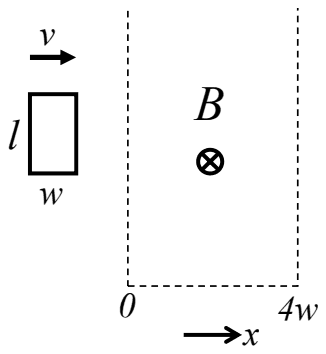
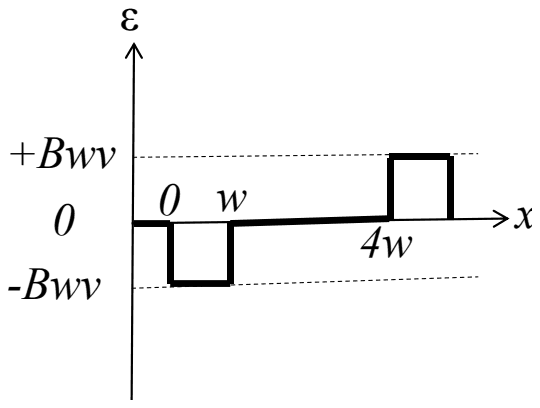
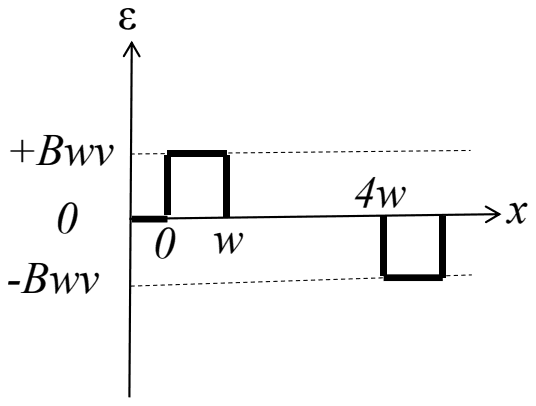
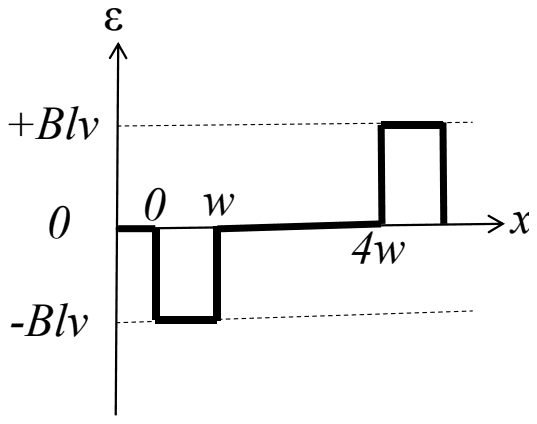
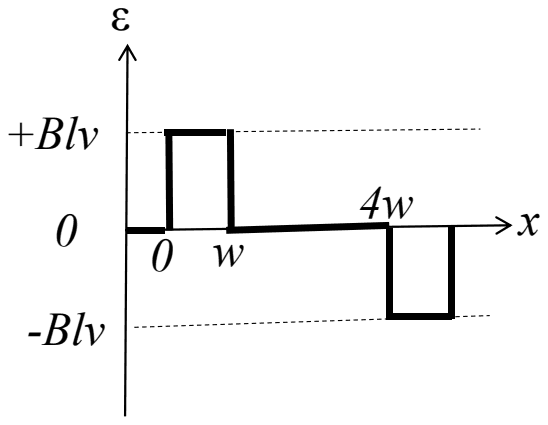
A rectangular loop of dimensions l and w moves with a constant speed of v through a region containing a uniform magnetic field B directed into the paper and extending a distance of 4w. Which of the following figures correctly represents the variation of emf (ε) with the position (x) of the front end of the loop?

A loop of width w along the motion and height l moves right at speed v towards a field region into the page that runs from x equals 0 to 4w

Exam Year(s)

IIT JAM - 2018,

Answer: C

The correct graph is (C).

The side of length l is perpendicular to the motion, so while the loop is entering or leaving the field the flux changes at the rate \(Blv\), and the emf has magnitude \(Blv\). This rules out (A) and (B), which use \(Bwv\).

  • From \(x = 0\) to \(w\) the loop enters and the inward flux grows, so \(\varepsilon = -d\Phi/dt = -Blv\).
  • From \(w\) to \(4w\) the loop is wholly inside and the flux is constant, so \(\varepsilon = 0\).
  • From \(4w\) to \(5w\) it leaves and the flux falls, so \(\varepsilon = +Blv\).

With inward flux counted positive, the pulse on entry is negative and on exit positive, as in (C); (D) has the signs reversed.

Please log in or register to report this question.
73.

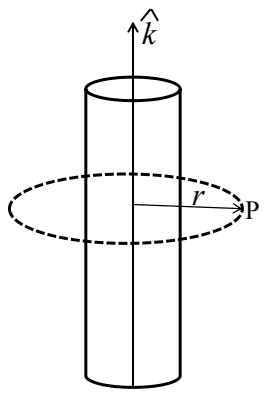
A long solenoid is carrying a time dependent current such that the magnetic field inside has the form \(\vec{B}(t) = B_{0} t^{2} \hat{k}\), where \(\hat{k}\) is along the axis of the solenoid. The displacement current at the point P on a circle of radius r in a plane perpendicular to the axis

A long vertical solenoid with its axis along k; a dashed circle of radius r centred on the axis, larger than the solenoid, with point P on the circle

Exam Year(s)

IIT JAM - 2018,

Answer: B

The displacement current at P is inversely proportional to r and tangential.

The changing flux inside the solenoid (radius a) induces a circulating electric field. Outside it, Faraday's law on a circle of radius r gives

\[ \begin{aligned} E \cdot 2\pi r &= -\frac{d}{dt}(B_{0}t^{2}\pi a^{2}) \\ E &= -\frac{B_{0} t\, a^{2}}{r} \end{aligned} \]

The displacement current density is \(\varepsilon_{0}\,\partial \vec{E}/\partial t = -\varepsilon_{0} B_{0} a^{2}/r\) along \(\hat{\phi}\): tangential, constant in time, and proportional to \(1/r\).

It is not radial, because the induced field circulates. It does not grow with time, because \(E\) is linear in \(t\) so its derivative is constant. The \(1/r^{2}\) option has the wrong dependence for a field produced by a fixed enclosed flux.

Please log in or register to report this question.
74.

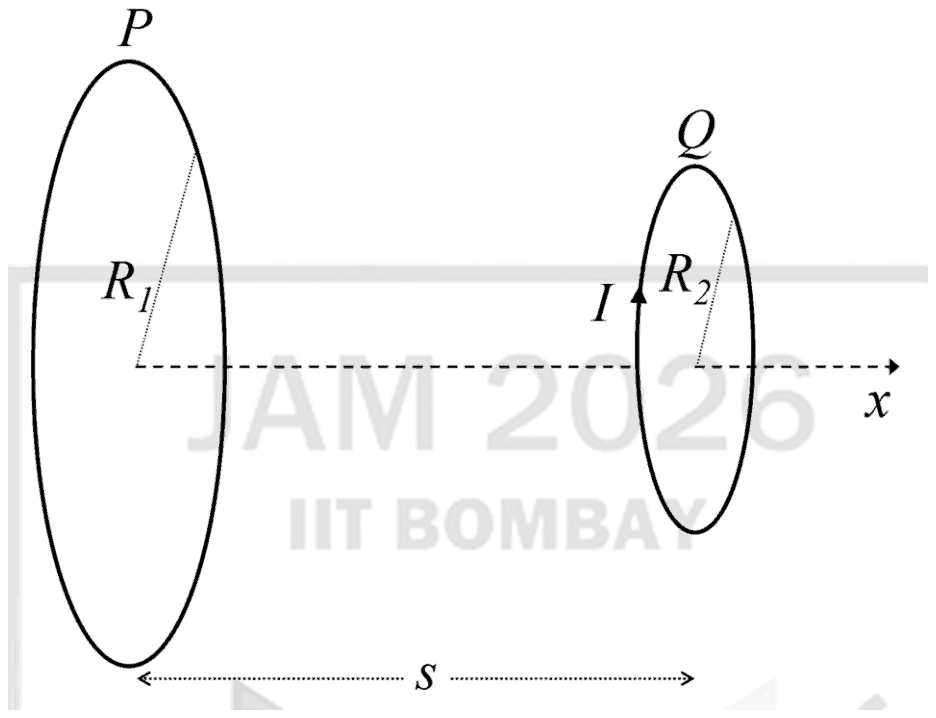
Two small circular copper loops P and Q of radii R1 and R2, respectively, are coaxially placed along the x-axis as shown in the figure. The loops are at a distance s apart, where s >> R1, R2. The loop Q carrying a steady current I is moving away along x-axis with a speed \(v\).

Which of the following statements is/are correct?

Loops P (radius R1) on the left and Q (radius R2, carrying current I) on the right, both perpendicular to and centred on the x axis, a distance s apart

Exam Year(s)

IIT JAM - 2026,

Answer: C

The correct statement is that the emf induced in loop P is \(\propto \frac{1}{s^4}\).

Because \(s\) is much larger than both radii, loop Q acts as a magnetic dipole \(m = I\pi R_2^2\), and its field on the axis at P falls off as the cube of the distance:

\[ \begin{aligned} B &= \frac{\mu_0 m}{2\pi s^{3}}, \quad \Phi_P \approx B\,\pi R_1^{2} \propto \frac{1}{s^{3}} \\ \varepsilon &= -\frac{d\Phi_P}{dt} = -\frac{d\Phi_P}{ds}\frac{ds}{dt} \propto \frac{v}{s^{4}} \end{aligned} \]

So the emf is proportional to \(1/s^4\) and to \(v\) to the first power.

The field at the centre of P goes as \(1/s^3\), not \(1/s^2\), and so does the flux, which rules out the first two statements. The emf is linear in \(v\), not proportional to \(v^2\).

Please log in or register to report this question.
75.

Match List I with List II.

List IList II
(a) Ohm's law at a point(i) ∇·D = ρ
(b) Kirchhoff's voltage law(ii) ∇·J = 0
(c) Kirchhoff's current law(iii) ΣV = I Σ R
(d) Gauss's law at a point(iv) J = σ E

Choose the most appropriate answer from the options given below :

Exam Year(s)

RSMSSB JE - 2025, RSMSSB - 2025,

Answer: A

The correct matching is (a)-(iv), (b)-(iii), (c)-(ii), (d)-(i).

  • Ohm's law at a point relates current density to field: J = σE, (iv).
  • Kirchhoff's voltage law says the emfs round a loop equal the IR drops: ΣV = IΣR, (iii).
  • Kirchhoff's current law in point form, for steady currents, is ∇·J = 0: no charge accumulates, (ii).
  • Gauss's law at a point is ∇·D = ρ, (i).

The other options swap the two Kirchhoff laws or pair Ohm's law with Gauss's law.

Please log in or register to report this question.
76.

What is the amplitude of the displacement current density in \(A/m^{2}\) inside a capacitor where \(\overline{D} =\) \(3 \times 10^{-7} \sin(6 \times 10^{7} t - 0{\cdot}35x)\,\hat{a}_{z}\) \(C/m^{2}\) and \(\epsilon_{r} = 100\).

Exam Year(s)

MH SET - 2018, SET Exam - 2018,

Answer: D

The amplitude is 18 A/m2.

The displacement current density is the time derivative of the electric flux density:

\[ \begin{aligned} J_{d} &= \frac{\partial D}{\partial t} \\ &= 3 \times 10^{-7} \times 6 \times 10^{7} \cos(\dots) \\ &= 18\cos(6 \times 10^{7}t - 0.35x)\ \text{A/m}^{2} \end{aligned} \]

The amplitude is 18 A/m2. The relative permittivity is not needed, because D is given directly; \(\epsilon_{r}\) would matter only if the field were given as E. The smaller options come from dropping or mis-multiplying the factors 3 and 6.

Please log in or register to report this question.
77.

The Maxwell's equation

\[ \begin{aligned} \nabla \times \bar{H} &= \Big(\bar{J}_{cond} \\ &\quad + \frac{\partial \bar{D}}{\partial t}\Big) \end{aligned} \]

for free space becomes :

Exam Year(s)

MH SET - 2018, SET Exam - 2018,

Answer: C

In free space the equation becomes \(\nabla \times \bar{H} = \dfrac{\partial \bar{D}}{\partial t}\).

Free space has no conductors and no free charges, so the conduction current density \(\bar{J}_{cond} = \sigma\bar{E}\) is zero (\(\sigma = 0\)). Only the displacement current term remains.

Setting the whole right side to zero would also drop the displacement current, which is what lets electromagnetic waves propagate through free space. Keeping only \(\bar{J}_{cond}\) is the form for a good conductor at low frequency, the opposite case, and 'infinite' has no physical meaning here.

Please log in or register to report this question.
78.

Match List I with List II and select the correct answer using codes given below :

List IList II
(a) Maxwell's equation based on Ampere's law(i) \(\nabla \cdot \bar{B} = 0\)
(b) Maxwell's second equation based on Faraday's law(ii) \(\nabla\times\bar{H}=\left(\bar{J}+\frac{\partial\bar{D}}{\partial t}\right)\)
(c) Maxwell's third equation based on Gauss' law(iii) \(\nabla \cdot \bar{D} = \rho\)
(d) Maxwell's fourth equation based on non-existence of magnetic monopole(iv) \(\nabla \times \bar{E} = \dfrac{-\partial \bar{B}}{\partial t}\)

Exam Year(s)

MH SET - 2018, SET Exam - 2018,

Answer: C

The correct matching is a-ii, b-iv, c-iii, d-i.

  • Ampere's law, with Maxwell's displacement current: \(\nabla \times \bar{H} = \bar{J} + \partial\bar{D}/\partial t\) (ii).
  • Faraday's law: \(\nabla \times \bar{E} = -\partial\bar{B}/\partial t\) (iv).
  • Gauss' law for electric fields: \(\nabla \cdot \bar{D} = \rho\) (iii).
  • No magnetic monopoles: \(\nabla \cdot \bar{B} = 0\) (i).

The curl equations describe circulation (Ampere and Faraday) and the divergence equations describe sources (charge, and the absence of magnetic charge). The near-miss code swaps the two divergence equations, giving the monopole law the charge density.

Please log in or register to report this question.

79.

A circular loop of radius r is placed in a magnetic field \(\vec{B}(t) = B_{0} e^{-\alpha t} \hat{z}\), \(B_{0}\) is constant. If the loop is in xy plane, then the induced emf in the loop is :

Exam Year(s)

MH SET - 2018, SET Exam - 2018,

Answer: B

The induced emf is \(\pi r^{2}\alpha B_{0} e^{-\alpha t}\).

The field is along z and the loop lies in the xy plane, so the flux is field times area:

\[ \begin{aligned} \Phi &= \pi r^{2} B_{0} e^{-\alpha t} \\ \varepsilon &= -\frac{d\Phi}{dt} = \pi r^{2}\alpha B_{0} e^{-\alpha t} \end{aligned} \]

The emf is not zero because the flux changes with time. The options with \(2\pi r\) use the circumference where Faraday's law needs the enclosed area; one of them also omits the factor \(\alpha\) that comes from differentiating the exponential.

Please log in or register to report this question.

Answer: B

The Lorentz gauge condition is \(\vec{\nabla}\cdot\vec{A}\) \(+ \mu_{0}\varepsilon_{0}\,\partial V/\partial t = 0\).

The Lorentz (Lorenz) gauge chooses the potentials so that the divergence of \(\vec{A}\) cancels the time derivative of V divided by \(c^{2}\). With \(c^{2} = 1/\mu_{0}\varepsilon_{0}\):

\[ \begin{aligned} &\vec{\nabla}\cdot\vec{A} \\ &+ \frac{1}{c^{2}}\frac{\partial V}{\partial t} = 0 \end{aligned} \]

In this gauge both V and \(\vec{A}\) satisfy inhomogeneous wave equations, and the condition is Lorentz invariant. Writing \(1/\mu_{0}\varepsilon_{0}\) instead multiplies by \(c^{2}\) where it should divide, the minus sign gives the wrong relative sign, and the second time derivative belongs to the wave equation, not the gauge condition.

Please log in or register to report this question.

Loading…

Other Subjects

Tags: Time Varying Fields and Maxwells Equations Questions and Answers || Time Varying Fields and Maxwells Equations MCQ Questions and Answers || Time Varying Fields and Maxwells Equations GK Questions and Answers || Time Varying Fields and Maxwells Equations GK MCQ Questions || Time Varying Fields and Maxwells Equations Multiple Choice Questions and Answers || Time Varying Fields and Maxwells Equations GK || GK on Time Varying Fields and Maxwells Equations || Electromagnetic Field Theory Questions and Answers || Electromagnetic Field Theory MCQ Questions and Answers || Electromagnetic Field Theory GK Questions and Answers || GK on Electromagnetic Field Theory