
Machine-translated by Google. Questions are authored in English.
Top

Geometry (Lines, Angles, Triangles, Polygons) Questions and Answers

Important Instructions
141.

Which of the following letters has no line of symmetry ?

Exam Year(s)

CTET - 2024,

Answer: A

The letter with no line of symmetry is L.

No line divides L into two mirror-image halves, vertically, horizontally or diagonally.

A and M each have a vertical line of symmetry, and X has both a vertical and a horizontal one.

Please log in or register to report this question.
142.

The area of an equilateral triangle is \(\sqrt{3}\). What is the perimeter of the triangle?

Exam Year(s)

GATE Physics - 2018, GATE AG - 2018,

Answer: C

The perimeter is 6.

An equilateral triangle of side \(a\) has area \(\frac{\sqrt{3}}{4}a^{2}\). Setting this equal to \(\sqrt{3}\):

\[ \begin{aligned} \frac{\sqrt{3}}{4}a^{2} &= \sqrt{3} \\ a^{2} &= 4, \quad a = 2 \end{aligned} \]

The perimeter is \(3a = 6\). 2 is the side itself, 4 is \(a^{2}\) or two sides, and 8 does not follow from the area.

Please log in or register to report this question.
143.

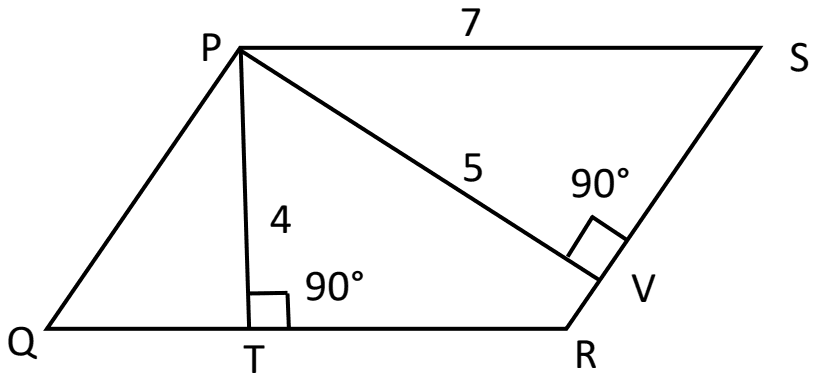
In the given figure, PQRS is a parallelogram with PS = 7 cm, PT = 4 cm and PV = 5 cm. What is the length of RS in cm? (The diagram is representative.)

Parallelogram PQRS with PS = 7 along the top; PT = 4 is perpendicular from P to QR, and PV = 5 is perpendicular from P to RS, meeting it at V

Exam Year(s)

GATE Physics - 2023, GATE AG - 2023,

Answer: B

RS is 28/5 cm.

The area of a parallelogram is any side times the perpendicular distance to it from the opposite side. PT is the height on base QR, and PV is the height on base RS.

\[ \begin{aligned} QR \times PT &= RS \times PV \\ 7 \times 4 &= RS \times 5 \\ RS &= \frac{28}{5} = 5.6\ \text{cm} \end{aligned} \]

QR equals PS = 7 cm because opposite sides of a parallelogram are equal. 20/7 is PT times PV divided by PS, which mixes the two heights, and 35/4 is PS times PV over PT, which pairs each height with the wrong base.

Please log in or register to report this question.
144.

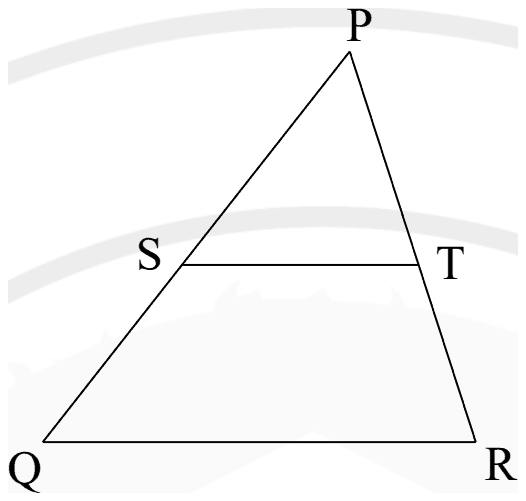
In the diagram, the lines QR and ST are parallel to each other. The shortest distance between these two lines is half the shortest distance between the point P and line QR. What is the ratio of the area of the triangle PST to the area of the trapezium SQRT?

Note: The figure shown is representative.

Triangle PQR with P at the top and base QR; S lies on PQ and T on PR, with ST drawn parallel to QR

Exam Year(s)

GATE AG - 2025,

Answer: A

The ratio is \(\frac{1}{3}\).

Let the distance from P to QR be \(h\). The gap between ST and QR is \(h/2\), so ST is at a distance \(h/2\) from P, halfway down. Because ST is parallel to QR, triangle PST is similar to triangle PQR with ratio \(1:2\), and areas scale as the square of that ratio:

\[ \begin{aligned} \text{Area}(PST) &= \tfrac{1}{4}\,\text{Area}(PQR) \\ \text{Area}(SQRT) &= \tfrac{3}{4}\,\text{Area}(PQR) \\ \text{ratio} &= \frac{1/4}{3/4} = \frac{1}{3} \end{aligned} \]

\(\frac{1}{4}\) is the ratio of triangle PST to the whole triangle PQR, not to the trapezium, and \(\frac{1}{2}\) is the ratio of the lengths ST and QR, not of the areas.

Please log in or register to report this question.
145.

Circles \(C_{1}\), \(C_{2}\), and \(C_{3}\), with centers \(O_{1}\), \(O_{2}\), and \(O_{3}\), and radii \(r_{1}\), \(r_{2}\), and \(r_{3}\), respectively, touch each other as shown in the following figure. Given \(r_{1} = 2\) cm, \(r_{2} = 1\) cm and the angle \(\angle O_{1}O_{3}O_{2}\) is 90°, \(r_{3} =\) _____ cm.

[In the figure each circle touches the other two externally: \(C_{1}\) and \(C_{2}\) touch side by side, \(C_{3}\) sits above the point where they meet, and \(O_{3}\) is joined to \(O_{1}\) and to \(O_{2}\) with a right angle marked at \(O_{3}\).]

Exam Year(s)

GATE AG - 2026,

Answer: A

The radius is \(r_{3} = \frac{1}{2}(-3 + \sqrt{17})\) cm.

When two circles touch externally, the distance between their centres is the sum of their radii. So \(O_{1}O_{2} = 2 + 1 = 3\), \(O_{1}O_{3} = 2 + r_{3}\) and \(O_{2}O_{3} = 1 + r_{3}\). The right angle at \(O_{3}\) makes \(O_{1}O_{2}\) the hypotenuse of triangle \(O_{1}O_{3}O_{2}\):

\[ \begin{aligned} (2 + r)^{2} + (1 + r)^{2} &= 3^{2} \\ 2r^{2} + 6r + 5 &= 9 \\ r^{2} + 3r - 2 &= 0 \end{aligned} \]

\[ \begin{aligned} r &= \frac{-3 \pm \sqrt{9 + 8}}{2} \\ &= \frac{-3 \pm \sqrt{17}}{2} \end{aligned} \]

A radius must be positive, so \(r_{3} = (-3 + \sqrt{17})/2 \approx 0.56\) cm, which fits the small circle in the figure. \((3 + \sqrt{17})/2\) has the wrong sign on 3, \((-2 + \sqrt{17})/2\) has the wrong linear coefficient, and \((-3 + 2\sqrt{17})/2 \approx 2.6\) would make \(C_{3}\) larger than \(C_{1}\).

Please log in or register to report this question.
146.

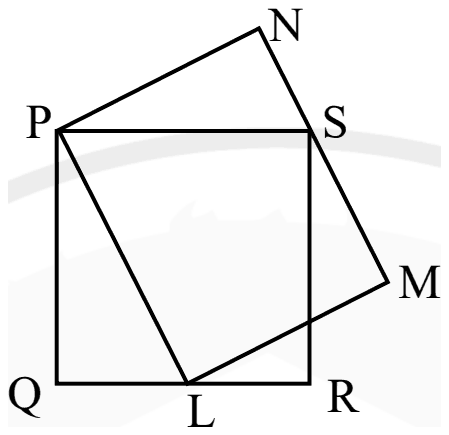
In the given figure, PQRS is a square of side 2 cm and PLMN is a rectangle. The corner L of the rectangle is on the side QR. Side MN of the rectangle passes through the corner S of the square.

What is the area (in cm2) of the rectangle PLMN?

Note: The figure shown is representative.

Square PQRS with P top left, Q bottom left, R bottom right and S top right; rectangle PLMN with L on side QR, M outside the square to the right, and side MN passing through S, with N above the square

Exam Year(s)

GATE CS - 2025,

Answer: D

The area of the rectangle is 4 cm2.

Look at the triangle PLS. Measured against the square, it has base PS (a side, 2 cm) and its third vertex L on the opposite side QR, so its height is also 2 cm:

\[ \tfrac{1}{2} \times 2 \times 2 = 2\ \text{cm}^{2} \]

Measured against the rectangle, the same triangle has base PL (a side of the rectangle) and its third vertex S on the opposite side MN. A triangle on one side of a rectangle with its apex on the opposite side has half the rectangle's area. So the rectangle's area is 2 × 2 = 4 cm2, the same as the square's, wherever L lies on QR.

2 is the triangle's area, 8 doubles the square, and 2√2 is the length of the square's diagonal, not an area.

Please log in or register to report this question.
147.

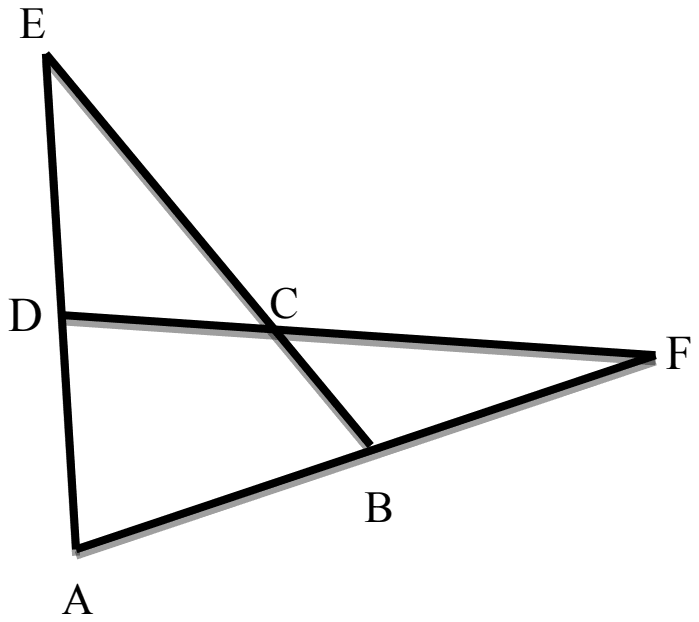
In the figure below, \(\angle DEC + \angle BFC\) is equal to ____________ .

Points A, D, E lie on one line and A, B, F on another; line EB and line DF cross at C

Exam Year(s)

GATE CS - 2018,

Answer: A

\(\angle DEC + \angle BFC\) equals \(\angle BCD - \angle BAD\).

In the figure A, D, E lie on one line and A, B, F on another, and EB and DF cross at C. Write \(A = \angle BAD\), \(E = \angle DEC\) and \(F = \angle BFC\).

Triangle AEB gives the angle at B, triangle AFD the angle at D, and the angles of quadrilateral ABCD sum to 360°:

\[ \begin{aligned} \angle ABC &= 180^\circ - A - E \\ \angle ADC &= 180^\circ - A - F \\ \angle BCD &= 360^\circ - A - \angle ABC - \angle ADC \\ &= A + E + F \end{aligned} \]

So \(E + F = \angle BCD - \angle BAD\). The options that add \(\angle BAD\) instead of subtracting it overshoot by \(2\angle BAD\), and \(\angle CBA + \angle ADC\) equals \(360^\circ - 2A - E - F\), not \(E + F\).

Please log in or register to report this question.

148.

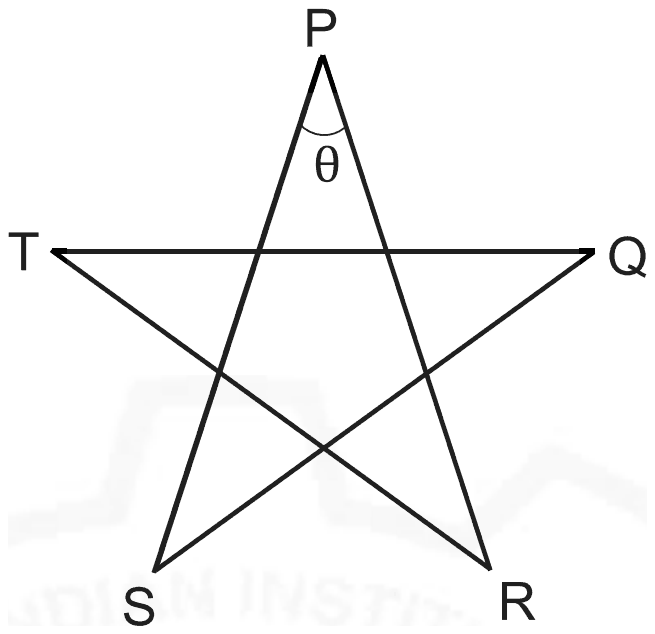
A five-pointed star with points P at the top, Q upper right, R lower right, S lower left and T upper left, and the angle theta marked at P

Five line segments of equal lengths, PR, PS, QS, QT and RT are used to form a star as shown in the figure above.

The value of θ, in degrees, is ______

Exam Year(s)

GATE Chemistry - 2021,

Answer: A

The angle θ is 36 degrees.

Five equal segments joined this way form a regular pentagram, whose vertices lie on a regular pentagon. The angle at a point of the star is an inscribed angle standing on one side of that pentagon, which subtends 360/5 = 72 degrees at the centre:

\[ \theta = \frac{1}{2} \times 72^{\circ} = 36^{\circ} \]

Check: the five point angles of any five-pointed star add up to 180 degrees, and 5 × 36 = 180. 72 degrees is the central angle, 108 degrees is the interior angle of the pentagon, and 45 has no place in a five-fold figure.

Please log in or register to report this question.

149.

Visualize two identical right circular cones such that one is inverted over the other and they share a common circular base. If a cutting plane passes through the vertices of the assembled cones, what shape does the outer boundary of the resulting cross-section make?

Exam Year(s)

GATE Chemistry - 2024,

Answer: A

The outline is a rhombus.

A plane through both apexes contains the common axis of the two cones. It cuts each cone in an isosceles triangle whose base is a diameter of the shared circular base. The two triangles share that diameter as a common side and point in opposite directions, so together they form a quadrilateral with all four sides equal to the slant height: a rhombus.

A single triangle would come from cutting one cone only. An ellipse arises when a plane cuts a cone without passing through its apex, and a hexagon cannot come from two cones.

Please log in or register to report this question.

150.

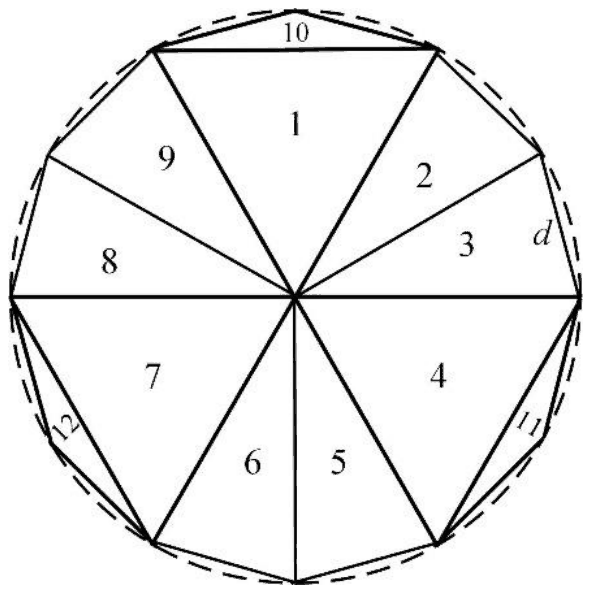
A regular dodecagon (12-sided regular polygon) is inscribed in a circle of radius r cm as shown in the figure. The side of the dodecagon is d cm. All the triangles (numbered 1 to 12) in the figure are used to form squares of side r cm and each numbered triangle is used only once to form a square.

The number of squares that can be formed and the number of triangles required to form each square, respectively, are:

Note: The figure shown is representative.

Regular dodecagon in a dashed circle, cut into 12 numbered triangles: nine meeting at the centre (1 to 9) and three thin triangles (10, 11, 12) along the edge; one side is labelled d.

Exam Year(s)

GATE Chemistry - 2025,

Answer: A

The answer is 3 squares, with 4 triangles each.

The dodecagon is made of 12 central triangles with apex angle 30 degrees, so its area is

\[ 12 \times \tfrac{1}{2} r^2 \sin 30^{\circ} = 3r^2, \]

exactly three squares of side r. Twelve triangles shared among 3 squares means 4 per square.

The pieces do fit that way. Triangles 1, 4 and 7 are equilateral with side r (area \(\frac{\sqrt{3}}{4}r^2\)), each thin edge triangle 10, 11, 12 has area \(\frac{2 - \sqrt{3}}{4}r^2\), and the six 30-degree triangles have area \(\frac{1}{4}r^2\) each. One equilateral, one thin and two 30-degree triangles total \(r^2\). 4 squares would need more area than the dodecagon has, and 3 or 2 triangles per square would leave pieces over.

Please log in or register to report this question.

Loading…
Tags: Geometry Lines, Angles, Triangles Questions || Polygons MCQ Questions and Answers || Geometry Quantitative Aptitude || Angles and Triangles GK Questions || Quantitative Aptitude Geometry GK