Machine-translated by Google. Questions are authored in English.
Top

Organometallic Chemistry Questions and Answers

1.

The number of terminal carbonyl groups present in Fe2(CO)9 is

Exam Year(s)

GATE Chemistry - 2012,

Answer: C

Fe2(CO)9 has 6 terminal carbonyl groups.

Diiron nonacarbonyl has two Fe(CO)3 units joined by three bridging (μ2) CO ligands: (CO)3Fe(μ-CO)3Fe(CO)3. That accounts for all nine: 3 + 3 terminal and 3 bridging. Its IR spectrum shows terminal CO stretches near 2000 cm-1 and a bridging CO stretch near 1830 cm-1.

3 is the number of bridging carbonyls, not terminal ones. 2 and 5 do not fit the structure at all: with three bridges, the remaining six CO ligands are shared equally, three on each iron.

Please log in or register to report this question.
2.

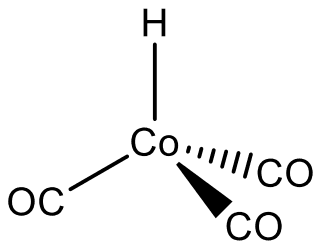
An intermediate formed during the hydroformylation of olefins using Co2(CO)8 as catalyst is

Exam Year(s)

GATE Chemistry - 2012,

Answer: D

The intermediate is HCo(CO)4.

In the cobalt oxo process, Co2(CO)8 reacts with H2 to give the hydride HCo(CO)4, an 18-electron species. It loses one CO to form the 16-electron HCo(CO)3, which binds the olefin, inserts it into the Co-H bond, takes up CO, inserts that into the Co-alkyl bond to form an acyl, and finally releases the aldehyde by hydrogenolysis, regenerating HCo(CO)4.

HCo(CO)6 would be a 22-electron complex. H4Co(CO)3 and H2Co(CO)4 are not intermediates of the accepted (Heck-Breslow) cycle, whose catalyst-carrying species is the tetracarbonyl hydride.

Please log in or register to report this question.
Answer: C

The incorrect statement is All the Pt-Cl bond lengths in Zeise's salt are equal.

Zeise's salt is K[PtCl3(C2H4)]·H2O. The ethylene exerts a strong trans influence, so the Pt-Cl bond trans to it is longer (about 2.34 Å) than the two mutually trans Pt-Cl bonds (about 2.30 Å). The three bonds are not equal.

The other statements are true. Platinum is +2 (three chlorides, neutral ethylene, overall charge -1). A square-planar d8 Pt(II) complex is diamagnetic. Back-donation from Pt d orbitals into ethylene's π* orbital lengthens the C=C bond, to about 1.37 Å against 1.34 Å in free ethylene.

Please log in or register to report this question.
4.

The product formed in the reaction of MeMn(CO)5 with 13CO is

Exam Year(s)

GATE Chemistry - 2017,

Answer: C

The product is (MeCO)Mn(CO)4(13CO).

The reaction is a migratory insertion. The methyl group moves from manganese onto a CO ligand already bound cis to it, forming an acetyl group and leaving a vacant site. The incoming 13CO then fills that site. So the label ends up as a terminal carbonyl, and the acetyl carbonyl carbon is unlabelled 12C.

The labelled acetyl options would need the incoming 13CO to insert directly into the Mn-CH3 bond, which labelling experiments of exactly this kind showed does not happen. (MeCO)Mn(CO)5 with no label would need the vacant site to be filled by unlabelled CO, but the only free CO present is the added 13CO.

Please log in or register to report this question.
5.

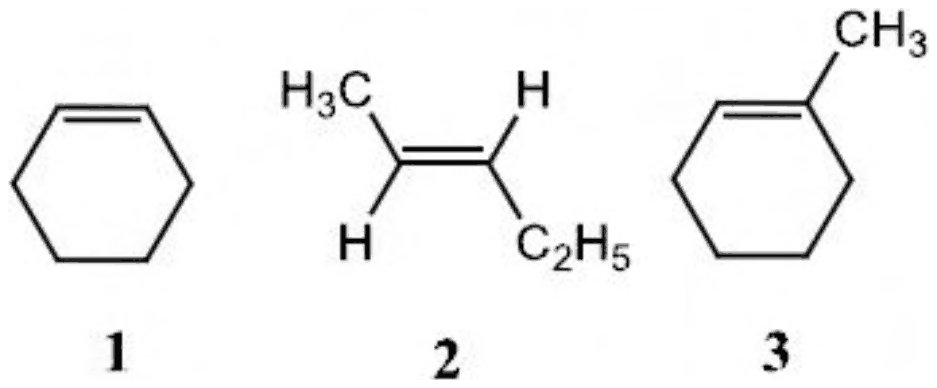
For the following three alkenes, 1, 2 and 3, the rates of hydrogenation using Wilkinson's catalyst at 25 °C vary in the order

Alkene 1 is cyclohexene, alkene 2 is trans-2-pentene and alkene 3 is 1-methylcyclohexene

Exam Year(s)

GATE Chemistry - 2017,

Answer: B

The hydrogenation rates vary as 1 \(\gt\) 2 \(\gt\) 3.

Wilkinson's catalyst, RhCl(PPh3)3, is bulky, and the alkene must coordinate to rhodium crowded by triphenylphosphine ligands, so the rate falls steeply as the alkene becomes more substituted and hindered.

  • Cyclohexene (1) is a cis-disubstituted alkene, the least hindered of the three, and is hydrogenated fastest.
  • trans-2-Pentene (2) is also disubstituted, but trans alkenes bind and react more slowly than cis ones.
  • 1-Methylcyclohexene (3) is trisubstituted and reacts slowest of all.

Any order that puts the trisubstituted alkene ahead of a disubstituted one, or the trans alkene ahead of cyclohexene, runs against this steric control.

Please log in or register to report this question.
6.

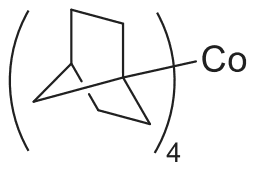
The geometry and the number of unpaired electrons in tetrakis(1-norbornyl)Co

Four 1-norbornyl groups bonded to Co through the bridgehead carbon

respectively, are:

Exam Year(s)

GATE Chemistry - 2021,

Answer: A

The complex is tetrahedral, with one unpaired electron.

Four 1-norbornyl groups make cobalt Co(IV), d5. The ligands are very bulky, which enforces a tetrahedral arrangement, and they are attached through a bridgehead carbon whose beta hydrogens cannot be eliminated (Bredt's rule forbids the bridgehead alkene), which is why this unusual alkyl survives.

Alkyl groups are strong σ-donors, and with a high oxidation state the tetrahedral splitting is large enough to give a low-spin configuration, e4t21: one unpaired electron. Five unpaired electrons would be the high-spin d5 case, and the square planar options ignore the steric demand of four such large groups.

Please log in or register to report this question.
7.

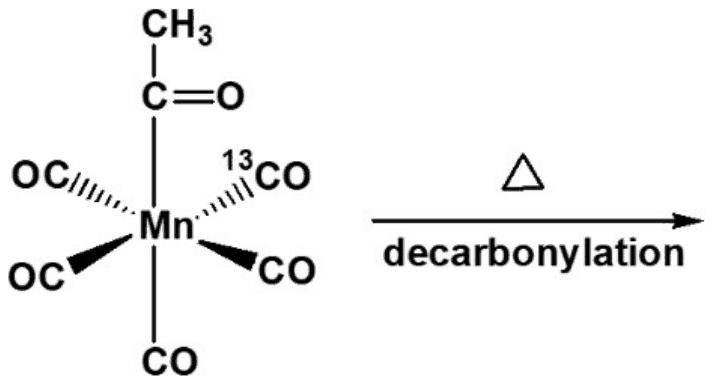
The CORRECT distribution of the products in the following reaction is

Octahedral CH3C(O)Mn(CO)4(13CO) with the 13CO cis to the acetyl group, heated (decarbonylation)

Exam Year(s)

GATE Chemistry - 2022,

Answer: C

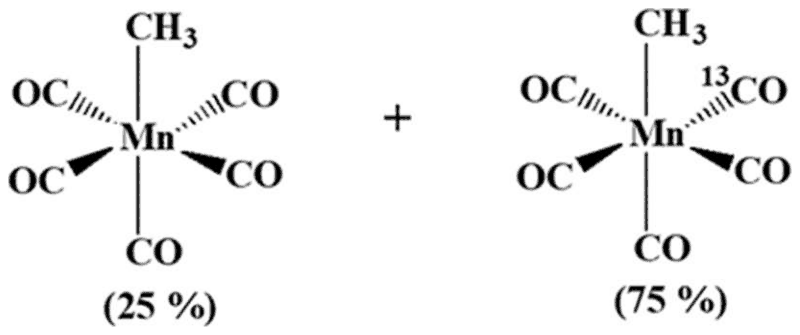
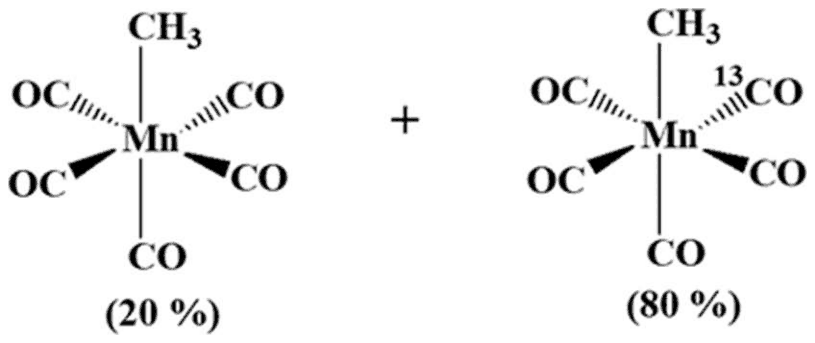
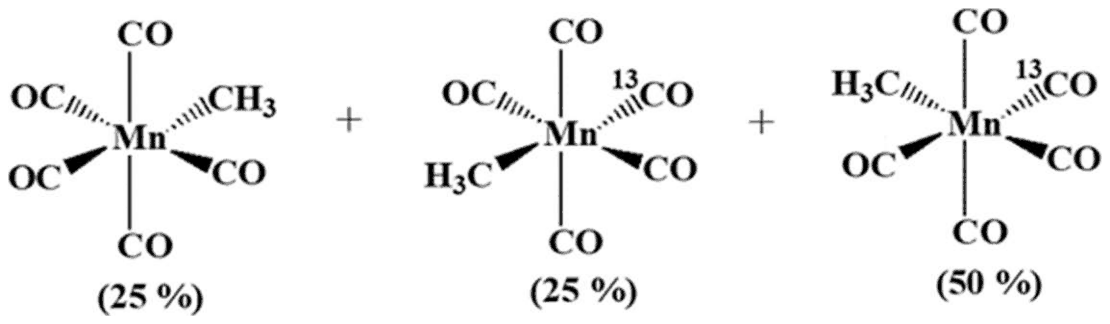
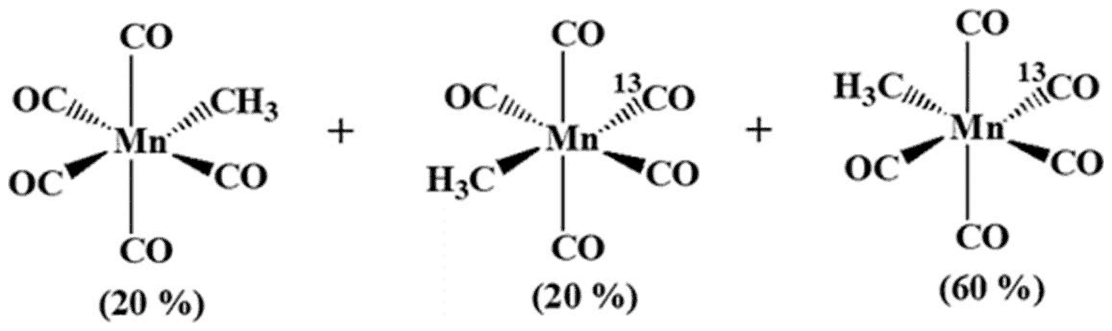
The distribution is (C): 25% unlabelled CH3Mn(CO)5, 25% with the CH3 trans to 13CO and 50% with the CH3 cis to 13CO.

Decarbonylation is the reverse of migratory insertion: a CO cis to the acetyl group dissociates, and the methyl then migrates from the acyl carbon onto the vacated site, while the acyl CO stays where the acetyl group was. The four CO ligands cis to the acetyl, one of them 13CO, are equally likely to be lost.

  • If the 13CO is the one lost (1 chance in 4), the product carries no label: 25%.
  • Otherwise the vacancy is at one of the other three cis sites. One of them lies opposite the 13CO in the equatorial plane, so methyl there ends up trans to 13CO: 25%.
  • The other two are adjacent to the 13CO, giving methyl cis to 13CO: 50%.

(A) and (B) keep the methyl in the acetyl position, as if the acyl CO itself were simply lost, and (D) has the right products in the wrong proportions.

Please log in or register to report this question.
8.

Wacker oxidation of alkenes is catalyzed by a combination of

Exam Year(s)

GATE Chemistry - 2023,

Answer: A

The Wacker process uses Pd(II) and Cu(II).

Pd(II) does the chemistry: it binds the alkene, water attacks the coordinated alkene, and β-hydride elimination releases the carbonyl compound (ethylene gives acetaldehyde), leaving Pd(0). Cu(II) chloride reoxidises Pd(0) to Pd(II) and is itself reduced to Cu(I), which air (O2) turns back into Cu(II). So palladium is the catalyst and copper the co-catalyst that lets oxygen act as the final oxidant.

Cobalt and nickel play no part in the Wacker process. Cobalt carbonyls are known for hydroformylation, and nickel cannot replace copper as the redox shuttle for palladium here.

Please log in or register to report this question.
9.

The organometallic catalyst for the following transformation is

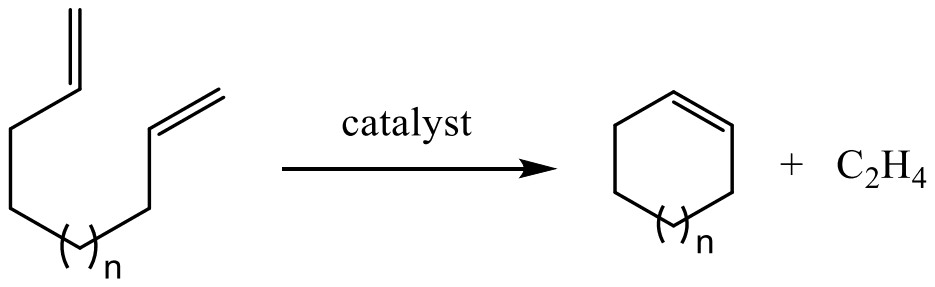
An acyclic alpha,omega-diene closes to a cycloalkene with loss of ethylene (C2H4) in the presence of a catalyst

Exam Year(s)

GATE Chemistry - 2023,

Answer: A

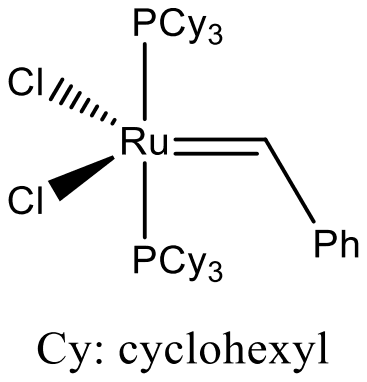
The catalyst is (A), the first-generation Grubbs catalyst RuCl2(PCy3)2(=CHPh).

The transformation joins the two ends of an α,ω-diene into a cycloalkene and releases ethylene: ring-closing metathesis. It needs a metal carbene (alkylidene) that undergoes [2+2] cycloaddition with an alkene to a metallacyclobutane and cycloreversion, exchanging alkylidene partners; the escape of ethylene drives the reaction. The Grubbs ruthenium benzylidene is the classic catalyst.

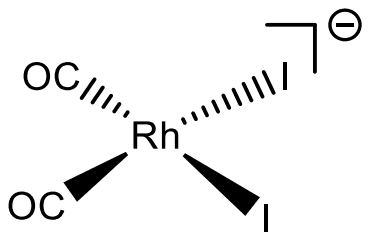
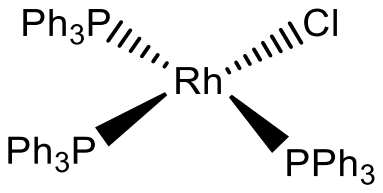
The other complexes have no carbene and catalyse other reactions: RhCl(PPh3)3 (Wilkinson's catalyst) is for hydrogenation, HCo(CO)4 for hydroformylation, and [RhI2(CO)2]− for methanol carbonylation (the Monsanto acetic acid process).

Please log in or register to report this question.
Answer: C

The product is (η5-C5H5)(η3-C5H7)Ni.

Nickelocene has 20 valence electrons (Ni(II) d8 plus two 6-electron Cp− rings), two more than the 18-electron ideal, and readily reacts to lose that excess. Sodium amalgam in ethanol reduces one Cp ring and ethanol protonates it, adding two hydrogens to give a cyclopentenyl ligand, C5H7, bound as an η3-allyl. The product, CpNi(η3-C5H7), is an 18-electron complex (Ni 10, Cp 5, allyl 3 in the neutral count).

(η5-C5H5)(η3-C5H5)Ni and (η3-C5H5)2Ni only change hapticity and add no hydrogen, so they are not reduction products. (η3-C5H7)2Ni would require both rings to be reduced, giving a 16-electron complex rather than the observed product.

Please log in or register to report this question.
Loading…

Other Subjects

Tags: Organometallic Chemistry Questions and Answers