Machine-translated by Google. Questions are authored in English.
Top

Stereochemistry Questions and Answers

Direction for [ Question No: 1 To 1 ] :

Statement for Linked Answer Questions:

Bromine water is decolourised upon reaction with (E)-3-hexene.

1.

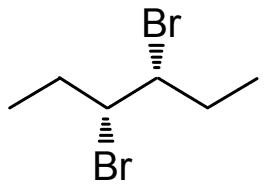
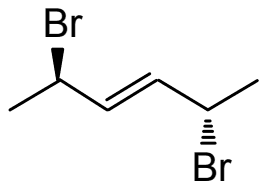
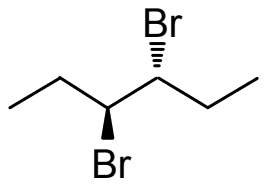
The structure of the product obtained is

Exam Year(s)

GATE Life Sciences - 2012,

Answer: C

The product is (C), meso-3,4-dibromohexane.

Addition of bromine through a bromonium ion is anti: the two bromine atoms add to opposite faces of the double bond. Anti addition to a trans (E) alkene gives the meso product, while anti addition to the cis alkene gives the racemic pair. With identical ethyl groups at both ends, (E)-3-hexene therefore gives (3R,4S)-3,4-dibromohexane, which is meso.

Assigning configurations to the drawings: in C one bromine is wedged and the other hashed on the zigzag chain, which works out as R at one centre and S at the other, the meso form. A (both hashed) and D (both wedged) are each one enantiomer of the chiral (R,R)/(S,S) pair, the product a syn addition would give. B, 2,5-dibromohex-3-ene, would come from allylic bromination, which does not occur here.

Please log in or register to report this question.
2.

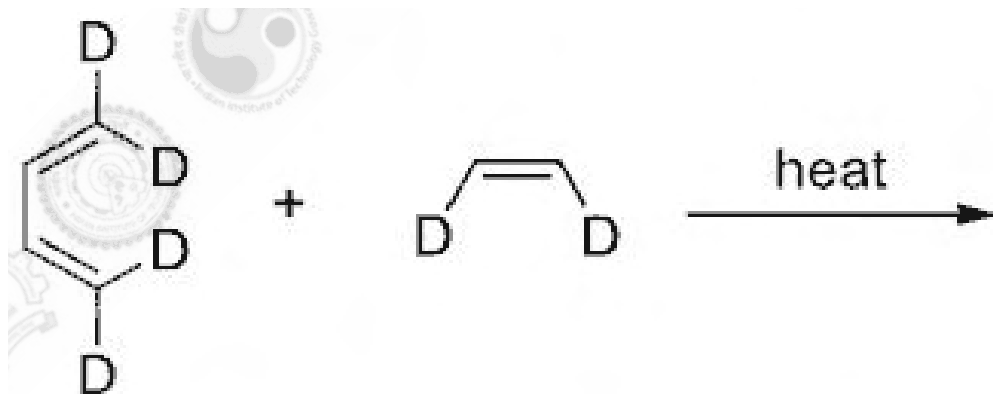
The product formed in the following reaction is

A tetradeuterated 1,3-butadiene and cis-1,2-dideuterioethylene heated together

Exam Year(s)

GATE Chemistry - 2017,

Answer: D

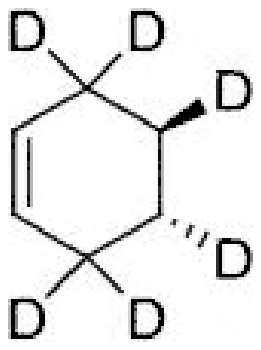
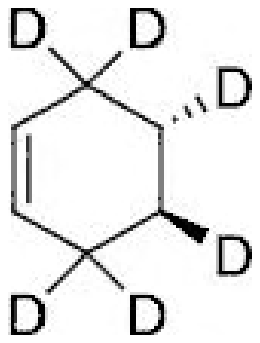
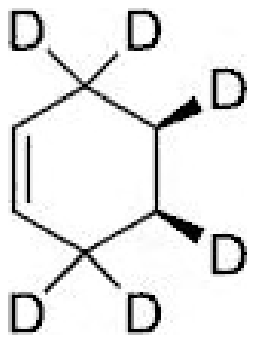
The product is (D), with the two deuteriums from the dienophile cis to each other.

The Diels-Alder reaction is a concerted [4+2] cycloaddition that is suprafacial on the dienophile: both new bonds form on the same face of the alkene at the same time, so the relative stereochemistry of the dienophile is kept in the product. The dienophile here is cis-1,2-dideuterioethylene, so its two deuteriums end up cis on adjacent ring carbons, both drawn with wedges in (D). The deuteriums on the diene termini become the two CD2 groups.

(B) and (C) both show the two deuteriums trans, the product a trans dienophile would give. A 1:1 mixture of cis and trans (A) would require a stepwise reaction through an intermediate that can rotate, which the concerted cycloaddition does not have.

Please log in or register to report this question.

3.

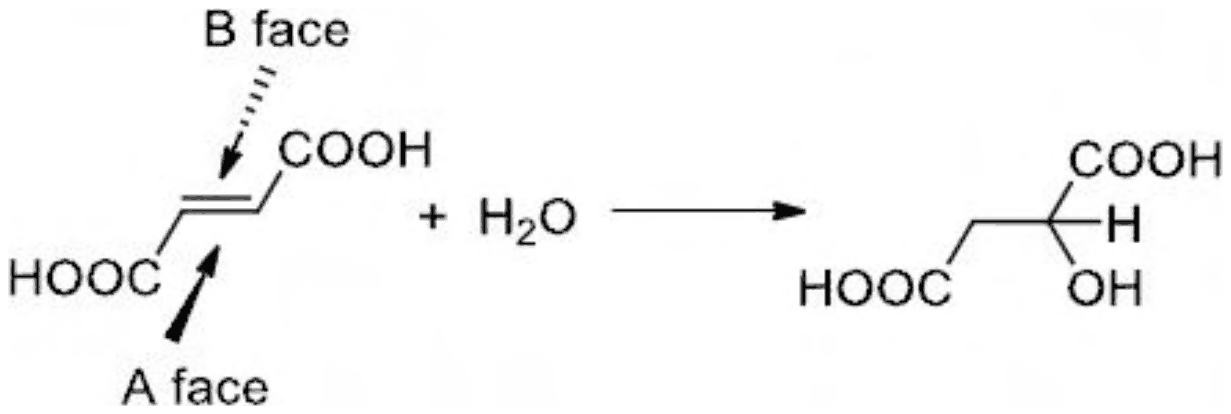
Hydration of fumaric acid gives malic acid as shown below. Assume that addition of water takes place specifically from A face or B face. The correct statement pertaining to stereochemistry of malic acid formed is

Fumaric acid drawn in the plane of the page, with the A face arrow in front (bold) and the B face arrow behind (hashed), adds water to give malic acid

Exam Year(s)

GATE Chemistry - 2017,

Answer: A

The correct statement is that addition specifically from the A face gives the S isomer of malic acid.

Fumaric acid is planar, and its two faces are enantiotopic: adding water to one face gives one enantiomer of malic acid, and adding it to the other face gives the other. In the drawing, the A face arrow is drawn bold, in front of the page, and the B face arrow hashed, behind it.

Take OH arriving from the A face at the carbon on the left, bonded to the HOOC group. The new stereocentre carries OH (priority 1), COOH (2), CH2COOH (3) and H (4). With the OH in front and the H in the plane of the page, pointing up and to the left, the sequence 1 \(\to\) 2 \(\to\) 3 viewed from the side opposite the hydrogen runs anticlockwise, so the centre is S. Addition from the B face therefore gives R.

That rules out 'A face gives R' and 'B face gives S'. Addition specifically from one face cannot give a racemic mixture, which needs both faces to react equally. (The enzyme fumarase does this addition stereospecifically and gives L-malic acid, which is S.)

Please log in or register to report this question.
4.

The rates of alkaline hydrolysis of the compounds shown below

Three 4-t-butylcyclohexane derivatives: I the carboxamide, wedge-wedge; II the ethyl ester, t-Bu wedge and ester hashed; III the ethyl ester, wedge-wedge

follow the order:

Exam Year(s)

GATE Chemistry - 2021,

Answer: C

The order is II \(\gt\) III \(\gt\) I.

The t-butyl group locks each ring in the chair with t-Bu equatorial. In II the ester is trans to t-Bu (one wedge, one hash, 1,4), so it is also equatorial. In III the ester is cis to t-Bu (both wedges), so it is forced axial.

Alkaline hydrolysis goes through a crowded tetrahedral intermediate at the carbonyl carbon. An equatorial ester is less hindered than an axial one, which suffers 1,3-diaxial interactions, so II reacts faster than III. Compound I is an amide: the nitrogen lone pair is strongly delocalised into the carbonyl and NH2− is a very poor leaving group, so amides are hydrolysed far more slowly than esters whatever their conformation.

Any order placing I first, or III ahead of II, contradicts these two effects.

Please log in or register to report this question.
5.

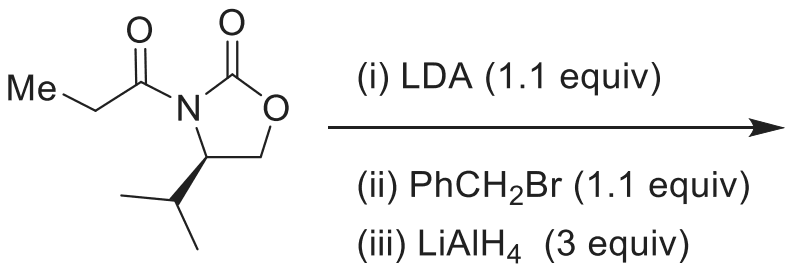
The major product formed in the following reaction

N-Propionyl oxazolidinone bearing a 4-isopropyl group on a wedged bond, treated with (i) LDA (1.1 equiv), (ii) PhCH2Br (1.1 equiv), (iii) LiAlH4 (3 equiv)

is:

Exam Year(s)

GATE Chemistry - 2021,

Answer: A

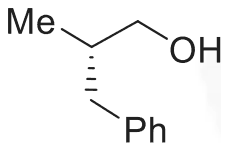
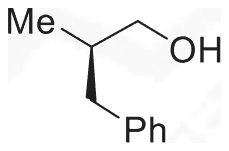
The product is (A), (S)-2-methyl-3-phenylpropan-1-ol.

This is an Evans asymmetric alkylation. The auxiliary drawn, with the isopropyl group on a wedge, is (R)-4-isopropyloxazolidin-2-one. LDA forms the (Z)-enolate, held rigid by lithium chelated between the enolate oxygen and the ring carbonyl oxygen. The isopropyl group then covers one face of the enolate, and benzyl bromide alkylates it from the other face, giving essentially one diastereomer.

Excess LiAlH4 reduces the exocyclic imide carbonyl and releases the auxiliary, giving the primary alcohol with the new stereocentre intact. With this auxiliary the stereocentre is (S), drawn in (A) with the benzyl bond hashed.

(B) is the enantiomer, the product of the (S)-auxiliary. (C) and (D) are amides from attack on the ring carbonyl, which is not the course of a hydride cleavage.

Please log in or register to report this question.
6.

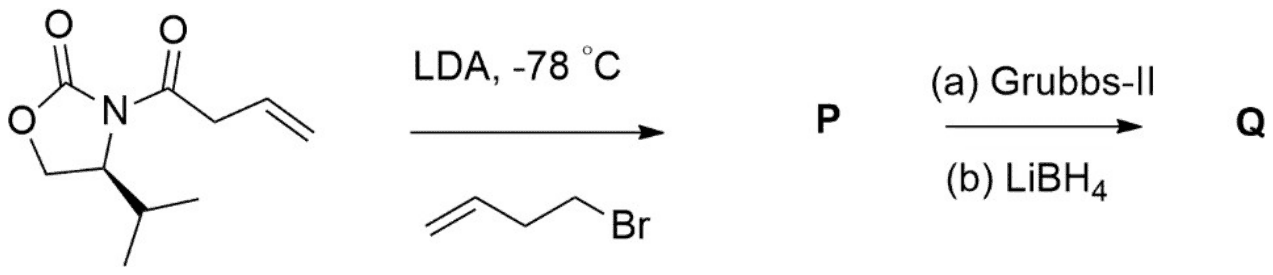
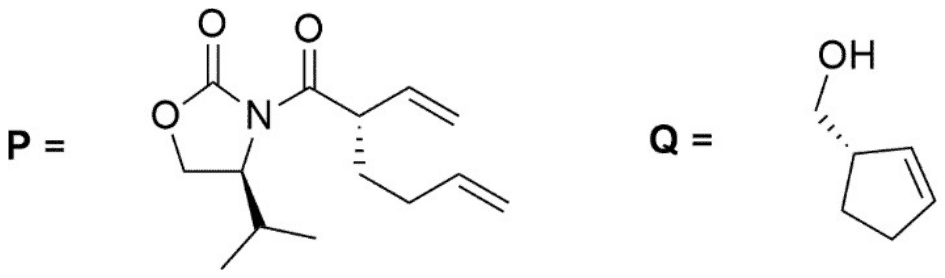
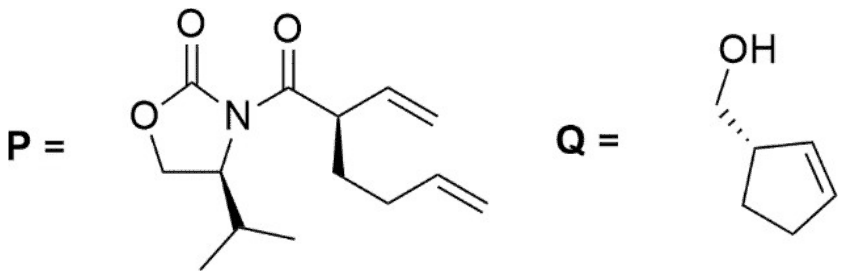
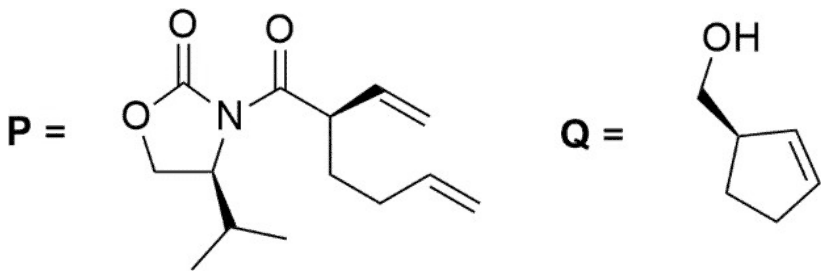
The major products P and Q in the following reaction sequence are

An N-(but-3-enoyl) 4-isopropyloxazolidinone alkylated with LDA at -78 C and 4-bromobut-1-ene to give P, then Grubbs-II and LiBH4 to give Q

Exam Year(s)

GATE Chemistry - 2022,

Answer: B

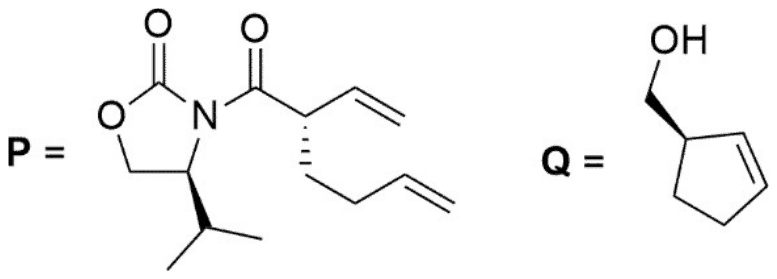
The answer is (B): P has the new stereocentre with the butenyl chain on a hashed bond, and Q is (S)-cyclopent-2-en-1-ylmethanol with CH2OH on a hashed bond.

LDA forms the Z-lithium enolate of the N-acyloxazolidinone, chelated between the enolate oxygen and the ring carbonyl. The isopropyl group of the (S)-auxiliary blocks one face, so 4-bromobut-1-ene alkylates the opposite face (Evans alkylation). With the CIP priorities in the order C(O)N, then vinyl, then butenyl, then H, the new centre in P is S, as drawn in (A) and (B).

Grubbs-II then joins the vinyl and butenyl alkenes by ring-closing metathesis, releasing ethylene and forming a cyclopentene, and LiBH4 cleaves the auxiliary to the primary alcohol. The stereocentre is untouched, and the priorities keep the same order (CH2OH, then the ring CH=, then the ring CH2, then H), so Q is also S, the hashed CH2OH of (B).

(A) has the right P but draws Q as the R alcohol. (C) and (D) show the alkylation on the face shielded by the isopropyl group (P is R); (C) also pairs it with an S alcohol that it cannot give.

Please log in or register to report this question.
7.

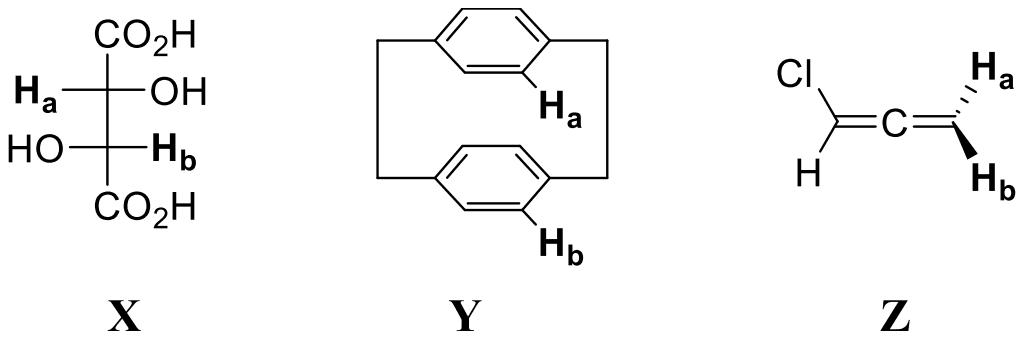
The topicity relationship of Ha and Hb in X, Y and Z are, respectively,

X: Fischer projection of tartaric acid with Ha and OH on the upper carbon and HO and Hb on the lower carbon, the hydrogens on opposite sides; Y: [2.2]paracyclophane with Ha on the upper ring and Hb on the lower ring; Z: ClCH=C=CHaHb

Exam Year(s)

GATE Chemistry - 2023,

Answer: B

The relationships are Homotopic, Enantiotopic and Enantiotopic.

  • X is a chiral tartaric acid: in the Fischer projection the two hydrogens lie on opposite sides (and so do the two OH groups). This molecule has a C2 axis that exchanges the two CH(OH) carbons, so Ha and Hb are interchanged by a rotation: homotopic.
  • Y is [2.2]paracyclophane. Ha on the upper ring and Hb on the lower ring sit at the same position relative to the bridges, so the mirror plane between the two rings maps one onto the other, but no rotation does: enantiotopic.
  • Z, ClCH=C=CHaHb, is an allene whose CH2 plane is perpendicular to the plane of the CHCl end. That CHCl plane is a mirror plane bisecting the H-C-H angle and exchanging Ha and Hb, and no axis does so: enantiotopic.

Calling X diastereotopic would fit meso-tartaric acid, not the chiral isomer drawn. Calling Y homotopic or Z homotopic overlooks that only a reflection relates the two hydrogens.

Please log in or register to report this question.

8.

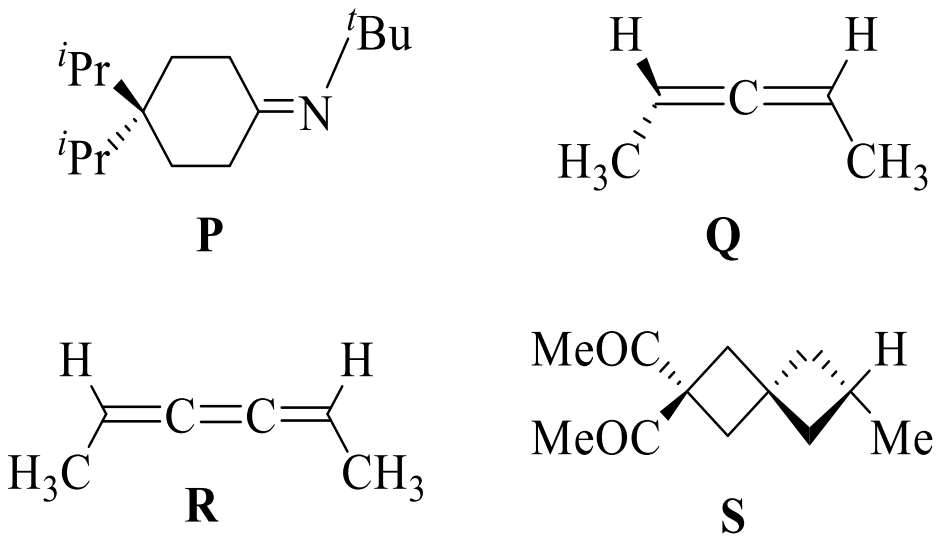
Among the following, the chiral compound is

P: 4,4-diisopropylcyclohexanone N-tert-butyl imine; Q: penta-2,3-diene; R: hexa-2,3,4-triene; S: a spiro[3.3]heptane with two acetyl groups on one carbon and H and Me on the far carbon

Exam Year(s)

GATE Chemistry - 2024,

Answer: B

The chiral compound is Q.

Q is penta-2,3-diene, an allene with two different groups (H and CH3) on each terminal carbon. In an allene the two terminal planes are perpendicular, so the molecule has no mirror plane and is axially chiral.

R has three cumulated double bonds; with an odd number the terminal substituents lie in one plane, giving cis-trans isomers but not chirality. P would be axially chiral only if the two groups on C4 differed, but both are isopropyl. S is a spiro[3.3]heptane, which is axially chiral only when each terminal carbon carries two different groups; here one carbon has two identical acetyl groups. So P, R and S are achiral.

Please log in or register to report this question.
9.

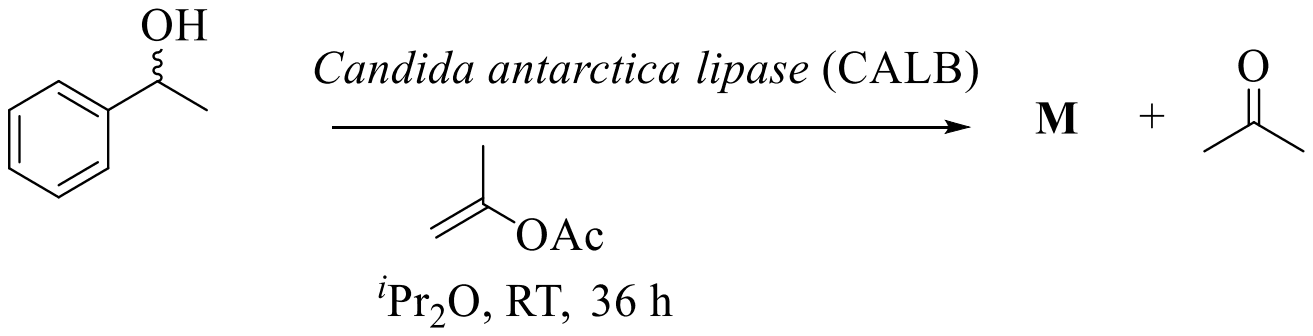
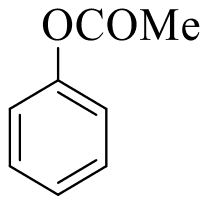
The product M in the following reaction is

Racemic 1-phenylethanol with Candida antarctica lipase (CALB), isopropenyl acetate, iPr2O, RT, 36 h, giving M plus acetone

Exam Year(s)

GATE Chemistry - 2024,

Answer: A

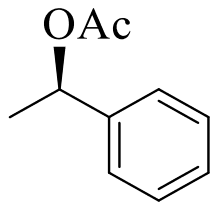
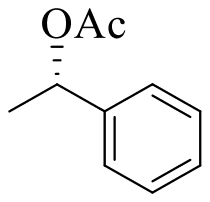
M is (A), (R)-1-phenylethyl acetate.

Candida antarctica lipase B carries out a kinetic resolution: it acetylates one enantiomer of racemic 1-phenylethanol much faster than the other. By Kazlauskas' rule for secondary alcohols, the lipase acylates the (R) enantiomer, in which the large (phenyl) and medium (methyl) groups fit its pockets, leaving the (S) alcohol behind. Isopropenyl acetate is the acyl donor; its enol by-product tautomerises to acetone, which makes the transfer irreversible.

In (A) the OAc is on a wedge with methyl to the left and phenyl to the right, which is the (R) configuration; (B) is the (S) acetate. Styrene (C) would need elimination, and phenyl acetate (D) has lost the CH(CH3) carbon, neither of which a lipase does.

Please log in or register to report this question.
10.

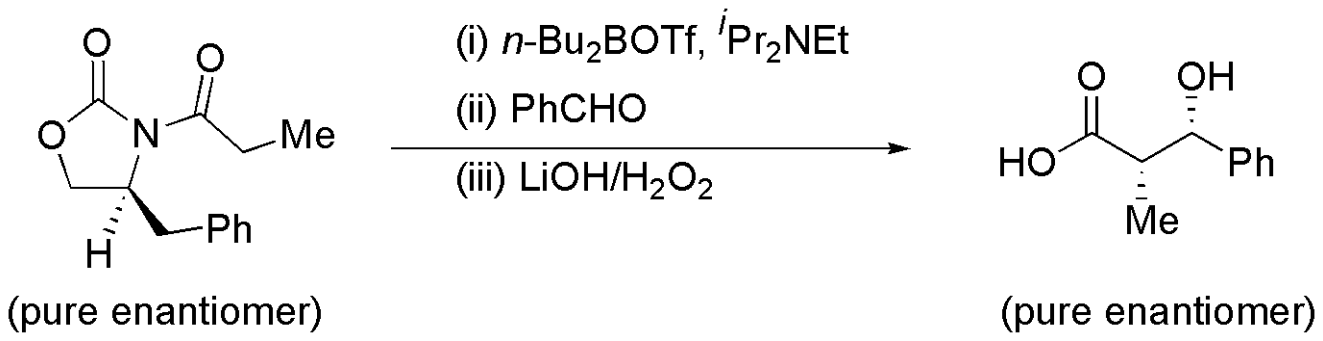
In the following asymmetric transformation, the key aldol reaction involves the attack of

An N-propionyl oxazolidinone bearing a 4-benzyl group (pure enantiomer) treated with (i) n-Bu2BOTf, iPr2NEt, (ii) PhCHO, (iii) LiOH/H2O2 to give 3-hydroxy-2-methyl-3-phenylpropanoic acid with both new stereocentres drawn hashed (pure enantiomer).

Exam Year(s)

GATE Chemistry - 2025,

Answer: D

The answer is Re face of enolate on to the Si face of aldehyde.

Bu2BOTf and Hunig's base give the Z-boron enolate of the Evans imide, which adds to benzaldehyde through a chair (Zimmerman-Traxler) transition state on the face left open by the benzyl group, giving the syn aldol. Reading the product as drawn, both new centres are S: (2S,3S)-3-hydroxy-2-methyl-3-phenylpropanoic acid.

At C3 the priorities are OH \(\gt\) Ph \(\gt\) C2 \(\gt\) H, so the incoming carbon ranks third; attack on the Si face of PhCHO then gives S. At C2 the priorities in the adduct are C(O)N \(\gt\) CH(O)Ph \(\gt\) CH3 \(\gt\) H, so the new bond ranks second; bond formation on the Re face of the enolate carbon then gives S. Each of the other three options would give at least one centre of the opposite configuration.

Please log in or register to report this question.
Loading…
Tags: Stereochemistry Questions and Answers || Stereochemistry MCQ Questions and Answers || Stereochemistry GK Questions and Answers || Stereochemistry GK MCQ Questions || Stereochemistry Multiple Choice Questions and Answers || Stereochemistry GK || GK on Stereochemistry || Organic Chemistry Questions and Answers || Organic Chemistry MCQ Questions and Answers || Organic Chemistry GK Questions and Answers || GK on Organic Chemistry