
Machine-translated by Google. Questions are authored in English.
Top

Atmospheric Waves Questions and Answers

Answer: A

The weakened stratospheric vortex is often followed within a few weeks by a negative phase of the Northern Annular Mode, with the storm track shifted equatorward and cold outbreaks over northern Europe and eastern North America. This downward influence is one route by which stratospheric prediction contributes to extended range surface forecasting, and the surface effect is cooling rather than warming.

Please log in or register to report this question.
Answer: B

Because the stratospheric influence on the surface persists for several weeks after a major warming, forecasting the stratospheric state adds skill in the two to six week range where tropospheric memory has been lost. This is now exploited operationally at several centres. The onset of a warming is itself predictable only a week or two ahead, so long lead prediction of the event is not available.

Please log in or register to report this question.

103.

Analysis of an atmospheric variable shows prominent modes at 5, 40 and 1460 days. These modes correspond respectively to

Exam Year(s)

GATE XE - 2018,

Answer: B

The modes are synoptic, MJO and ENSO.

A period of about 5 days is typical of synoptic weather systems, the passage of mid-latitude cyclones and anticyclones. About 40 days falls in the 30 to 60 day band of the Madden-Julian Oscillation. 1460 days is 4 years, within the 2 to 7 year period of El Nino-Southern Oscillation.

Tides have periods of about half a day and a day, not 5 days. Milankovitch cycles last tens of thousands of years, and decadal variability means about 10 years or more, far longer than 4 years.

Please log in or register to report this question.

Answer: B

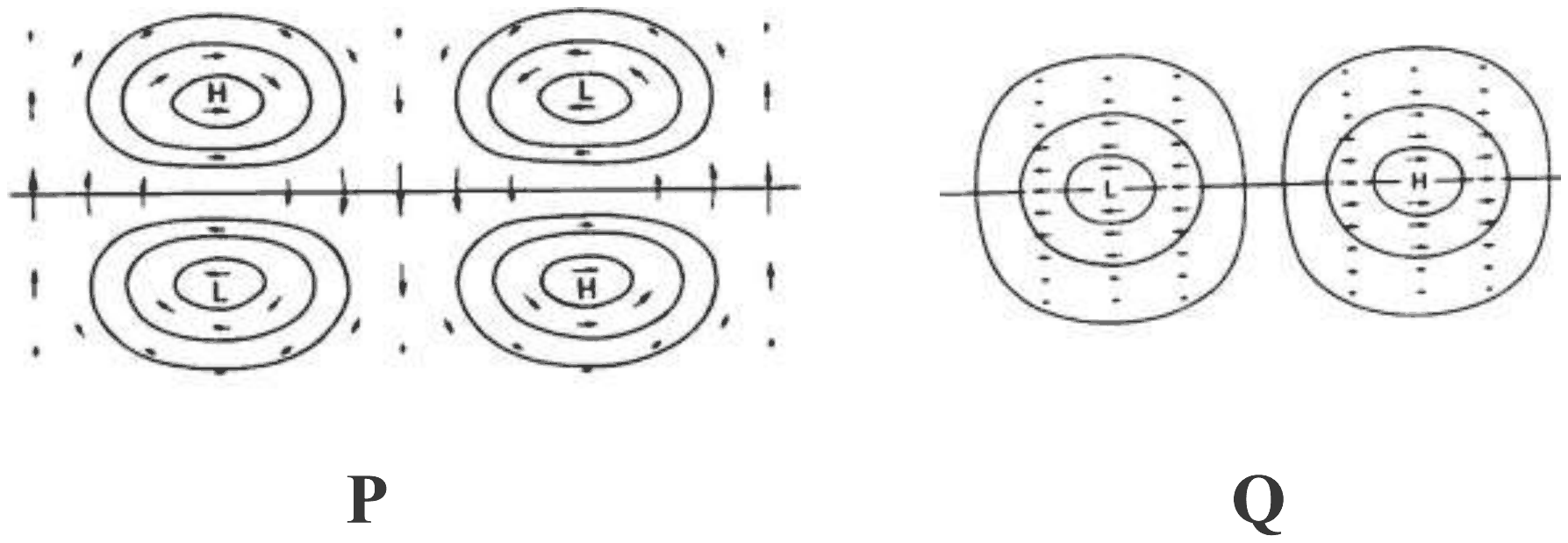
P and Q are equatorial Rossby and equatorial Kelvin waves.

Both patterns are organised about the equator, so they are equatorially trapped waves, not mid-latitude or polar ones. In P the pressure cells lie off the equator with opposite signs to north and south, with flow circling each cell and crossing the equator: the Rossby-type equatorial wave with cross-equatorial flow (the mixed Rossby-gravity, or Yanai, wave). In Q the highs and lows are centred on the equator and the wind is purely east-west, in geostrophic balance with the north-south pressure gradient: the equatorial Kelvin wave, which has no meridional velocity.

Option D reverses the two, and options A and C name mid-latitude and polar waves, which these equator-centred patterns are not.

Please log in or register to report this question.

105.

Rossby waves depend fundamentally upon the variation of the Coriolis parameter with latitude, known as :

Exam Year(s)

MH SET - 2019, SET Exam - 2019,

Answer: C

The variation of the Coriolis parameter with latitude is the beta effect.

The Coriolis parameter is \(f = 2\Omega\sin\phi\), and its northward gradient is \(\beta = df/dy\). As an air or water parcel moves north or south, conservation of absolute vorticity makes its relative vorticity change, and this restoring tendency is what produces westward-propagating Rossby waves. The beta-plane approximation is named after it.

'Alfa', 'gamma' and 'lambda' effects are not the name given to this gradient.

Please log in or register to report this question.

106.

Which of the following is not Dispersive wave ?

Exam Year(s)

MH SET - 2021, SET Exam - 2021,

Answer: C

The non-dispersive wave is the shallow water gravity wave.

A wave is dispersive when its speed depends on its wavelength. In shallow water the speed of a gravity wave is

\[ c = \sqrt{g h} \]

which depends only on depth, so all wavelengths travel together; tsunamis are the classic example.

Deep-water gravity waves travel at \(c = \sqrt{g\lambda/2\pi}\), so long waves outrun short ones. Rossby waves (printed Russby) and inertia (inertia-gravity) waves also have speeds that depend on wavelength, so they are dispersive.

Please log in or register to report this question.

Loading…

Other Subjects

Tags: Atmospheric Waves Questions and Answers || Atmospheric Waves MCQ Questions and Answers || Atmospheric Waves GK Questions and Answers || Atmospheric Waves GK MCQ Questions || Atmospheric Waves Multiple Choice Questions and Answers || Atmospheric Waves GK || GK on Atmospheric Waves || Atmospheric Dynamics Questions and Answers || Atmospheric Dynamics MCQ Questions and Answers || Atmospheric Dynamics GK Questions and Answers || GK on Atmospheric Dynamics