
Crystal structures of two metals A and B are two-dimensional square lattices with same lattice constant a. Electrons in metals behave as free electrons. The Fermi surfaces corresponding to A and B are shown by solid circles in figures.
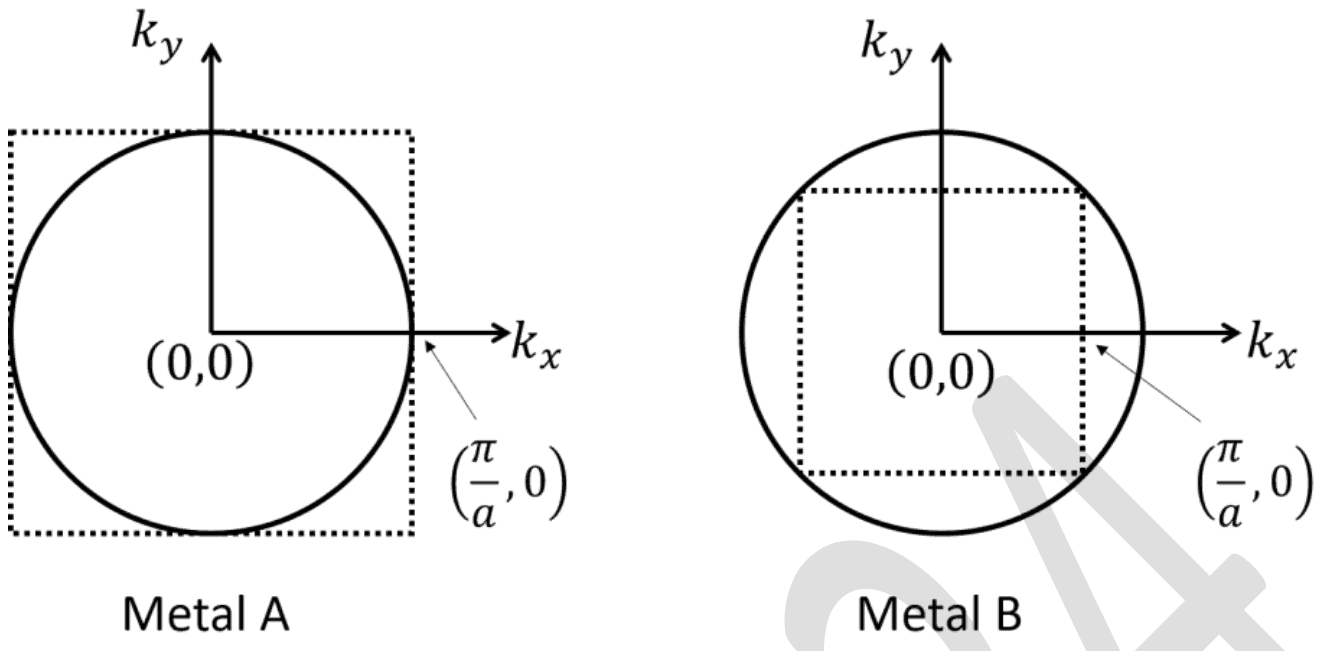
The electron concentrations in A and B are \(n_{A}\) and \(n_{B}\), respectively. The value of \(\left(\dfrac{n_{B}}{n_{A}}\right)\) is
GATE Physics - 2024,
Answer: B
The ratio nB/nA is 2.
For free electrons in two dimensions the electron concentration is proportional to the area of the Fermi circle, πkF2, so n ∝ kF2.
- Metal A: the circle touches the zone boundary at (π/a, 0), so kF = π/a.
- Metal B: the circle passes through the corners of the square zone, at (π/a, π/a), so kF = √2 π/a.
\[ \begin{aligned} \frac{n_{B}}{n_{A}} &= \left(\frac{\sqrt{2}\,\pi/a}{\pi/a}\right)^{2} \\ &= 2 \end{aligned} \]
√2 is the ratio of the Fermi wavevectors, not of the concentrations. 3 and 3√3 would need other radii, and 3√3 a three-dimensional kF3 scaling.
Please log in or register to report this question.