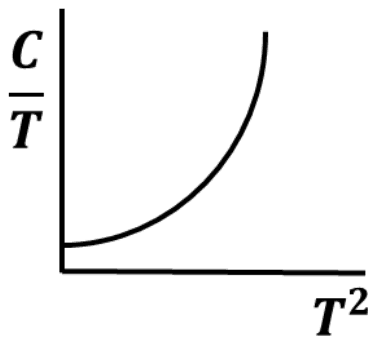
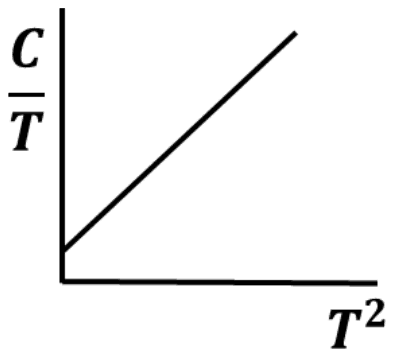
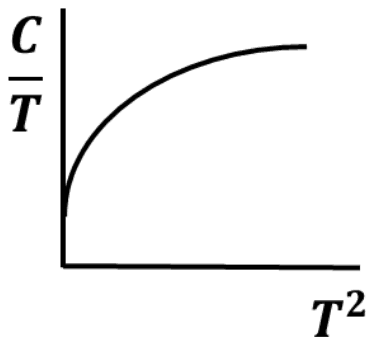
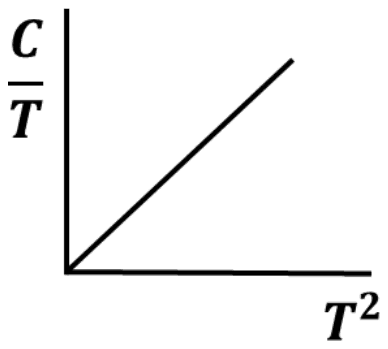
At low temperatures (\(T\)), the specific heat of common metals is described by (with \(\alpha\) and \(\beta\) as constants)
GATE Physics - 2018,
Answer: A
The low-temperature specific heat of a metal is \(\alpha T + \beta T^{3}\).
Two contributions add. The conduction electrons give a term linear in \(T\), because only the electrons within about \(k_{B}T\) of the Fermi level can be excited. The lattice vibrations give the Debye \(T^{3}\) law at temperatures well below the Debye temperature. At the lowest temperatures the linear electronic term dominates, and a plot of \(C/T\) against \(T^{2}\) is a straight line.
\(\beta T^{3}\) alone describes an insulator, with no free electrons. \(\exp(-\alpha/T)\) is the behaviour of a system with an energy gap, such as the Einstein model or a superconductor. There is no \(T^{5}\) term in the specific heat; a \(T^{5}\) law belongs to the electron-phonon resistivity.
Please log in or register to report this question.