
Machine-translated by Google. Questions are authored in English.
Top

Magnetic Properties of Solids Questions and Answers

1.

The high temperature magnetic susceptibility of solids having ions with magnetic moments can be described by \(\chi \propto \frac{1}{T + \theta}\) with \(T\) as absolute temperature and \(\theta\) as constant. The three behaviors i.e. paramagnetic, ferromagnetic and anti-ferromagnetic are described, respectively, by

Exam Year(s)

GATE Physics - 2018,

Answer: C

The three behaviours correspond to \(\theta = 0, \theta \lt 0, \theta \gt 0\).

With \(\chi \propto 1/(T + \theta)\):

  • A paramagnet obeys Curie’s law, \(\chi \propto 1/T\), so \(\theta = 0\).
  • A ferromagnet above its Curie temperature obeys the Curie-Weiss law \(\chi \propto 1/(T - T_{C})\), which diverges at \(T_{C}\); this is \(\theta = -T_{C} \lt 0\).
  • An antiferromagnet above its Néel temperature follows \(\chi \propto 1/(T + \theta)\) with \(\theta \gt 0\), so the susceptibility stays finite and the extrapolated intercept is at negative temperature.

The options with \(\theta \gt 0\) for the ferromagnet reverse the signs of the two ordered cases, and any option giving the paramagnet a non-zero \(\theta\) contradicts Curie’s law.

Please log in or register to report this question.
2.

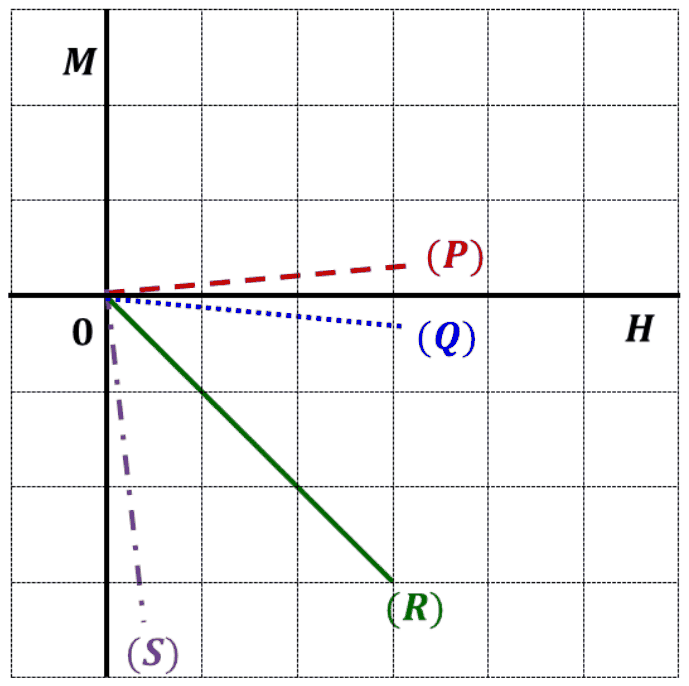
The figure schematically shows the \(M\) (magnetization) - \(H\) (magnetic field) plots for certain types of materials. Here \(M\) and \(H\) are plotted in the same scale and units. Which one of the following is the most appropriate combination?

M against H on a square grid: line P has a small positive slope, Q a small negative slope, R a slope of minus one, and S a very steep negative slope

Exam Year(s)

GATE Physics - 2023,

Answer: B

The combination is (P) - Paramagnet; (Q) - Diamagnet; (R) - Type-I Superconductor.

The slope of each line is the susceptibility \(\chi = M/H\). P has a small positive slope, the weak positive response of a paramagnet. Q has a small negative slope, the weak opposing response of a diamagnet. R has a slope of exactly -1, so \(M = -H\) and \(B = \mu_{0}(H + M) = 0\): perfect diamagnetism, the Meissner state of a Type-I superconductor.

S is steeper than -1, a susceptibility below -1, which no material shows in equilibrium. An antiferromagnet has a small positive susceptibility, so calling Q an antiferromagnet is wrong, and the options assigning S to an antiferromagnet or a Type-I superconductor, or calling P diamagnetic, fail as well.

Please log in or register to report this question.

3.

A paramagnetic material containing paramagnetic ions with total angular momentum \(J = \frac{1}{2}\) is kept at absolute temperature T. The ratio of the magnetic field required for 80% of the ions to be in the lowest energy state to that required for having 60% of the ions to be in the lowest energy state at the same temperature is

Exam Year(s)

GATE Physics - 2025,

Answer: A

The ratio is \(\frac{2\ln 2}{\ln(\frac{3}{2})}\).

For \(J = \frac{1}{2}\) there are two levels at \(\mp\mu B\). With \(x = \frac{\mu B}{k_{B}T}\), the fraction in the lower level is \(\frac{1}{1 + e^{-2x}}\).

\[ \begin{aligned} 80\%: e^{-2x_{1}} &= \tfrac{1}{4} \Rightarrow x_{1} = \ln 2 \\ 60\%: e^{-2x_{2}} &= \tfrac{2}{3} \Rightarrow x_{2} = \tfrac{1}{2}\ln\tfrac{3}{2} \end{aligned} \]

At the same temperature the field is proportional to \(x\), so \(\frac{B_{1}}{B_{2}} = \frac{2\ln 2}{\ln(3/2)}\), about 3.4.

\(\frac{\ln 2}{\ln(3/2)}\) drops the factor of 2 from \(x_{2}\), and the others come from wrong occupation fractions.

Please log in or register to report this question.

4.

In an anti-ferromagnet, susceptibility χ above Neel temperature θ has a form :

Exam Year(s)

MH SET - 2018, SET Exam - 2018,

Answer: A

Above the Néel temperature the susceptibility has the form \( \chi = \frac{2c}{T + \theta} \), with the paper's constant written as 2c.

In the paramagnetic region an antiferromagnet obeys a Curie-Weiss law with a negative Weiss temperature, \( \chi = \frac{C}{T + \theta} \): the antiparallel exchange opposes alignment, so \( \chi \) stays finite at \( T = \theta \) and peaks at the Néel temperature.

\( \frac{C}{T - \theta} \) is the ferromagnetic Curie-Weiss law, which diverges at the Curie point. The forms \( 2c(T \pm \theta) \) increase with temperature, while a paramagnetic susceptibility falls as T rises.

Please log in or register to report this question.

5.

According to Hund's rule, the value of total angular momentum J is S when :

Exam Year(s)

MH SET - 2018, SET Exam - 2018,

Answer: C

J equals S when the shell is just half full.

By Hund's rules, electrons first occupy separate orbitals with parallel spins. In a half-filled shell every \( m_{l} \) value is used exactly once, so \( L = \sum m_{l} = 0 \) and \( J = |L \pm S| = S \). Half-filled ions such as Mn2+ (3d5, \( ^{6}S_{5/2} \)) show this.

For a shell less than half full the third rule gives \( J = |L - S| \), for more than half full \( J = L + S \), and for a completely full shell \( L = S = J = 0 \).

Please log in or register to report this question.

6.

For a rare earth ion the ground state energy level is characterized by the term value \(^{4}I_{9/2}\). The number of 4f unpaired electrons in this ion is :

Exam Year(s)

MH SET - 2019, SET Exam - 2019,

Answer: B

The ion has 3 unpaired 4f electrons.

In the term \(^{4}I_{9/2}\), the multiplicity 2S + 1 = 4 gives S = 3/2, which means three unpaired electrons each contributing 1/2. The letter I means L = 6, and J = L - S = 9/2, as Hund's third rule requires for a shell less than half full.

This is the ground term of \(Nd^{3+}\), which has the configuration \(4f^{3}\). Two unpaired electrons would give a triplet, four a quintet and five a sextet.

Please log in or register to report this question.

Loading…
Tags: Magnetic Properties of Solids Questions and Answers || Magnetic Properties of Solids MCQ Questions and Answers || Magnetic Properties of Solids GK Questions and Answers || Magnetic Properties of Solids GK MCQ Questions || Magnetic Properties of Solids Multiple Choice Questions and Answers || Magnetic Properties of Solids GK || GK on Magnetic Properties of Solids || Solid State Physics Questions and Answers || Solid State Physics MCQ Questions and Answers || Solid State Physics GK Questions and Answers || GK on Solid State Physics