
Machine-translated by Google. Questions are authored in English.
Top

Crystal Lattices and Symmetry Questions and Answers

1.

For the given unit cells of a two dimensional square lattice, which option lists all the primitive cells?
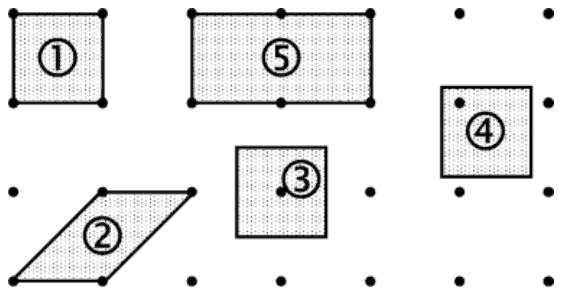
Five shaded cells numbered 1 to 5 drawn on the points of a square lattice: 1 a unit square, 2 a parallelogram, 3 and 4 unit squares each enclosing one lattice point, 5 a rectangle two units long

Exam Year(s)

GATE Physics - 2018,

Answer: C

The primitive cells are ①, ②, ③ and ④.

A primitive cell contains exactly one lattice point and has the smallest possible area, one lattice spacing squared for this lattice; it can have any shape and need not have lattice points at its corners.

  • ①, a unit square with points at its four corners, holds 4 × 1/4 = 1 point.
  • ②, a parallelogram on four lattice points with the same base and height as the unit square, also has unit area and one point.
  • ③ and ④ are unit squares shifted off the lattice, each enclosing exactly one lattice point inside: still one point per cell.
  • ⑤ is two units long and holds 4 × 1/4 + 2 × 1/2 = 2 points, so it is a conventional (non-primitive) cell.

Options stopping at ② or ③ leave out valid primitive cells, and the option including ⑤ adds a cell of double area.

Please log in or register to report this question.

2.

A compound consists of three ions X, Y and Z. The Z ions are arranged in an FCC arrangement. The X ions occupy \(\frac{1}{6}\) of the tetrahedral voids and the Y ions occupy \(\frac{1}{3}\) of the octahedral voids. Which one of the following is the CORRECT chemical formula of the compound?

Exam Year(s)

GATE Physics - 2023,

Answer: B

The formula is \(\mathrm{XYZ_{3}}\).

An FCC unit cell holds 4 lattice points, here 4 Z ions. It contains 8 tetrahedral voids and 4 octahedral voids.

\[ \begin{aligned} X &= \frac{1}{6} \times 8 = \frac{4}{3}, \quad Y = \frac{1}{3} \times 4 = \frac{4}{3} \\ X : Y : Z &= \frac{4}{3} : \frac{4}{3} : 4 = 1 : 1 : 3 \end{aligned} \]

The other formulas do not follow from these counts; they come from miscounting the ions or voids per cell, for example forgetting that an FCC cell has twice as many tetrahedral as octahedral voids.

Please log in or register to report this question.

3.

For a two-dimensional hexagonal lattice with lattice constant \(a\), the atomic density is

Exam Year(s)

GATE Physics - 2025,

Answer: C

The key's answer is \(\frac{4}{3\sqrt{3}a^{2}}\), which treats the hexagonal lattice as a honeycomb of regular hexagons of side \(a\).

In that reading, atoms sit at the corners of hexagons of side \(a\). Each corner is shared by three hexagons, so one hexagon holds \(6 \times \frac{1}{3} = 2\) atoms, and its area is \(\frac{3\sqrt{3}}{2}a^{2}\):

\[ \begin{aligned} n &= \frac{2}{\frac{3\sqrt{3}}{2}a^{2}} \\ &= \frac{4}{3\sqrt{3}a^{2}} \approx \frac{0.77}{a^{2}} \end{aligned} \]

Strictly, the honeycomb is not a Bravais lattice; the triangular Bravais lattice with spacing \(a\) has density \(\frac{2}{\sqrt{3}a^{2}}\), which is not among the options, so the paper intends the honeycomb arrangement. \(\frac{1}{3\sqrt{3}a^{2}}\) counts only one-third of an atom per hexagon, and the other options use wrong areas.

Please log in or register to report this question.

4.

Consider a crystal that has a basis of one atom. Its primitive vectors are \(\vec{a_{1}} = a\hat{i}\), \(\vec{a_{2}} = a\hat{j}\), \(\vec{a_{3}} = \frac{a}{2}(\hat{i} + \hat{j} + \hat{k})\), where \(\hat{i}, \hat{j}, \hat{k}\) are the unit vectors in the \(x\), \(y\) and \(z\) directions of the Cartesian coordinate system and \(a\) is a positive constant. Which one of the following is the correct option regarding the type of the Bravais lattice?

Exam Year(s)

GATE Physics - 2025,

Answer: A

It is BCC, with a primitive cell volume of \(\frac{a^{3}}{2}\).

The primitive cell volume is the scalar triple product of the primitive vectors:

\[ \begin{aligned} V &= \vec{a_{1}} \cdot (\vec{a_{2}} \times \vec{a_{3}}) \\ &= a\hat{i} \cdot \left(a\hat{j} \times \tfrac{a}{2}(\hat{i} + \hat{j} + \hat{k})\right) = \frac{a^{3}}{2} \end{aligned} \]

Lattice points generated by these vectors include all cube corners \((a\hat{i}, a\hat{j}\) and, since \(2\vec{a_{3}} - \vec{a_{1}} - \vec{a_{2}} = a\hat{k}\), also \(a\hat{k}\)) and the cube centre \(\vec{a_{3}}\). Corners plus body centre of a cube of side \(a\) is the BCC lattice, whose conventional cell of volume \(a^{3}\) contains 2 points, so the primitive cell has \(\frac{a^{3}}{2}\).

An FCC lattice has 4 points per conventional cell, giving \(\frac{a^{3}}{4}\), and needs face-centre vectors such as \(\frac{a}{2}(\hat{i} + \hat{j})\), which this set does not contain.

Please log in or register to report this question.

5.

Consider a BCC lattice with one atom per lattice point.

The maximum packing fraction is close to:

Exam Year(s)

IIT JAM - 2026,

Answer: B

The packing fraction of BCC is close to 68 %.

A BCC cell has 2 atoms (8 corners shared eight ways, plus 1 at the centre). The atoms touch along the body diagonal, so \(4r = \sqrt{3}\,a\):

\[ \begin{aligned} \text{PF} &= \frac{2 \times \frac{4}{3}\pi r^{3}}{a^{3}}, \quad r = \frac{\sqrt{3}}{4}a \\ &= \frac{\sqrt{3}\,\pi}{8} \approx 0.680 \end{aligned} \]

74 % is the close-packed value for FCC and HCP, and 53 % is near the simple cubic value of \(\pi/6 \approx 52\) %. 81 % exceeds the close-packing limit for equal spheres, so no lattice of identical atoms can reach it.

Please log in or register to report this question.

6.

Which of the following cubic structure is most loosely packed ?

Exam Year(s)

MH SET - 2018, SET Exam - 2018,

Answer: D

The most loosely packed is the diamond structure.

Packing fractions (the fraction of volume filled by touching spheres) are: diamond \( \frac{\sqrt{3}\pi}{16} \approx 0.34 \), simple cubic \( \frac{\pi}{6} \approx 0.52 \), body-centred cubic \( \frac{\sqrt{3}\pi}{8} \approx 0.68 \), and face-centred cubic \( \frac{\sqrt{2}\pi}{6} \approx 0.74 \).

Diamond's atoms have only four nearest neighbours, set by its directed covalent bonds, which leaves much empty space. Simple cubic, with six neighbours, is the loosest of the three Bravais cubic lattices, and FCC is the most closely packed of all.

Please log in or register to report this question.

Loading…
Tags: Crystal Lattices and Symmetry Questions and Answers || Crystal Lattices and Symmetry MCQ Questions and Answers || Crystal Lattices and Symmetry GK Questions and Answers || Crystal Lattices and Symmetry GK MCQ Questions || Crystal Lattices and Symmetry Multiple Choice Questions and Answers || Crystal Lattices and Symmetry GK || GK on Crystal Lattices and Symmetry || Solid State Physics Questions and Answers || Solid State Physics MCQ Questions and Answers || Solid State Physics GK Questions and Answers || GK on Solid State Physics