
Machine-translated by Google. Questions are authored in English.
Top

Reciprocal Lattice and Diffraction Questions and Answers

1.

Graphene is a two dimensional material, in which carbon atoms are arranged in a honeycomb lattice with lattice constant \(a\). As shown in the figure, \(\vec{a}_{1}\) and \(\vec{a}_{2}\) are two lattice vectors. Which one of the following is the area of the first Brillouin zone for this lattice?
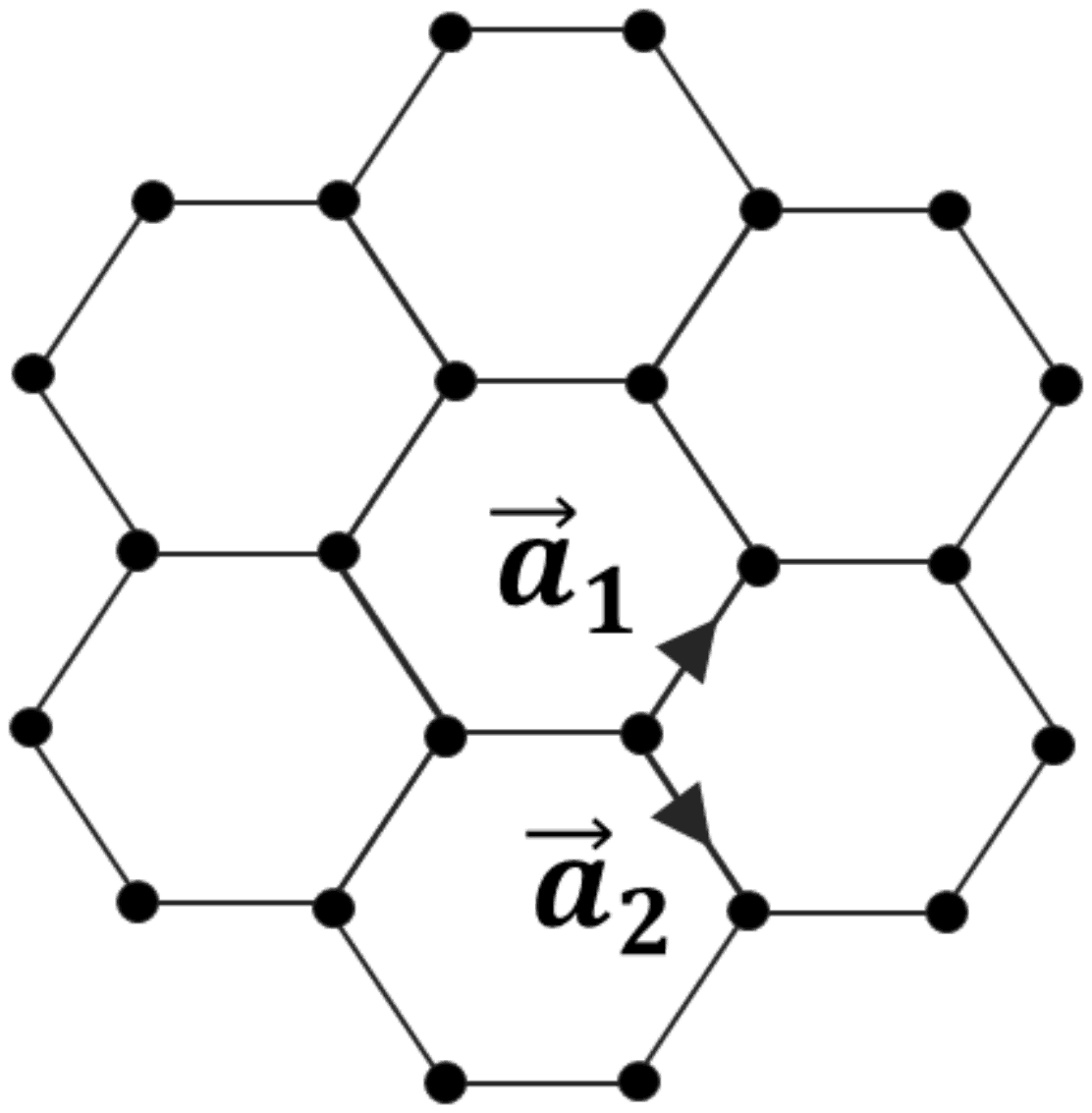
A honeycomb of carbon atoms with two arrows a1 and a2 drawn from one atom to its upper right and lower right neighbouring atoms

Exam Year(s)

GATE Physics - 2023,

Answer: A

The area is \(\frac{8\pi^{2}}{3\sqrt{3}a^{2}}\), with \(a\) read, as in the figure, as the carbon-carbon spacing.

The arrows \(\vec{a}_{1}\) and \(\vec{a}_{2}\) in the figure each join one carbon atom to a neighbouring atom, so the length \(a\) here is the C-C distance. The honeycomb's true Bravais lattice is triangular, with primitive vectors of length \(\sqrt{3}a\) at 60° to each other, so the real-space unit cell has area

\[ \begin{aligned} A_{cell} &= (\sqrt{3}a)^{2}\sin 60^{\circ} \\ &= \frac{3\sqrt{3}}{2}a^{2} \end{aligned} \]

The first Brillouin zone has area \((2\pi)^{2}/A_{cell}\):

\[ \begin{aligned} A_{BZ} &= \frac{4\pi^{2} \times 2}{3\sqrt{3}a^{2}} \\ &= \frac{8\pi^{2}}{3\sqrt{3}a^{2}} \end{aligned} \]

If \(a\) were instead the length of the primitive vectors, the same steps would give \(8\pi^{2}/\sqrt{3}a^{2}\); the key follows the figure's labelling. The options with \(4\pi^{2}\) drop the factor 2 that comes from \(\sin 60^{\circ} = \sqrt{3}/2\).

Please log in or register to report this question.

2.

A neutron beam with a wave vector \(\vec{k}\) and an energy 20.4 meV diffracts from a crystal with an outgoing wave vector \(\vec{k}'\). One of the diffraction peaks is observed for the reciprocal lattice vector \(G\) of magnitude 3.14 Å-1. What is the diffraction angle in degrees (rounded off to the nearest integer) that \(\vec{k}\) makes with the plane? (Use mass of neutron = 1.67 × 10⁻²⁷ Kg)

Exam Year(s)

GATE Physics - 2023,

Answer: B

The angle is 30°.

Find the neutron's wave number from its energy:

\[ \begin{aligned} E &= 20.4\ \text{meV} = 3.27 \times 10^{-21}\ \text{J} \\ p &= \sqrt{2mE} = 3.30 \times 10^{-24}\ \text{kg m/s} \\ k &= p/\hbar \approx 3.13\ \mathring{\mathrm{A}}^{-1} \end{aligned} \]

Elastic diffraction requires \(\vec{k}' - \vec{k} = \vec{G}\), which with \(|\vec{k}'| = |\vec{k}|\) is Bragg's law in the form \(G = 2k\sin\theta\), where \(\theta\) is the angle between \(\vec{k}\) and the reflecting planes:

\[ \begin{aligned} \sin\theta &= \frac{3.14}{2 \times 3.13} \approx 0.50 \\ \theta &= 30^{\circ} \end{aligned} \]

60° is the total scattering angle \(2\theta\), not the angle with the planes; 15° and 45° do not satisfy the Bragg condition.

Please log in or register to report this question.

3.

The X-ray diffraction pattern of a monatomic cubic crystal with rigid spherical atoms of radius 1.56 Å shows several Bragg reflections of which the reflection appearing at the lowest \(2\theta\) value is from (111) plane. If the wavelength of X-ray used is 0.78 Å, the Bragg angle (in \(2\theta\), rounded off to one decimal place) corresponding to this reflection and the crystal structure, respectively, are

Exam Year(s)

GATE Physics - 2024,

Answer: B

The reflection is at 2θ = 17.6°, and the crystal is face centered cubic.

In a cubic crystal the first reflection is (110) for body centered cubic and (111) for face centered cubic, so a lowest reflection from (111) means fcc. In fcc the atoms touch along the face diagonal, so 4r = a√2:

\[ \begin{aligned} a &= 2\sqrt{2}\,r = 2\sqrt{2} \times 1.56 = 4.41\ \text{\AA} \\ d_{111} &= a/\sqrt{3} = 2.55\ \text{\AA} \\ \sin\theta &= \frac{\lambda}{2d} = \frac{0.78}{5.10} = 0.153 \end{aligned} \]

So θ = 8.8° and 2θ = 17.6°. The option '8.8 and face centered cubic' gives θ, not 2θ. Both bcc options are ruled out because (111) is absent in bcc (h + k + l must be even).

Please log in or register to report this question.

Loading…
Tags: Reciprocal Lattice and Diffraction Questions and Answers || Reciprocal Lattice and Diffraction MCQ Questions and Answers || Reciprocal Lattice and Diffraction GK Questions and Answers || Reciprocal Lattice and Diffraction GK MCQ Questions || Reciprocal Lattice and Diffraction Multiple Choice Questions and Answers || Reciprocal Lattice and Diffraction GK || GK on Reciprocal Lattice and Diffraction || Solid State Physics Questions and Answers || Solid State Physics MCQ Questions and Answers || Solid State Physics GK Questions and Answers || GK on Solid State Physics