
Machine-translated by Google. Questions are authored in English.
Top

Differential Amplifiers Questions and Answers

101.

A current mirror's output impedance is \( 400 \ \mathrm{k\Omega} \) and the input devices' is \( 200 \ \mathrm{k\Omega} \). The effective load is

Answer: A

The two impedances appear in parallel at the output node:

\[ \frac{400 \times 200}{600} \approx 133 \ \mathrm{k\Omega} \]

giving about 133 kilohms. Adding them would apply to a series connection. Since the device's own output resistance now matters as much as the load's, improving only one of them yields diminishing returns - which is why a cascoded mirror is used where the highest gain is wanted.

Please log in or register to report this question.
Answer: B

Stacking a second device above each mirror transistor multiplies the output impedance by roughly that device's own gain, so the load no longer limits the stage. Offset, tail stability and common-mode range are separate matters, and the arrangement costs headroom. Applying the cascode idea to the load as well as to the input devices is how the highest-gain integrated stages are built, and both uses rest on the same mechanism.

Please log in or register to report this question.

Answer: C

A conventional cascode stacks devices and eats supply voltage, while folding the cascode to the opposite rail keeps the gain and impedance benefits with far less headroom - which matters greatly as supply voltages have fallen. It does not double the gain, still needs a tail, and does nothing for matching. A rearrangement adopted because a resource became scarce is worth recognising as such, since it explains a topology that looks needlessly complicated.

Please log in or register to report this question.

Answer: D

Digital scaling has driven supplies from fifteen volts to under two, while a transistor still needs a few hundred millivolts across it to behave properly, so the number of devices that can be stacked has fallen sharply. Thresholds have fallen rather than risen, and saturation and compliance requirements are unchanged. A constraint that tightened because of changes elsewhere in the technology is what drove folded cascodes and rail-to-rail input stages.

Please log in or register to report this question.

Answer: A

One pair works near the negative rail and a complementary pair near the positive, with the two handing over in the middle so that the inputs may reach both supplies. A cascode, a larger current and a compliant load all address other limits. The handover brings its own problem, since the offset changes as the stage switches from one pair to the other, which is a characteristic weakness worth knowing before such a device is chosen for precision work.

Please log in or register to report this question.

Answer: B

The two complementary pairs have different offsets, so as the common-mode input crosses the handover region the stage's offset shifts - a step in the transfer characteristic that limits its precision. Bandwidth, bias current direction and slew rate are affected far less. An arrangement that extends a range by switching between two circuits inherits a discontinuity where they meet, which is a general consequence worth expecting whenever such a technique is used.

Please log in or register to report this question.

107.

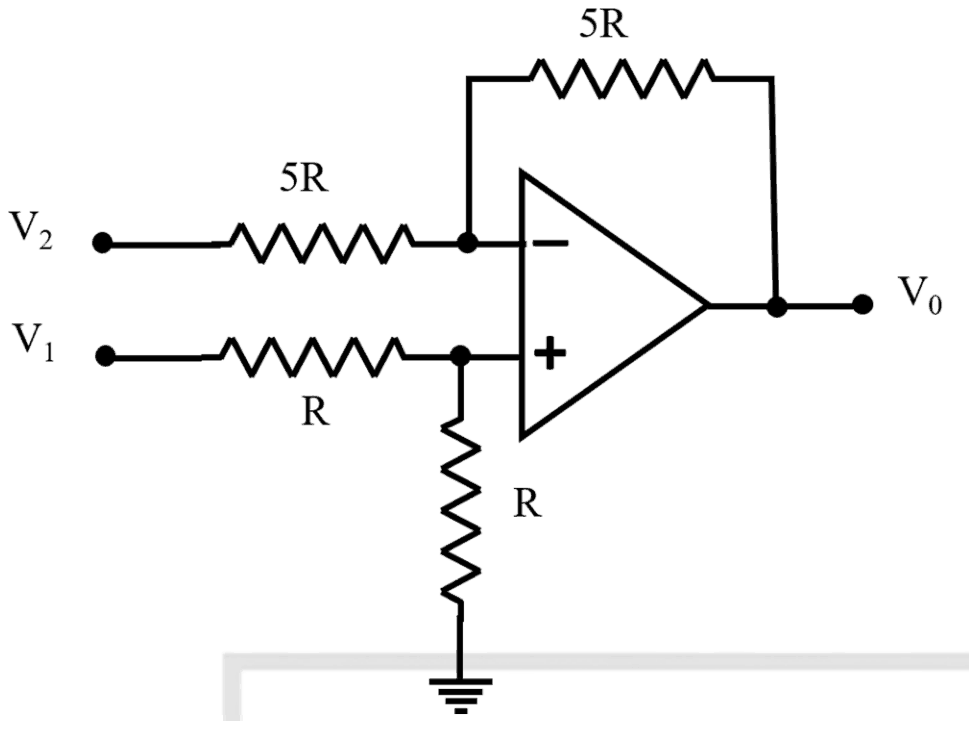
The output voltage V0 for the circuit shown in the figure is:

Op-amp: V2 goes through 5R to the inverting input, with a feedback resistor 5R from the output V0 to that input; V1 goes through R to the non-inverting input, which is also connected to ground through R

Exam Year(s)

IIT JAM - 2026,

Answer: A

The output is \(V_0 = V_1 - V_2\).

This is a difference amplifier. The non-inverting input sits on a divider of two equal resistors R, so \(V_+ = V_1/2\). By superposition, the inverting stage has gain \(-5R/5R = -1\) for \(V_2\) and the non-inverting stage has gain \(1 + 5R/5R = 2\) for \(V_+\):

\[ \begin{aligned} V_0 &= \left(1 + \frac{5R}{5R}\right)\frac{V_1}{2} - \frac{5R}{5R}V_2 \\ &= V_1 - V_2 \end{aligned} \]

\(2(V_1 - V_2)\) forgets that the divider halves \(V_1\). \(V_1 - 2V_2\) doubles the inverting gain, and \(V_2 - V_1\) has the sign of the inputs reversed.

Please log in or register to report this question.

Loading…
Tags: Differential Amplifiers Questions and Answers || Differential Amplifiers MCQ Questions and Answers || Differential Amplifiers GK Questions and Answers || Differential Amplifiers GK MCQ Questions || Differential Amplifiers Multiple Choice Questions and Answers || Differential Amplifiers GK || GK on Differential Amplifiers || Analog Electronics Questions and Answers || Analog Electronics MCQ Questions and Answers || Analog Electronics GK Questions and Answers || GK on Analog Electronics