
Machine-translated by Google. Questions are authored in English.
Top

Molecular Biology Techniques Questions and Answers

11.

With reference to Agrobacterium tumefaciens mediated plant transformation, match the virulence factors in Group 1 with their protein types in Group 2.

Group 1Group 2
(P) VirG(i) Kinase
(Q) VirA(ii) Helicase
(R) VirE(iii) Transcriptional activator
(S) VirC(iv) Single strand binding protein

Exam Year(s)

GATE Life Sciences - 2024,

Answer: D

The Commission's answer is P-iii, Q-i, R-iv, S-ii.

VirA is the membrane sensor kinase that detects phenolic signals such as acetosyringone from wounded plant cells and autophosphorylates. It passes the phosphate to VirG, the response regulator, which acts as a transcriptional activator of the other vir genes. VirE2 is the single-strand binding protein that coats the T-strand on its way into the plant cell.

That leaves helicase for VirC, which assists the processing of the T-strand at the overdrive region; this is the assignment the textbook account uses. The other options swap the kinase and the activator or give VirE the helicase role.

Please log in or register to report this question.
12.

Which one of the following restriction endonucleases is a blunt cutter?

Exam Year(s)

GATE Life Sciences - 2025,

Answer: D

The blunt cutter is EcoRV.

EcoRV recognises GATATC and cuts both strands at the same point, in the middle (GAT|ATC), leaving blunt ends with no single-stranded overhang.

The other three make staggered cuts that leave 5' overhangs (sticky ends): BamHI cuts G|GATCC, EcoRI cuts G|AATTC and HindIII cuts A|AGCTT, each leaving a four-base single-stranded tail that can pair with a matching end.

Please log in or register to report this question.

Answer: B

FRET does not depend on the fluorescence quantum yield of the acceptor.

The efficiency of Förster transfer is set by the distance r between donor and acceptor relative to the Förster radius \(R_{0}\), where

\[ R_{0}^{6} \propto \kappa^{2}\,\Phi_{D}\,J\,n^{-4} \]

Here \(\kappa^{2}\) is the orientation factor, \(\Phi_{D}\) the quantum yield of the donor, J the spectral overlap of donor emission with acceptor absorption, and n the refractive index. The efficiency itself falls as \(r^{-6}\).

The acceptor only has to absorb the energy; transfer happens whether or not it then fluoresces (a non-fluorescent quencher works as an acceptor). Orientation, distance and spectral overlap all appear in the expression, so they cannot be the answer.

Please log in or register to report this question.

14.

Correctly match the enzymes used as selectable markers (Group I) and the chemicals used for their selection (Group II).

Group IGroup II
(P) Neomycin phosphotransferase(1) Bialaphos
(Q) Phosphinothricin acetyltransferase(2) Kanamycin
(R) Dihydrofolate reductase(3) Glyphosate
(S) 5-Enolpyruvyl shikimate 3-phosphate synthase(4) Methotrexate

Exam Year(s)

GATE Life Sciences - 2025,

Answer: A

The correct match is P-2; Q-1; R-4; S-3.

  • Neomycin phosphotransferase (nptII) phosphorylates aminoglycosides, so transformed cells survive kanamycin.
  • Phosphinothricin acetyltransferase (bar/pat) acetylates phosphinothricin, the active part of the herbicide bialaphos.
  • Dihydrofolate reductase, in a resistant form, lets cells grow on methotrexate, an inhibitor of the normal enzyme.
  • EPSP synthase, in a glyphosate-insensitive form, confers resistance to glyphosate, which inhibits the native enzyme.

The other options misplace these pairs, for example giving neomycin phosphotransferase bialaphos or pairing DHFR with glyphosate, whose target is EPSPS.

Please log in or register to report this question.

15.

Correctly match the following molecules/methods in Group-I with their major uses in Group-II.

Group-IGroup-II
(P) CRISPR-Cas9(1) Global gene expression analysis
(Q) DNA Microarray(2) Molecular marker
(R) Vir genes(3) Targeted gene editing
(S) RAPD(4) Agrobacterium-mediated plant transformation

Exam Year(s)

GATE Life Sciences - 2026,

Answer: B

The correct matching is P-3; Q-1; R-4; S-2.

  • CRISPR-Cas9 uses a guide RNA to bring the Cas9 nuclease to a chosen DNA sequence: targeted gene editing (3).
  • A DNA microarray measures the hybridisation of thousands of transcripts at once: global gene expression analysis (1).
  • The vir genes of the Ti plasmid process and transfer T-DNA into the plant cell, the basis of Agrobacterium-mediated transformation (4).
  • RAPD (random amplified polymorphic DNA) uses short random primers to reveal polymorphic bands, a molecular marker (2).

The options that give CRISPR-Cas9 the expression-analysis role or put the vir genes down as a marker swap these well-defined uses.

Please log in or register to report this question.

16.

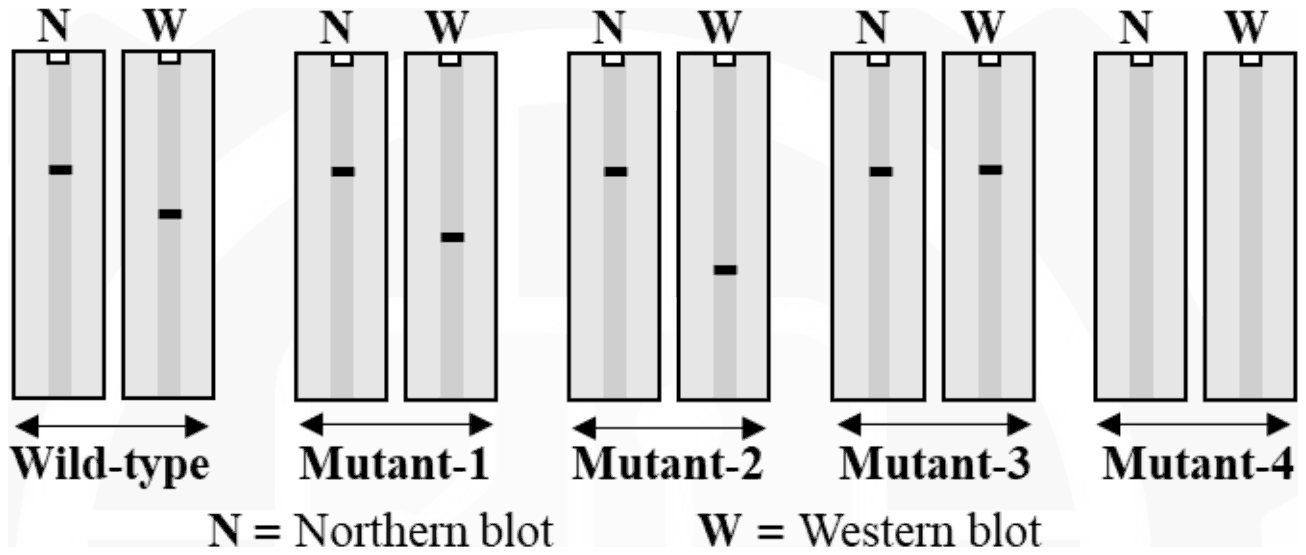
The effect of mutations in a gene at their transcriptional and translational levels were analyzed using Northern (N) and Western (W) blot techniques, respectively. The following figure shows the schematic representation of mRNA and protein expression profiles of the wild-type and its four different mutants. Which one of the following mutants contains mutation in the upstream regulatory region of the gene?

Paired Northern (N) and Western (W) blot lanes for the wild-type and Mutant-1 to Mutant-4; Mutant-4 shows no band in either lane

Exam Year(s)

GATE Life Sciences - 2026,

Answer: D

The mutation in the upstream regulatory region is in Mutant-4.

Mutant-4 shows no band on either blot: no mRNA on the Northern blot and therefore no protein on the Western blot. Transcription itself has failed, which is what happens when the promoter or another upstream regulatory element is destroyed.

Mutants 1, 2 and 3 all make mRNA of normal size, so their transcription is intact. Their proteins differ in size: smaller in Mutants 1 and 2 (the band runs lower), as from a premature stop codon in the coding region, and larger in Mutant 3, as when a stop codon is lost. Those are mutations in the coding sequence, not in the regulatory region.

Please log in or register to report this question.

17.

DNA amplification in the polymerase chain reaction is

Exam Year(s)

GATE Life Sciences - 2026,

Answer: D

DNA amplification in PCR is exponential.

Each cycle of denaturation, annealing and extension copies every target molecule present, so in the ideal case the number of copies doubles each cycle. After n cycles,

\[ N = N_{0} \times 2^{n} \]

so 30 cycles can turn one molecule into about a billion copies.

Linear amplification would add a fixed number of copies each cycle, as when only one primer is used. Parabolic growth has no basis in the reaction. A real-time PCR curve does flatten into a sigmoid at late cycles, when primers and enzyme run short, but that plateau marks the end of amplification; the amplification itself is exponential.

Please log in or register to report this question.

Answer: D

The statement that is NOT correct is ELISA is used to detect specific DNA sequences directly without antibodies; it is the only one the key marks in this multiple-select question.

ELISA, the enzyme-linked immunosorbent assay, depends on antibodies by definition: an antibody (or antigen) is fixed to a plate, the target binds, and an enzyme-linked antibody produces a coloured or fluorescent signal. It is normally used to detect and quantify proteins and other antigens, not DNA sequences.

The other three statements are correct: Southern blotting detects specific DNA sequences with a labelled probe, Northern blotting detects RNA and so reports expression levels, and Western blotting detects proteins with antibodies.

Please log in or register to report this question.

19.

Which of the following molecules binds with greater affinity to calcium hydroxy apatite column ?

Exam Year(s)

MH SET - 2018, SET Exam - 2018,

Answer: D

The molecule that binds hydroxyapatite with greatest affinity is ds-DNA.

Hydroxyapatite, a crystalline calcium phosphate, binds nucleic acids through their phosphate backbones. In double-stranded DNA the phosphates are held in a rigid, regular array that interacts with the crystal surface over many contacts, so ds-DNA binds most strongly and needs a higher phosphate concentration to be eluted than single-stranded DNA. This is the basis for separating ds-DNA from ss-DNA in reassociation (Cot) studies.

ss-DNA and RNA, with flexible, irregular backbones, bind more weakly, and a small molecule such as ATP binds least.

Please log in or register to report this question.

20.

In the Acrosome, there is an abundance of Bindin. The method to detect such in situ distribution is :

Exam Year(s)

MH SET - 2018, SET Exam - 2018,

Answer: A

The method is immunocytochemistry.

Bindin is the sea urchin acrosomal protein that binds the sperm to the egg's vitelline envelope. To see where a protein lies in situ, that is, within the intact cell, the cells are fixed and treated with a labelled antibody against it, then viewed with a fluorescence or electron microscope (immunogold labelling). This is how bindin was shown to coat the acrosomal process.

Western blot, ELISA and SDS-PAGE all work on extracted, homogenised proteins. They can show that bindin is present, how much there is and what size it is, but the cell structure is destroyed, so they cannot show its distribution.

Please log in or register to report this question.

Loading…

Other Subjects

Tags: Molecular Biology Techniques Questions and Answers || Molecular Biology Techniques MCQ Questions and Answers || Molecular Biology Techniques GK Questions and Answers || Molecular Biology Techniques GK MCQ Questions || Molecular Biology Techniques Multiple Choice Questions and Answers || Molecular Biology Techniques GK || GK on Molecular Biology Techniques || Molecular Biology Questions and Answers || Molecular Biology MCQ Questions and Answers || Molecular Biology GK Questions and Answers || GK on Molecular Biology