Machine-translated by Google. Questions are authored in English.
Top

Aldehydes and Ketones Questions and Answers

1.

The acid catalyzed cyclization of 5-ketodecan-1,9-diol is given below

Decane-1,9-diol-5-one drawn as a zigzag chain, HO at C1, C=O at C5 and OH at C9, treated with p-TSA in benzene with heat to give a spiroketal

(p-TSA = p-toluenesulfonic acid)

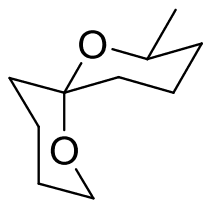
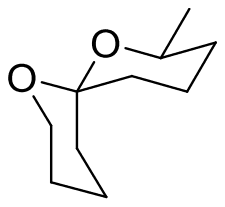
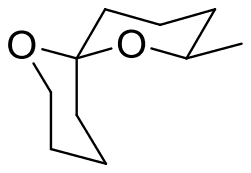
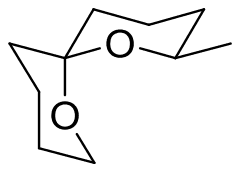
The most predominant spiroketal is
Exam Year(s)

GATE Chemistry - 2012,

Answer: A

The predominant spiroketal is the one with both ring oxygens axial at the spiro carbon and the methyl group equatorial (A).

Under acid and heat the ketone and the two hydroxyl groups form 2-methyl-1,7-dioxaspiro[5.5]undecane, and the reaction is reversible, so the most stable isomer accumulates. Two effects decide which one that is:

  1. the anomeric effect: each C-O bond at the spiro carbon prefers to be axial with respect to the other ring, where an oxygen lone pair can donate into its σ* orbital. Structure A has this doubly anomeric arrangement;
  2. sterics: the methyl group prefers the equatorial position on its chair.

A satisfies both. B has the right anomeric arrangement but an axial methyl. C and D place the second ring's oxygen equatorial, losing anomeric stabilisation, and C also has the methyl axial.

Please log in or register to report this question.

2.

In the reaction

6-Oxoheptanal, CH3CO(CH2)4CHO, treated with KOH-EtOH to give the product

the product formed is

Exam Year(s)

GATE Chemistry - 2012,

Answer: A

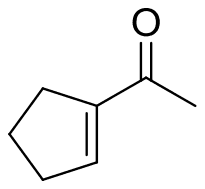
The product is 1-acetylcyclopentene (A).

6-Oxoheptanal has a methyl ketone at one end and an aldehyde at the other. In base it undergoes an intramolecular aldol condensation. The more electrophilic carbonyl, the aldehyde, is attacked, and the enolate that can reach it to close a five-membered ring is the one formed at the ketone's internal CH2. The aldol then dehydrates to give a double bond conjugated with the ketone: 1-acetylcyclopentene.

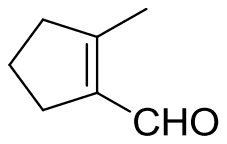
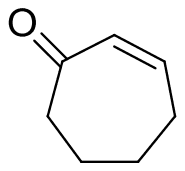
B is the other five-membered aldol, made by an aldehyde enolate attacking the less electrophilic ketone, which is the minor path. C would need the terminal methyl enolate to close a seven-membered ring, which is slower than five-membered closure. D contains no oxygen at all, while an aldol condensation keeps the ketone, so it cannot form here.

Please log in or register to report this question.
3.

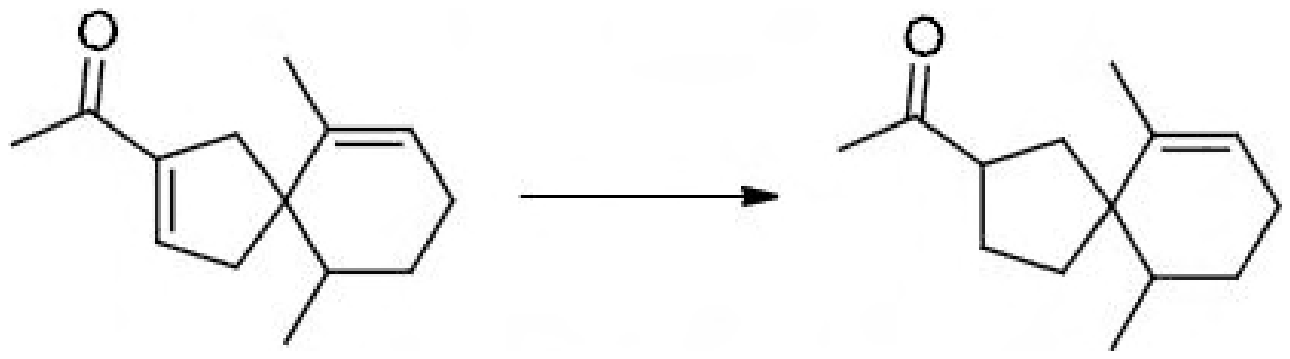
The most suitable reagent for the following transformation is

A spiro ketone with a conjugated ring double bond next to the acetyl group and a second ring double bond is converted to the same compound with only the conjugated double bond reduced

Exam Year(s)

GATE Chemistry - 2017,

Answer: A

The most suitable reagent is Li / Liq. NH3.

Only the carbon-carbon double bond conjugated with the ketone is reduced; the isolated ring double bond and the C=O group survive. A dissolving-metal reduction does exactly this: lithium in liquid ammonia adds an electron to the enone, the radical anion is protonated and reduced again, and the resulting enolate is protonated on work-up, so the α,β-double bond is reduced while isolated alkenes, which cannot accept an electron, are left alone.

PtO2 / H2 would hydrogenate both double bonds. LiAlH4 attacks the carbonyl group, giving an alcohol. B2H6 hydroborates the more accessible isolated alkene and reduces ketones, the opposite of the selectivity needed.

Please log in or register to report this question.
4.

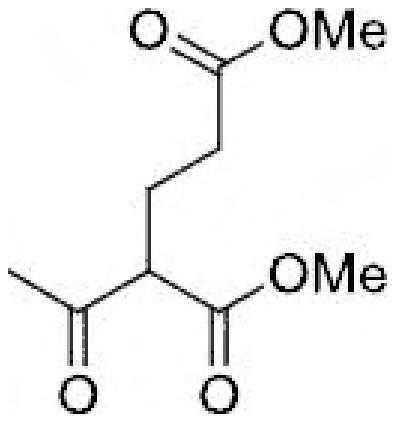
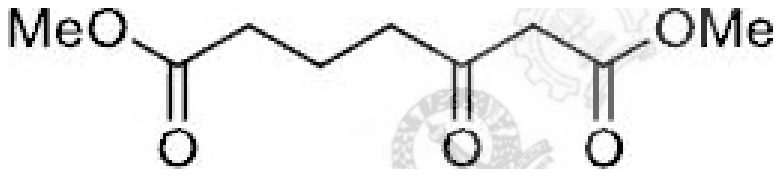
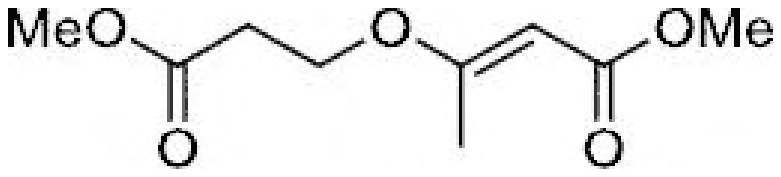
The major product formed in the following reaction is

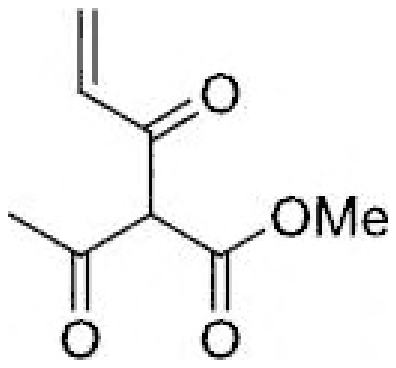
Methyl acetoacetate plus methyl acrylate with MeONa in MeOH

Exam Year(s)

GATE Chemistry - 2017,

Answer: D

The major product is (D), the Michael adduct.

Sodium methoxide removes a proton from the active methylene group of methyl acetoacetate, flanked by the ketone and ester carbonyls. The stabilised enolate adds to the β-carbon of methyl acrylate, a Michael acceptor, and protonation gives dimethyl 2-acetylpentanedioate: the former CH2 now carries the acetyl group, the ester and a CH2CH2CO2Me chain, which is structure (D).

(A) would need the attack to come from the terminal methyl group, the less acidic site. (B) is an enol ether, the product of attack through oxygen, which is not the course of a Michael addition with a soft enolate. (C) would need acylation of the enolate by the acrylate ester, giving a vinyl ketone, not conjugate addition.

Please log in or register to report this question.
5.

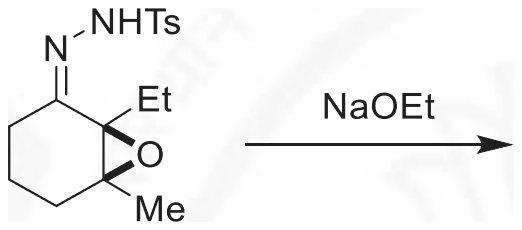
The major product formed in the following reaction

The tosylhydrazone of 2,3-epoxy-2-ethyl-3-methylcyclohexanone, the epoxide fused at C2 (Et) and C3 (Me), treated with NaOEt

is:

Exam Year(s)

GATE Chemistry - 2021,

Answer: A

The product is non-6-yn-2-one.

This is the Eschenmoser fragmentation of an alpha,beta-epoxy ketone tosylhydrazone. Base removes the N-H proton; the epoxide opens as the tosyl group leaves, and the ring bond between the two former epoxide carbons breaks, releasing N2 and Ts−.

The carbon bearing Et and the former C=N carbon become the two ends of a C≡C bond, and the carbon bearing Me and the epoxide oxygen becomes a ketone. Opening the six-membered ring gives a straight chain:

\[ \mathrm{CH_{3}CH_{2}C{\equiv}C(CH_{2})_{3}COCH_{3}} \]

Numbering from the ketone end gives the carbonyl at C2 and the triple bond at C6: non-6-yn-2-one, nine carbons. non-3-yn-8-one is the same chain numbered from the wrong end, non-2-yn-6-one puts the alkyne and ketone in the wrong places, and an alkene product would need hydrogen that the fragmentation does not supply.

Please log in or register to report this question.
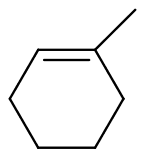
6.

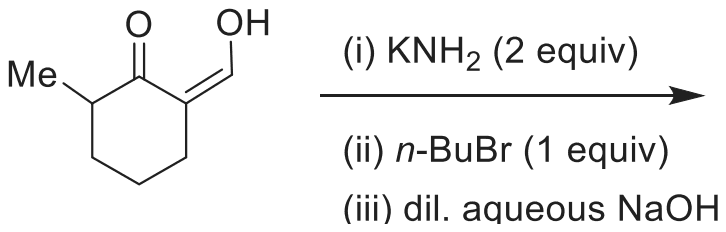
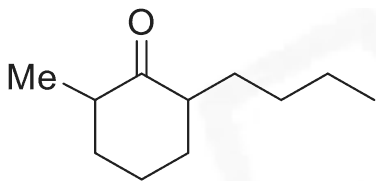
The major product formed in the following reaction

2-(Hydroxymethylene)-6-methylcyclohexanone treated with (i) KNH2 (2 equiv), (ii) n-BuBr (1 equiv), (iii) dil. aqueous NaOH

is:

Exam Year(s)

GATE Chemistry - 2021,

Answer: B

The product is 2-butyl-2-methylcyclohexanone, option (B).

The hydroxymethylene group is a temporary blocking group. The first equivalent of KNH2 removes the acidic enol O-H, giving a delocalised, unreactive enolate over C2. The second equivalent forms a dianion by removing the proton at C6, the carbon carrying the methyl group; this second enolate is far more nucleophilic and is the one alkylated by one equivalent of n-BuBr.

Dilute aqueous NaOH then removes the formyl group by a retro-Claisen cleavage, giving 2-butyl-2-methylcyclohexanone, with both groups on the same carbon.

(A) alkylates the blocked carbon, which the blocking group prevents. (C) needs two equivalents of BuBr and keeps no blocking. (D) is O-alkylation of the hydroxymethylene group, which is not what the dianion does, and it also keeps the formyl group that NaOH removes.

Please log in or register to report this question.
7.

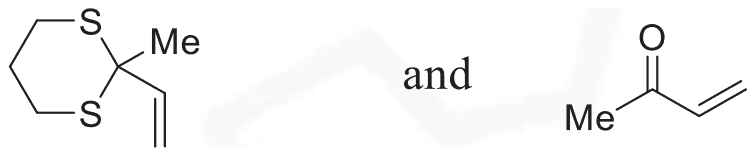
In the following reaction

2-Methyl-1,3-dithiane with n-BuLi and phenyl vinyl sulfoxide gives X; X with (i) xylene, reflux, (ii) HgCl2, CdCO3, H2O gives Y

the major products X and Y, respectively, are:

Exam Year(s)

GATE Chemistry - 2021,

Answer: C

X and Y are 2-methyl-2-(2-phenylsulfinylethyl)-1,3-dithiane and methyl vinyl ketone.

n-BuLi removes the C2 proton of 2-methyl-1,3-dithiane, giving an acyl-anion equivalent. It adds in conjugate fashion to phenyl vinyl sulfoxide, a Michael acceptor, so X carries a CH2CH2S(O)Ph chain on C2.

Refluxing in xylene triggers a syn (Ei) sulfoxide elimination through a five-membered cyclic transition state, losing PhSOH and leaving a vinyl group. HgCl2 with CdCO3 in water then hydrolyses the dithiane to the ketone, giving CH3COCH=CH2, methyl vinyl ketone. The phenyl vinyl sulfoxide has served as a vinyl cation equivalent.

(A) shows the vinyl compound as X, but the elimination needs the heating of the second step. (B) keeps a phenyl in Y, though phenyl leaves with the sulfur. (D) has the anion attacking sulfur rather than the alkene.

Please log in or register to report this question.

8.

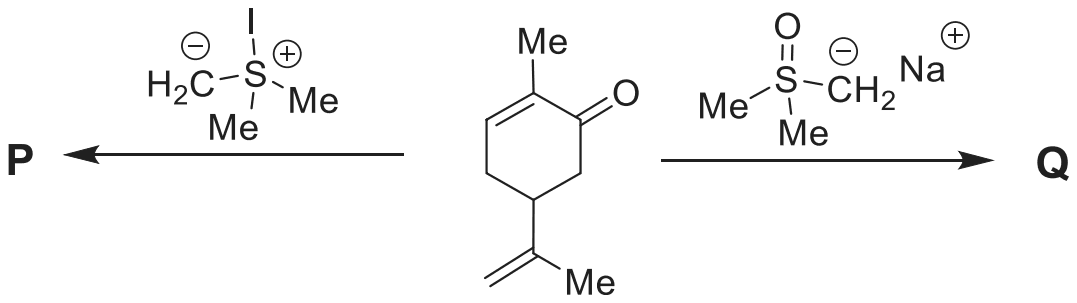
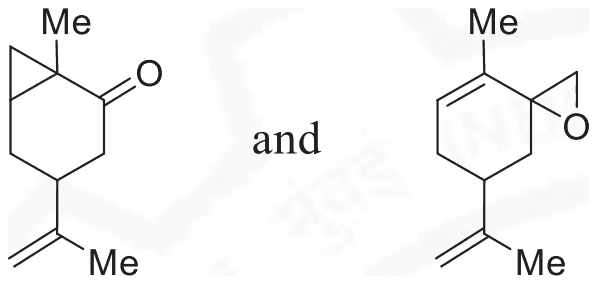
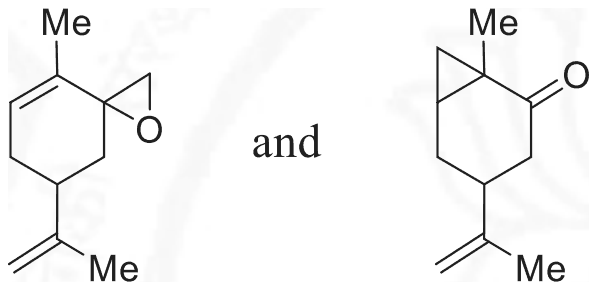
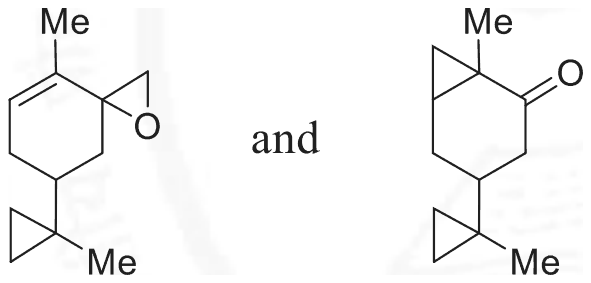
The major products P and Q formed in the following reactions

Carvone treated with the sulfonium ylide H2C-SMe2 to give P, and with the sodium salt of the sulfoxonium ylide H2C-S(O)Me2 to give Q

respectively, are:

Exam Year(s)

GATE Chemistry - 2021,

Answer: B

P is the spiro-epoxide and Q the cyclopropyl ketone, with the isopropenyl group untouched: option (B).

Both reagents are Corey-Chaykovsky sulfur ylides, but they differ in stability. Dimethylsulfonium methylide is reactive and unstabilised; it adds quickly and irreversibly to the carbonyl carbon (1,2-addition), and the alkoxide then displaces dimethyl sulfide to close an epoxide. Dimethylsulfoxonium methylide is stabilised by the S=O group; its 1,2-addition is reversible, so it ends up in the conjugate (1,4) position of the enone, and ring closure gives a cyclopropane next to the ketone.

Neither ylide reacts with the isolated isopropenyl double bond, which is not electron-poor, so (C) and (D) are wrong. (A) swaps the two products.

Please log in or register to report this question.
9.

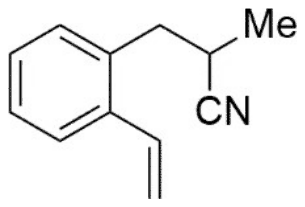
The major product P obtained in the following reaction sequence is

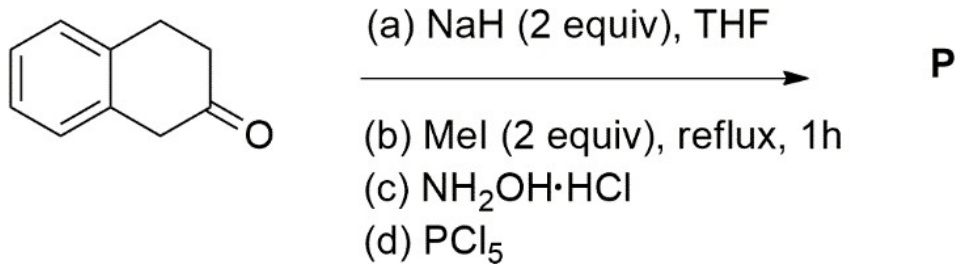
2-Tetralone treated with (a) NaH (2 equiv), THF; (b) MeI (2 equiv), reflux, 1h; (c) NH2OH.HCl; (d) PCl5 to give P

Exam Year(s)

GATE Chemistry - 2022,

Answer: A

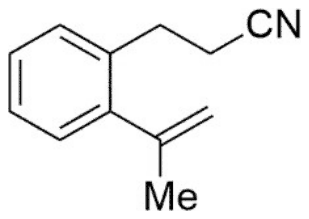
P is (A), the nitrile with an ortho isopropenyl group.

  1. NaH and MeI (2 equivalents each) methylate 2-tetralone twice at C1, the carbon that is both alpha to the ketone and benzylic, so it is the most acidic. This gives 1,1-dimethyl-2-tetralone.
  2. NH2OH·HCl converts the ketone to its oxime.
  3. PCl5 activates the oxime OH. The group anti to it is the quaternary C1, which can leave as a stable tertiary benzylic cation. Instead of a normal Beckmann migration, the C1-C2 bond breaks: a Beckmann fragmentation. C2 becomes a nitrile carbon (CH2CH2C≡N chain on the ring), and the ArC+Me2 cation loses a proton to give the isopropenyl group.

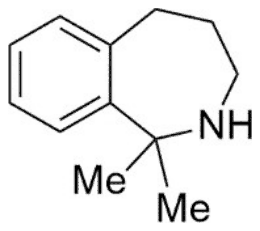
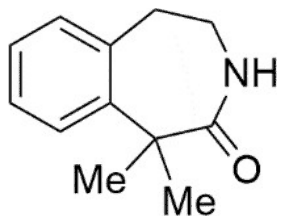
(C) is the lactam a normal Beckmann rearrangement would give, and (B) is that lactam reduced to an amine, which no step here does. (D) puts the methyl on the chain carbon and a vinyl group on the ring, which needs the methylation at C3 instead of C1.

Please log in or register to report this question.
10.

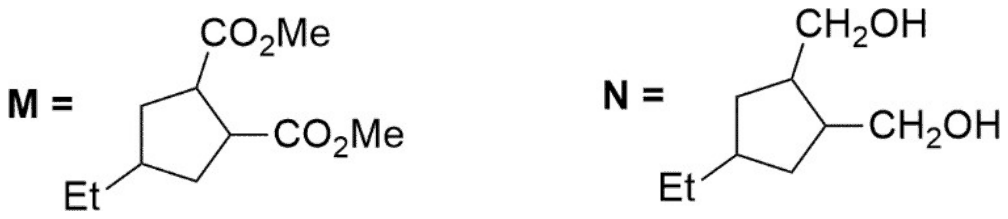
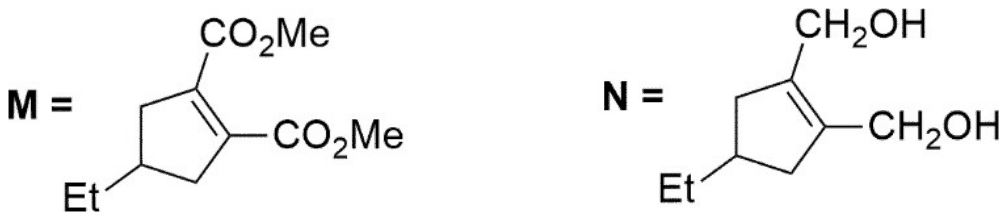
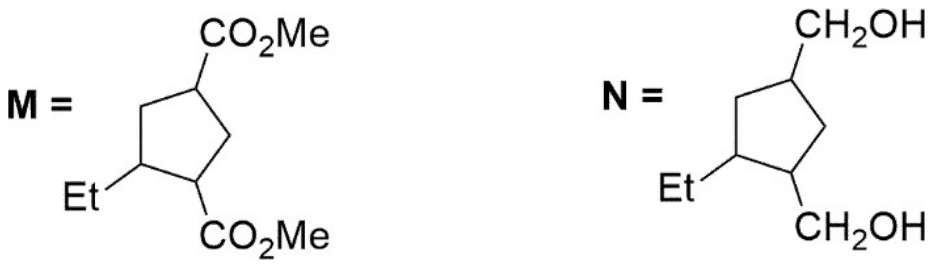
The major products M and N in the given reaction sequence are

4-Ethylcyclohexanone treated with (a) NaH, (MeO)2CO, benzene; (b) Br2 (2 equiv), Et2O; (c) NaOMe, MeOH to give M, then excess DIBAL-H to give N

Exam Year(s)

GATE Chemistry - 2022,

Answer: B

The answer is (B): M is dimethyl 4-ethylcyclopent-1-ene-1,2-dicarboxylate and N is the corresponding diol, with the ring double bond kept.

  1. NaH and dimethyl carbonate put a CO2Me group on C2 of 4-ethylcyclohexanone, giving the beta-keto ester.
  2. Two equivalents of Br2 brominate both alpha carbons: C2, between the two carbonyls, and C6.
  3. NaOMe starts a Favorskii rearrangement: the enolate at C6 displaces the C2 bromide to form a cyclopropanone, methoxide adds to the carbonyl, and the ring opens towards the ester-stabilised carbanion. The ring contracts to a cyclopentane carrying two adjacent ester groups, one carbon still bearing Br. Elimination of HBr then puts the double bond between the two ester-bearing carbons, giving the conjugated cyclopentene-1,2-diester M.
  4. Excess DIBAL-H reduces both esters to CH2OH groups and leaves the C=C bond alone, giving N.

(A) is the saturated diester and diol, which would need the C-Br bond to be reduced rather than eliminated. (C) puts both esters on one carbon and (D) places the esters 1,3 with the ethyl group moved, neither of which the Favorskii ring contraction produces.

Please log in or register to report this question.
Loading…

Other Subjects

Tags: Aldehydes and Ketones Questions and Answers || Aldehydes and Ketones MCQ Questions and Answers || Aldehydes and Ketones GK Questions and Answers || Aldehydes and Ketones GK MCQ Questions || Aldehydes and Ketones Multiple Choice Questions and Answers || Aldehydes and Ketones GK || GK on Aldehydes and Ketones || Organic Chemistry Questions and Answers || Organic Chemistry MCQ Questions and Answers || Organic Chemistry GK Questions and Answers || GK on Organic Chemistry