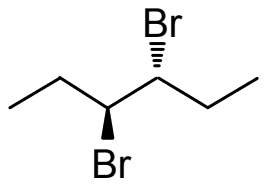

Answer: C
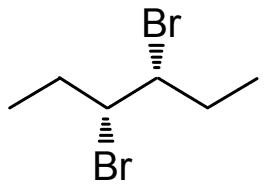
The product is (C), meso-3,4-dibromohexane.
Addition of bromine through a bromonium ion is anti: the two bromine atoms add to opposite faces of the double bond. Anti addition to a trans (E) alkene gives the meso product, while anti addition to the cis alkene gives the racemic pair. With identical ethyl groups at both ends, (E)-3-hexene therefore gives (3R,4S)-3,4-dibromohexane, which is meso.
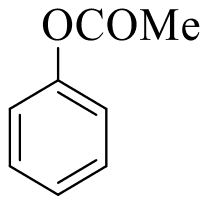
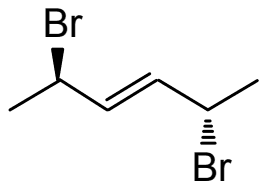
Assigning configurations to the drawings: in C one bromine is wedged and the other hashed on the zigzag chain, which works out as R at one centre and S at the other, the meso form. A (both hashed) and D (both wedged) are each one enantiomer of the chiral (R,R)/(S,S) pair, the product a syn addition would give. B, 2,5-dibromohex-3-ene, would come from allylic bromination, which does not occur here.
Please log in or register to report this question.