Machine-translated by Google. Questions are authored in English.
Top

Spectroscopy in Structure Determination Questions and Answers

1.

An organic compound with molecular formula \(\mathrm{C_{10}H_{13}Cl}\) gives the following NMR data.

(i)Singlet, δ 1.57, 6H
(ii)Singlet, δ 3.07, 2H
(iii)Singlet, δ 7.27, 5H

Identify the structure.

Exam Year(s)

DSSSB AE - 2023,

Answer: C

The formula \(\mathrm{C_{10}H_{13}Cl}\) has an aromatic ring and the NMR data show three singlets, so none of the groups is split by neighbouring hydrogens.


The 5H signal at 7.27 is a monosubstituted benzene ring, \(\mathrm{C_6H_5}\). The 6H singlet at 1.57 is two equivalent methyl groups on a carbon that carries no hydrogen but bears the chlorine, \(\mathrm{C(CH_3)_2Cl}\). The 2H singlet at 3.07 is a \(\mathrm{CH_2}\) between the ring and the quaternary carbon, so there is no neighbour to split it. Together this is \(\mathrm{C_6H_5CH_2C(CH_3)_2Cl}\), option C.


Option A has the formula \(\mathrm{C_{10}H_{14}Cl}\) with no CH2, option B would show a doublet and multiplets, and option D would give several triplets, so they do not match.

Please log in or register to report this question.
2.

In the proton decoupled 13C NMR spectrum of 7-norbornanone, the number of signals obtained is

Exam Year(s)

GATE Chemistry - 2012,

Answer: B

The spectrum shows 3 signals.

7-Norbornanone is bicyclo[2.2.1]heptan-7-one: the carbonyl sits on the one-carbon bridge. The molecule has C2v symmetry, with one mirror plane through C7 and both bridgeheads, which swaps the two ethano bridges, and a second through C7 and the midpoints of the C2-C3 and C5-C6 bonds, which swaps the two bridgeheads. That leaves three sets of equivalent carbons:

  1. C7, the carbonyl carbon;
  2. C1 and C4, the two bridgehead CH carbons;
  3. C2, C3, C5 and C6, the four CH2 carbons.

7 counts every carbon as different and ignores symmetry. 4 or 5 would need the two ethano bridges, or the two ends of each bridge, to differ, which the mirror planes rule out.

Please log in or register to report this question.
3.

The ratio of relative intensities of the two molecular ion peaks of methyl bromide (CH3Br) in the mass spectrum is

Exam Year(s)

GATE Chemistry - 2012,

Answer: C

The M+ and (M+2)+ peaks are in the ratio 1:1.

Bromine has two stable isotopes, 79Br (about 50.7%) and 81Br (about 49.3%), two mass units apart and almost equally abundant. CH379Br gives the molecular ion at m/z 94 and CH381Br the ion at m/z 96, so the two peaks are of nearly equal height.

3:1 is the pattern of chlorine (35Cl : 37Cl), which is the usual trap here. 1:3 reverses it, and 1:2 matches no single halogen.

Please log in or register to report this question.
4.

The spectroscopic data for an organic compound with molecular formula C10H12O2 are given below.

IR band around 1750 cm-1, 1H NMR δ 7.3 (m, 5H), 5.85 (q, 1H, J = 7.2 Hz), 2.05 (s, 3H), 1.5 (d, 3H, J = 7.2 Hz) ppm. The compound is

Exam Year(s)

GATE Chemistry - 2017,

Answer: B

The compound is 1-(phenylethyl) acetate, CH3COOCH(CH3)C6H5.

Read the data piece by piece. The IR band near 1750 cm-1 is an ester carbonyl. 7.3 (5H, m) is a monosubstituted benzene ring. 2.05 (3H, s) is an acetyl CH3 with no neighbours. 1.5 (3H, d) and 5.85 (1H, q), with the same J of 7.2 Hz, are a CH-CH3 pair coupled to each other. A CH as far downfield as 5.85 ppm must sit on an oxygen and a phenyl ring at once, which is exactly the benzylic CH-O-C(O)CH3 of 1-phenylethyl acetate.

Methyl 2-phenylpropionate would show an OCH3 singlet near 3.7 ppm and its CH quartet near 3.7, not 5.85. 2-Phenylethyl acetate and methyl 3-phenylpropionate have CH2CH2 chains, which give two triplets and no quartet-doublet pair.

Please log in or register to report this question.
5.

An organic compound exhibits the [M]+, [M+2]+ and [M+4]+ peaks in the intensity ratio 1:2:1 in the mass spectrum, and shows a singlet at δ 7.49 in the 1H NMR spectrum in CDCl3. The compound is:

Exam Year(s)

GATE Chemistry - 2021,

Answer: B

The compound is 1,4-dibromobenzene.

Bromine has two isotopes, 79Br and 81Br, in almost equal amounts. A molecule with two bromines therefore shows M, M+2 and M+4 in the ratio 1 : 2 : 1. Two chlorines (35Cl : 37Cl about 3 : 1) give roughly 9 : 6 : 1 instead, which rules out both dichlorobenzenes.

A single 1H NMR signal means all four ring hydrogens are equivalent, which is true only of the para isomer. 1,2-Dibromobenzene has two sets of hydrogens (AA'BB'), giving two multiplets rather than a singlet.

Please log in or register to report this question.
6.

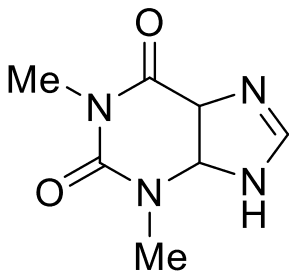
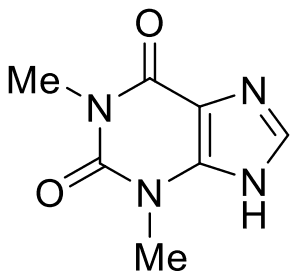
The compound which gives a fragment at \(m/z\) = 124[M+H]+ is

Exam Year(s)

GATE Chemistry - 2023,

Answer: B

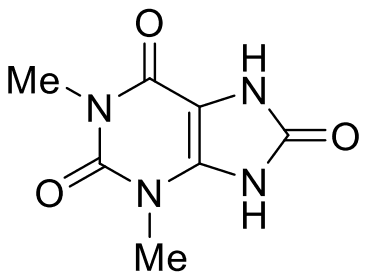
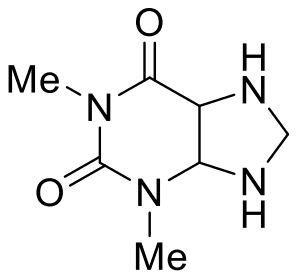
The compound is (B), theophylline (1,3-dimethylxanthine).

Theophylline is C7H8N4O2, mass 180, so its protonated molecule [M+H]+ appears at m/z 181. The characteristic fragmentation of the 1,3-dimethylxanthine ring is loss of methyl isocyanate (CH3NCO, 57) from the pyrimidinedione ring, which gives the ion at

\[ 181 - 57 = 124 \]

The same loss from the other structures gives different masses: (A), with two extra hydrogens at the ring fusion (C7H10N4O2, MH+ 183), gives 126; the uric acid (C), C7H8N4O3 (MH+ 197), gives 140; and the fully saturated (D), C7H12N4O2 (MH+ 185), gives 128.

Please log in or register to report this question.
7.

A compound, C15H16O2, has the following spectral data;

1H NMR (ppm): 9.16 (s), 6.89 (d, J = 8 Hz), 6.64 (d, J = 8 Hz), 1.53 (s)
13C NMR (ppm): 154.7, 140.9, 127.1, 114.4, 40.7, 30.7

The structure of the compound is

Exam Year(s)

GATE Chemistry - 2023,

Answer: A

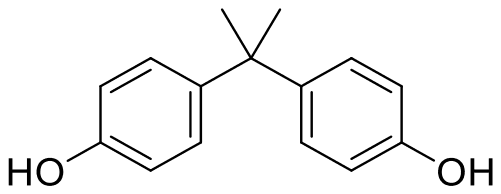
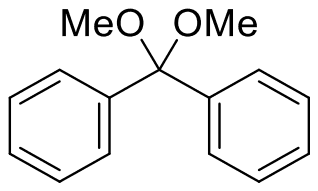
The compound is (A), bisphenol A, 2,2-bis(4-hydroxyphenyl)propane.

  • 1H: 9.16 (s) is the two phenolic OH protons (typical in DMSO); 6.89 and 6.64 (d, J = 8 Hz) are the two pairs of ortho-coupled ring protons of a para-disubstituted benzene, the 6.64 signal being ortho to OH; 1.53 (s) is the six protons of two equivalent methyl groups on a quaternary carbon.
  • 13C: six signals for a symmetric molecule: 154.7 (C-OH), 140.9 (ring carbon bearing the CMe2), 127.1 and 114.4 (ring CH), 40.7 (quaternary CMe2) and 30.7 (CH3).

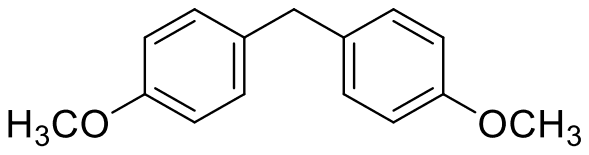
All four structures fit C15H16O2, so the spectra decide. (B) would show OCH3 and ArCH2Ar singlets near 3.7 to 3.8 ppm and no OH. (C) has monosubstituted phenyl rings, not two doublets, and methoxy singlets near 3 ppm. (D) would show three aromatic signals per ring, an aryl methyl near 2.1 ppm and a CH2 near 3.7 ppm, not a six-proton singlet at 1.53.

Please log in or register to report this question.
8.

Consider the following 1H-NMR (400 MHz, DMSO-d6) data of a compound:

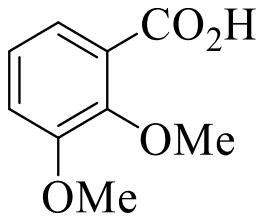
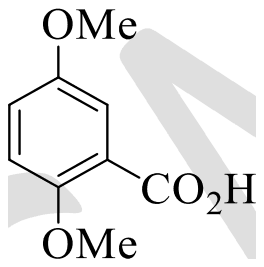
δ in ppm: 3.85 (s, 6H), 6.73 (t, J = 2.2 Hz, 1H), 7.1 (d, J = 2.2 Hz, 2H), and 13.05 (brs, 1H).

The compound is

Exam Year(s)

GATE Chemistry - 2024,

Answer: B

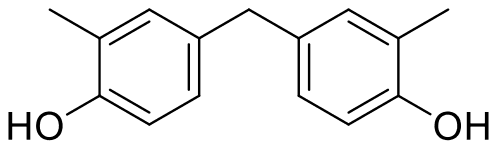
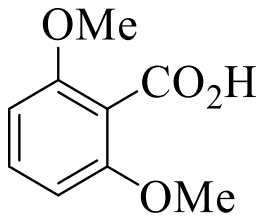
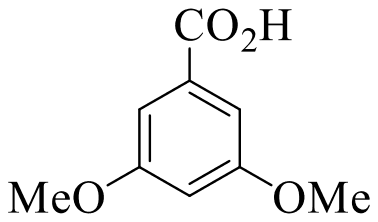
The compound is (B), 3,5-dimethoxybenzoic acid.

The data: a 6H singlet at 3.85 ppm (two equivalent OCH3 groups), a broad 1H singlet at 13.05 ppm (CO2H), and three aromatic protons as a 2H doublet and a 1H triplet with the small coupling of 2.2 Hz, typical of meta coupling.

In 3,5-dimethoxybenzoic acid, H2 and H6 are equivalent and each is meta to H4, giving the 2H doublet; H4 is meta to both and appears as a 1H triplet. No ortho coupling (about 8 Hz) appears, so no two ring protons are adjacent.

2,6-dimethoxybenzoic acid (A) has three adjacent protons and would show ortho couplings. The 2,3- and 2,5-isomers (C, D) have non-equivalent methoxy groups, giving two 3H singlets, as well as ortho couplings.

Please log in or register to report this question.
9.

In the 1H-NMR spectrum of the following molecule, the signal of proton Ha appears as

(The molecule is C6H5CD2Ha: a benzene ring bearing a CD2Ha group.)

Exam Year(s)

GATE Chemistry - 2025,

Answer: C

The signal of Ha is a quintet.

Ha is on the same carbon as two deuterium atoms. Deuterium has nuclear spin I = 1, so a group of n equivalent deuterons splits a neighbouring proton into \(2nI + 1\) lines:

\[ 2(2)(1) + 1 = 5 \]

The quintet has intensities 1:2:3:2:1 and a small spacing, since an H-D coupling is about one-sixth of the corresponding H-H coupling.

A triplet is what the n + 1 rule for spin-1/2 nuclei would give for two neighbours, a common slip here. A singlet would apply only if there were no coupled nuclei, and a quartet would need three spin-1/2 neighbours.

Please log in or register to report this question.
10.

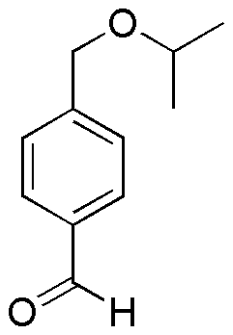
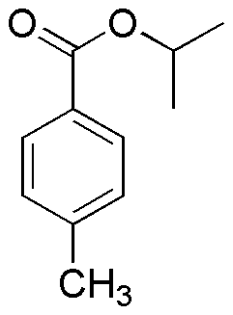
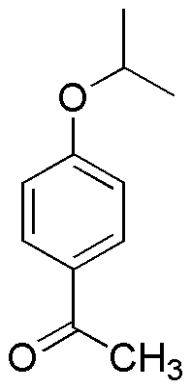
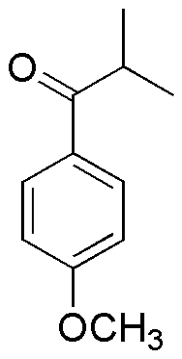
Compound K displayed a strong band at 1680 cm-1 in its IR spectrum. Its 1H-NMR spectral data are as follows: δ (ppm) 7.30 (d, J = 7.2 Hz, 2H), 6.8 (d, J = 7.2 Hz, 2H), 3.8 (septet, J = 7.0 Hz, 1H), 2.2 (s, 3H), 1.9 (d, J = 7.0 Hz, 6H). The correct structure of compound K is

Exam Year(s)

GATE Chemistry - 2025,

Answer: C

Compound K is (C), 4-isopropoxyacetophenone.

The strong band at 1680 cm-1 is a ketone conjugated with an aromatic ring. In the NMR, two 2H doublets show a para-disubstituted ring with one electron-donating group (the doublet at 6.8 lies ortho to oxygen). A 1H septet coupled to a 6H doublet is an isopropyl group, and its CH at 3.8 is deshielded, so it is bonded to oxygen: an O-CH(CH3)2 ether. The 3H singlet at 2.2 is then the acetyl methyl. The paper's shift values are rounded, but the multiplicities and integrals fit only (C).

(A) is an aldehyde, which would show a CHO singlet near 10 ppm. (B) is an ester, absorbing near 1720 cm-1. (D) would show its OCH3 as a 3H singlet near 3.8 and an isopropyl CH not attached to oxygen.

Please log in or register to report this question.
Loading…

Other Subjects

Tags: Spectroscopy in Structure Determination Questions and Answers || Spectroscopy in Structure Determination MCQ Questions and Answers || Spectroscopy in Structure Determination GK Questions and Answers || Spectroscopy in Structure Determination GK MCQ Questions || Spectroscopy in Structure Determination Multiple Choice Questions and Answers || Spectroscopy in Structure Determination GK || GK on Spectroscopy in Structure Determination || Organic Chemistry Questions and Answers || Organic Chemistry MCQ Questions and Answers || Organic Chemistry GK Questions and Answers || GK on Organic Chemistry