Machine-translated by Google. Questions are authored in English.
Top

Stereochemistry Questions and Answers

11.

The correct statement about the following quaternary ammonium ion is
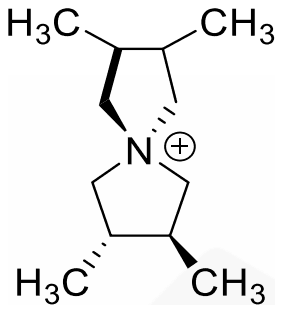
A spiro ammonium ion: two pyrrolidine rings joined at the N+ atom, each carrying two methyl groups on adjacent carbons with wedge and dash bonds

Exam Year(s)

GATE Chemistry - 2026,

Answer: B

The correct statement is It has \(S_{4}\)-symmetry, hence achiral.

The ion is a spiro compound: the two pyrrolidine rings share the nitrogen and lie in perpendicular planes. Each ring carries a trans pair of methyl groups, and the two rings carry their pairs in mirror-image configurations. An \(S_{4}\) axis runs through the nitrogen, bisecting both rings: rotating by 90° carries one ring onto the position of the other, and reflecting through the plane perpendicular to the axis then restores the configuration, so the ion is reproduced.

A molecule with any improper axis \(S_{n}\) is superimposable on its mirror image, so the ion is achiral, even though it has neither a mirror plane nor a centre of symmetry. That is why this ion is the standard example of an achiral molecule that has no \(\sigma\) and no i.

It does contain a \(C_{2}\) axis (since \(S_{4}^{2} = C_{2}\)), but 'only \(C_{2}\), hence chiral' misses the \(S_{4}\). 'No symmetry' is wrong for the same reason, and there is no centre of symmetry.

Please log in or register to report this question.
12.

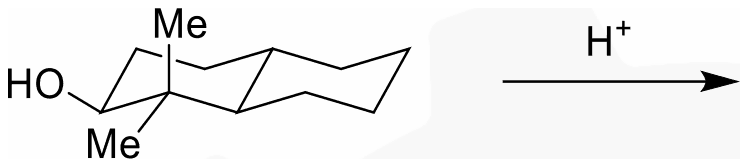
The major product formed in the following reaction is

A trans-decalin chair drawing with an equatorial OH next to a ring carbon bearing two methyl groups, one axial and one equatorial, treated with H+

Exam Year(s)

GATE Chemistry - 2026,

Answer: B

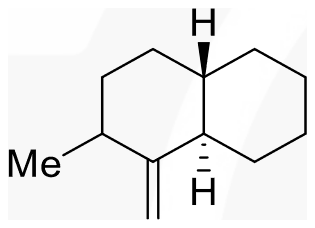
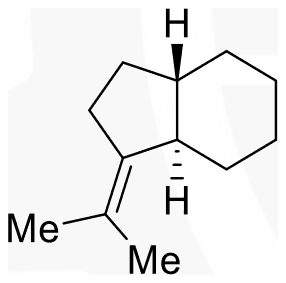
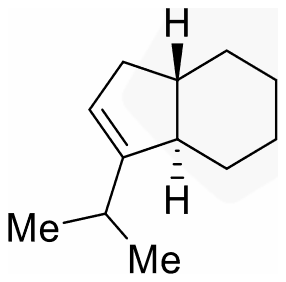
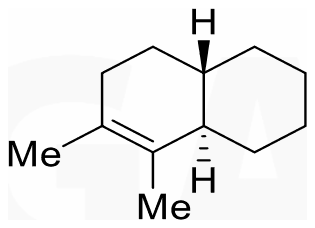
The major product is (B), the hydrindane carrying an exocyclic isopropylidene group.

Acid protonates the OH and water leaves, giving a secondary carbocation next to the quaternary CMe2 carbon. In the rigid trans-decalin the OH is equatorial, and the group antiperiplanar to an equatorial leaving group is a ring C-C bond, not the axial methyl. So the ring bond from the CMe2 carbon to the ring-fusion carbon migrates to the cationic centre (a Wagner-Meerwein shift).

That migration contracts the six-membered ring to a five-membered one and leaves the positive charge on the CMe2 carbon, now outside the ring: a stable tertiary cation. Loss of a proton from the ring carbon gives the tetrasubstituted exocyclic alkene, the isopropylidene hydrindane (B). The trans ring fusion is untouched.

(A) and (D) keep the six-membered ring and would come from methyl migration, which needs the methyl antiperiplanar to the leaving group (an axial OH). (C), with the isopropyl group on an endocyclic alkene, is the less substituted alkene from the same cation, not the major product.

Please log in or register to report this question.
13.

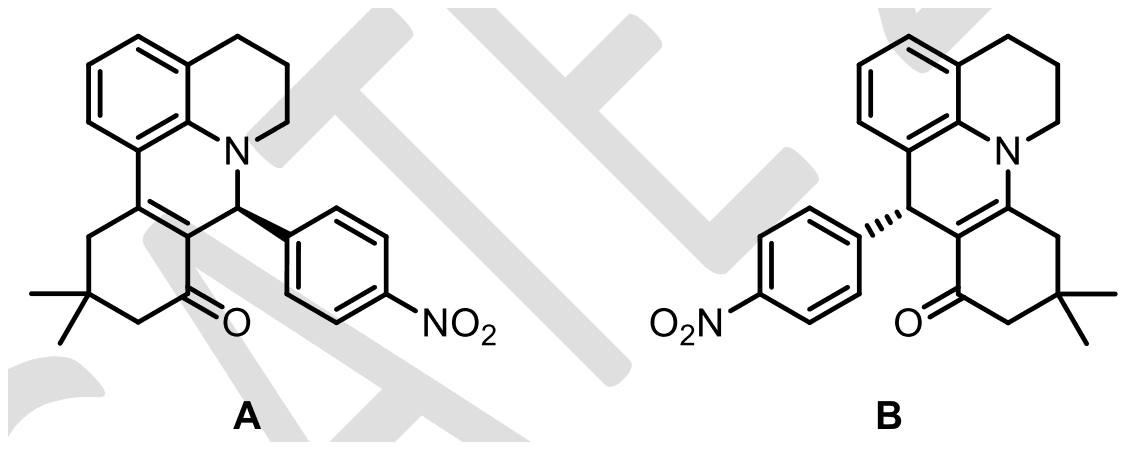
The molecules A and B are a pair of ____________.

Two fused polycyclic structures A and B, each with a 4-nitrophenyl group on an sp3 CH, a dimethylcyclohexenone ring and a julolidine-type N; in A the CH bearing the aryl group is bonded to N, in B it is bonded to the benzo ring carbon.

Exam Year(s)

GATE Life Sciences - 2024,

Answer: D

A and B are constitutional isomers.

They have the same molecular formula but different connectivity. In A the sp3 carbon carrying the 4-nitrophenyl group is bonded to the ring nitrogen, and the C=C bond joins the benzo-ring carbon to the enone carbon. In B the sp3 carbon carrying the aryl group is bonded to the benzo-ring carbon instead, and the C=C bond now joins the carbon next to nitrogen to the enone carbon.

Because atoms are joined differently, they cannot be enantiomers or diastereomers, which share connectivity and differ only in spatial arrangement, and they cannot be conformers, which interconvert by bond rotation. B is drawn flipped and with a hashed bond to make it look like a mirror image of A, which is the trap.

Please log in or register to report this question.
14.

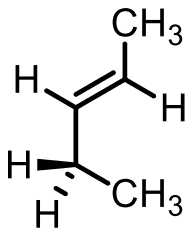
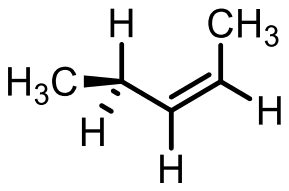
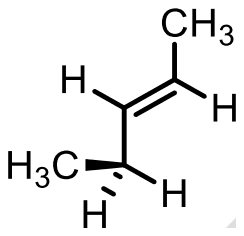
Which one among the following structures is the most stable conformer of (Z)-pent-2-ene?

Exam Year(s)

GATE Life Sciences - 2024,

Answer: C

The most stable conformer is (C).

In (Z)-pent-2-ene the C2 methyl lies on the same side as C4. Rotation about the C3-C4 bond decides which C4 substituent eclipses the double bond and points towards that cis methyl. If it is the C5 methyl, as in (A), the two methyl groups clash severely (allylic 1,3-strain). In (C) a small hydrogen on C4 takes that position and the C5 methyl is turned away, so (C) is the lowest-energy conformer.

(B) and (D) place C4 trans to the C2 methyl across the double bond, so they are drawings of (E)-pent-2-ene, not conformers of the Z isomer at all.

Please log in or register to report this question.
15.

The achiral molecules among the following (I, II, III and IV) are

Four structures labelled I to IV: two tartaric acid stereoisomers I and II drawn as zigzag chains with wedge and hash OH groups, an epoxide III with phenyl and methyl ester groups on wedge and hash bonds, and a 4-tert-butylcyclohexanol IV

Exam Year(s)

IIT JAM - 2018,

Answer: D

The achiral molecules are I and IV.

Molecule I is meso-tartaric acid. Its two stereocentres carry the same substituents and are mirror images of each other, so in the zigzag drawing the OH groups sit one on a wedge and one on a hash, on opposite sides of the chain. An internal mirror (centre of inversion) maps one half onto the other, so the molecule is achiral. Molecule IV, 4-tert-butylcyclohexanol, has a mirror plane through C1 and C4, so it is achiral too, whichever way the two groups are placed.

Molecule II has both OH groups on wedges, which gives a chiral (R,R) or (S,S) tartaric acid with no internal mirror. Molecule III is a trans-disubstituted epoxide with two different groups on its two stereocentres, and it has no mirror plane. So II and III are chiral, which rules out the options that contain them.

Please log in or register to report this question.
16.

Among the dimethylcyclohexanes, which one can be obtained in enantiopure form?

Exam Year(s)

IIT JAM - 2018,

Answer: A

The enantiopure form can be obtained for (A).

A compound can be isolated as a single enantiomer only if it is chiral. Of the dimethylcyclohexanes, trans-1,2- (and trans-1,3-) are chiral; the cis isomers of 1,2- and 1,3- are meso, and both isomers of the 1,4-dimethyl compound have a plane of symmetry. Drawing (A) shows the two methyl groups on adjacent carbons on opposite faces of the ring, the trans-1,2 compound, which has no mirror plane.

(B) is the cis-1,2 isomer, a meso compound with a mirror plane. (C) and (D) are the 1,4-isomers, cis and trans, both achiral.

Please log in or register to report this question.
17.

The molecule that gets inter-converted into its enantiomer, upon ring flipping in its chair conformation, is ____________.

Exam Year(s)

IIT JAM - 2026,

Answer: A

The molecule is cis-1,2-dimethylcyclohexane.

In a chair, a cis-1,2 pair must be one axial and one equatorial. Ring flipping turns the axial methyl equatorial and the equatorial one axial, and the new chair is the non-superimposable mirror image of the old one. So each chair is chiral, but the two chairs are enantiomers that interconvert rapidly at room temperature, which is why the compound cannot be resolved and behaves as an achiral (meso) compound.

The other options do not do this. In cis-1,3-dimethylcyclohexane both chairs (diaxial and diequatorial) contain a mirror plane, so neither is chiral. In cis-1,4-dimethylcyclohexane the flip gives an identical, achiral chair. In trans-1,2-dimethylcyclohexane the flip converts the diequatorial chair into the diaxial chair of the same enantiomer, a diastereomeric conformer, not its mirror image.

Please log in or register to report this question.

18.

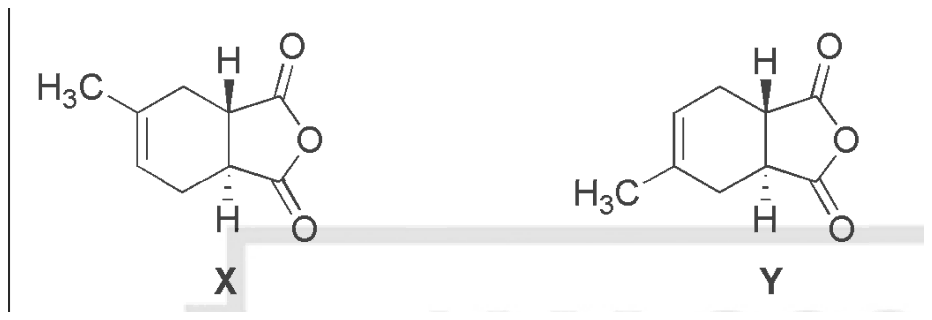
The correct relationship between the molecules X and Y is that, they are _____.

Two drawn bicyclic anhydrides X and Y: a cyclohexene ring with one methyl group fused to a five-membered cyclic anhydride, with a wedged H at the top ring fusion and a hashed H at the bottom, the methyl group on opposite sides of the ring

Exam Year(s)

IIT JAM - 2026,

Answer: D

The molecules X and Y are identical.

Both are the same methyl-substituted cyclohexene fused to a five-membered cyclic anhydride, with the same relative arrangement of the two ring-fusion hydrogens (one wedged, one hashed). In X the methyl-bearing carbon of the double bond is two bonds away from the upper ring-fusion carbon, and in Y it is two bonds away from the lower one. Turn X over by 180° about the horizontal axis in the plane of the page: the upper and lower ring-fusion carbons exchange places, a wedge becomes a hash and a hash a wedge, and the methyl moves to the bottom. That is exactly the drawing of Y.

They are not regioisomers, which would need a different position of the methyl group in the ring, and not diastereomers or enantiomers, because the two drawings do not differ at any stereocentre once X is turned over.

Please log in or register to report this question.
19.

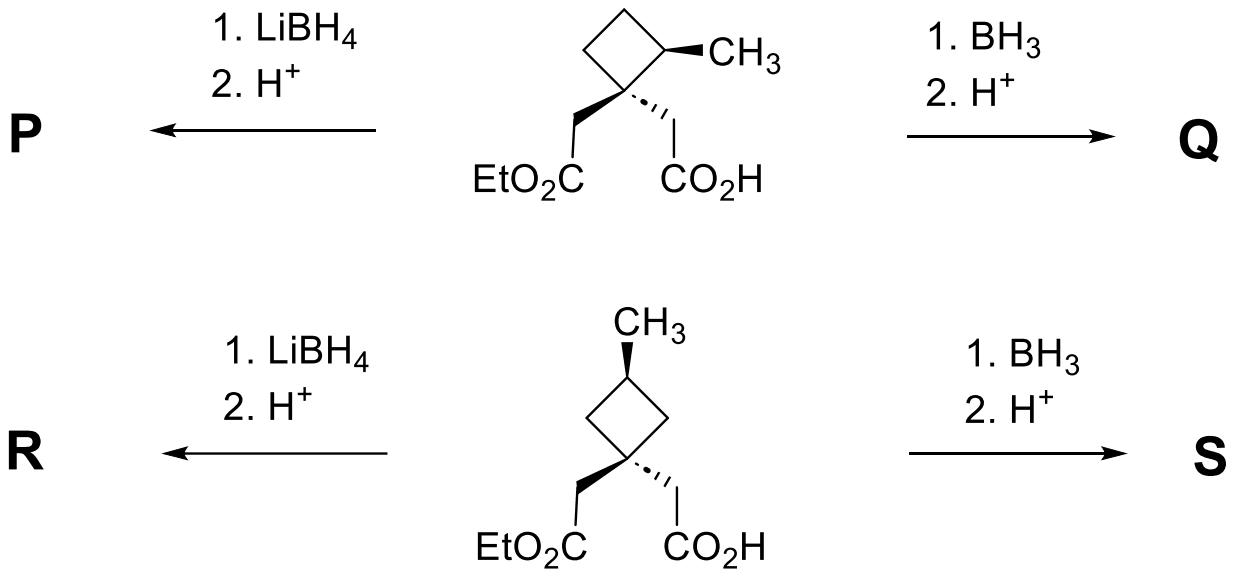
Considering LiBH4 reduces an ester group to the corresponding alcohol and does not reduce a carboxylic acid group, the correct statement about the major products P, Q, R and S is

Two starting cyclobutanes each carrying CH2CO2Et and CH2CO2H on one ring carbon and a methyl group, treated with LiBH4 then H+ to give P and R, and with BH3 then H+ to give Q and S

Exam Year(s)

JEE Advanced - 2026,

Answer: C

The correct statement is (C): P and Q are diastereomers, and R and S are diastereomers.

The starting material has two arms on one ring carbon: \(CH_{2}CO_{2}Et\) and \(CH_{2}CO_{2}H\). LiBH4 reduces the ester arm to \(CH_{2}CH_{2}OH\) and leaves the acid; BH3 reduces the acid arm to \(CH_{2}CH_{2}OH\) and leaves the ester. On the acidic workup, each hydroxy acid or hydroxy ester closes to the same kind of six-membered lactone, a spiro compound in which a \(CH_{2}C(=O)O\) arm and a \(CH_{2}CH_{2}O\) arm are joined at the ring carbon. This is the reading that makes the question well formed: without ring closure, P (a hydroxy acid) and Q (a hydroxy ester) would not even be isomers.

In P the carbonyl arm is the one that was drawn hashed; in Q it is the one that was drawn bold. So at the spiro carbon P and Q differ in configuration while the methyl-bearing carbon is unchanged: they are diastereomers. In the second starting material the methyl group is opposite the spiro carbon, so the carbonyl arm of R is trans (hashed) and that of S is cis (bold) to the methyl group: again diastereomers. Options (A), (B) and (D) each call at least one of the pairs identical.

Please log in or register to report this question.
20.

An optically active compound among the following is

Exam Year(s)

KEAM - 2025,

Answer: E

The optically active compound is 2-Chlorobutane.

A molecule is optically active when it is chiral, and the usual cause is a carbon atom carrying four different groups. In 2-chlorobutane, CH3CH(Cl)CH2CH3, carbon 2 bears H, Cl, CH3 and C2H5: four different groups, so the molecule exists as a pair of non-superimposable mirror images.

None of the others has such a carbon. 1-Chlorobutane has Cl on a CH2. Neopentyl chloride, (CH3)3CCH2Cl, and isobutyl chloride, (CH3)2CHCH2Cl, have carbons with two identical groups. tert-Butyl chloride, (CH3)3CCl, has three identical methyl groups on the carbon bearing chlorine.

Please log in or register to report this question.
Loading…

Other Subjects

Tags: Stereochemistry Questions and Answers || Stereochemistry MCQ Questions and Answers || Stereochemistry GK Questions and Answers || Stereochemistry GK MCQ Questions || Stereochemistry Multiple Choice Questions and Answers || Stereochemistry GK || GK on Stereochemistry || Organic Chemistry Questions and Answers || Organic Chemistry MCQ Questions and Answers || Organic Chemistry GK Questions and Answers || GK on Organic Chemistry